

What do the latest report on the Moroccan publishing industry, the dismissal of the CEO of the French publishing house Grasset, and the censorship of thousands of books in the United States have in common? First, a great deal of concern about the publishing world here and elsewhere. But above all, there is that famous “we saw this coming…” uttered by Virginie Despentes a few weeks ago, somewhere between an admission of helplessness and the realization of a more alarming situation.
We saw it coming…
In Morocco, the latest report from the King Abdul-Aziz Al Saoud Foundation on the state of publishing and books in Morocco was published in early May, as is customary on the sidelines of the International Book and Publishing Fair. One might already wonder why is it a private foundation that releases this type of information annually and not a professional association or a specialized body, let’s dare to say a union! But this has been going on for almost ten years and doesn’t seem to bother many people.
“Why, in Morocco, is it a private foundation that releases annual information on the state of publishing and books, rather than a professional association or a specialized body—let’s dare to say, a union?”
Nor does the fact that this report does not measure the market, but rather “intellectual production in literature and humanities and social sciences”. It therefore makes no mention of revenue, sales, or print runs. Furthermore, this survey relies solely on bibliographic information from the Foundation’s database. But so be it! Despite everything, can we rejoice that the number of titles recorded for 2024–2025 has reached 4,124, which shows a 10% increase in comparison to the previous year? In particular terms: 4,124 titles for… 38 million residents. Suddenly, our satisfaction takes a bit of a hit!
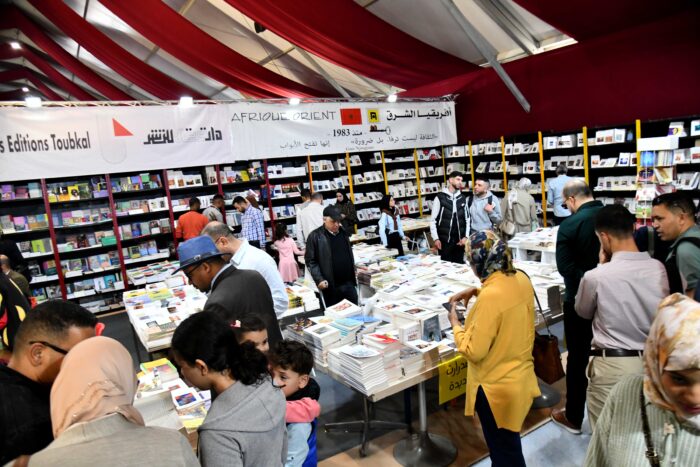
“In Morocco’s publishing sector, we can point to a very recent trend of horizontal consolidation among players whose appetite for acquiring competitors, peers, or bookstores is becoming increasingly evident”
One could also point to creeping concentrations at various levels: geographic concentration, since more than half of all publications are produced in the country’s two largest regions (Rabat-Salé-Kenitra and Casablanca-Settat); digital concentration, with a predominance of public institutions; linguistic concentration, with 80% of production in Arabic; and a concentration of non-fiction publications, which account for 78% of all literary works…
Not to mention another, very recent, horizontal concentration of publishing players whose appetite for acquiring competitors, peers, or bookstores is becoming increasingly apparent.
Growing concentrations equals certain vulnerability!
Multiple concentrations that are neither new nor surprising persist in a sector that remains poorly structured and deeply fragile. Today, the average print run barely reaches 500 copies. These realities are well known, yet the sector’s vulnerability continues to deepen despite the glitz of occasional events whose impact, if any, remains limited.
Morocco is far from alone in facing such concentration dynamics, even if their forms differ from one country to another. As early as 2022, American writer Stephen King observed: “I’ve been in the book business for about 50 years. When I started, there were literally hundreds of publishers. One by one, they were swallowed up by others or went out of business.”
The outcome is clear: five multinational corporations (the so-called Big Five) now dominate the American publishing market and control an overwhelming share of bestsellers. And when libraries, public schools, or universities are expected to “purge” certain books, political powers can be counted on to do that, invariably in the name of preserving supposedly sacred values…One might be tempted to invoke To Kill a Mockingbird, though that novel, too, has faced censorship.
In France, nearly three-quarters of the publishing industry is now concentrated in the hands of five major groups, even if independent publishing continues to resist.
What seems increasingly evident is that high levels of concentration (economic, territorial, linguistic, or ideological) rarely encourage healthy competition, let alone the development of diverse publishing landscapes or equitable access to publishing and distribution networks. Distribution itself remains the publishing industry’s blind spot in Morocco, as in much of Africa.
Books, contrary to popular belief, do not magically find their way to readers who are patiently waiting to obtain them, preferably for free, especially since fixed book pricing exists in only around fifteen countries worldwide. Distribution is therefore crucial. French billionaire Vincent Bolloré clearly understands this: beyond acquiring the Hachette Group, he also ensured control of Relay stores, a network present in more than 1,000 transit hubs worldwide, including train stations, metro systems, and airports.
Resist, prove that you exist!
Voices, such as those of King, Despentes, and many others are rising, through petitions, articles, or proposed legislation. The goal is to try ;just try; to counter the economic, political, and ideological steamroller reshaping the publishing world. In Morocco, the Collectif de la nouvelle édition marocaine (CNEM) was established in March 2025 to create “a space for reflection and action where each member can assert their editorial identity while benefiting from collective support.” The CNEM“rejects the standardization and precariousness of publishing professions.” A drop in the ocean? Perhaps…
The situations are, of course, not identical given the differences in market size and maturity. Yet several realities remain strikingly similar: the vulnerability of publishers and authors alike in the face of economic or political power; the growing threat to the freedom to write, and therefore to read; and the tendency to reduce a book’s value to a single criterion: sales figures. As Anne-Sylvie Bameule, chair of the board of the independent French publishing house Actes Sud, stated in 2023: “Large-scale consolidation fosters the phenomenon of ‘bestsellerization,’ meaning that a few titles become extremely visible, monopolize all distribution channels, and leave very little room for pieces that seek out new forms of writing and new talent.”
Publishing and media in the age of consolidation
Another sector offers a telling parallel: the media industry. Beneath the luxury labels, taffeta gowns, and towering 12 centimeter heels of The Devil Wears Prada 2 lies a story about the transformation of the press, increasingly shaped by the interests of the highest bidder, in this case financial conglomerates. And if that means dismissing an entire editorial team by text message on a Sunday evening, so be it.
A satire that, ultimately, mirrors very real political and economic dynamics, the two often deeply intertwined. The Moroccan press is all too familiar with this reality. “The gradual restriction of freedoms, the economic intimidation of certain media outlets, and the prosecution of journalists have ultimately sapped the vitality of our press and plunged it into its current crisis, ” wrote journalist Abdellah Tourabi recently.
Economic struggle, political struggle, cultural struggle. In recent months, the phrase “reclaiming our narrative” has become increasingly popular, as though constructing narratives were now the media’s primary mission. Another similarity between the press and the publishing industry in Morocco is the dependence of many companies on state subsidies simply to survive.
Will the answer come from rebuilding a collective dynamic among the actors within these sectors? For now, nothing is certain. Many professionals no longer identify with existing associations in either the press or publishing industries. Above all, however, the issue points to the urgent need for coherent public policies: a genuine national strategy for books and publishing that extends beyond a few selected regions, as well as democratic safeguards capable of protecting press freedom and preserving spaces for public debate, both of which seem increasingly out of fashion.
They say the devil is in the details. One can only hope that some of those details will eventually find their way into future election platforms. Hope being the operative word.
Written in French by Loubna Serraj, edited in English by Amina Kadiri


