

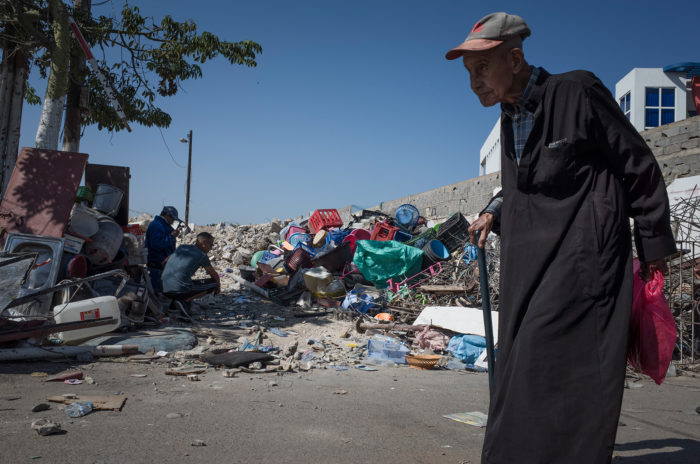
Square Bonnat, Palmiers district, Casablanca. At the end of August, a few stray cats are lounging amid piles of garbage, broken cement bags, torn-up grass, rusty garbage cans and alcohol bottles left on the ground by young homeless people who regularly squat in what can hardly be called a « garden. »
What should have been a place for local residents to relax has turned into a sinister open-air rubbish dump. « It’s infernal, we’re living in hell », complained one resident, in a video posted on August 31 on the Facebook page « Save Casablanca », on which angry Casablancans post daily photos and videos of incivilities encountered in Morocco’s economic capital.
Situations such as these, not to mention the many other forms of incivility – motorists failing to stop at crosswalks, red lights being run, queues not being respected, spitting on the ground, street corners being turned into urinals, night-time rodeos, « psst psst » and other forms of harassment of passersby are commonplace in every corner of the Kingdom, making daily travel in the public space sometimes unbearable.
There’s a general fed-up feeling. A study published at the end of May by the Moroccan Center for Citizenship (CMC) on the civic behavior of Moroccans confirms this: only 2.9% of Moroccans consider the level of civic behavior in public spaces to be high, 39.5% consider it to be average, and more than half (57.6%) consider it to be low. In other words, more than nine out of ten Moroccans are « fed up » with the incivilities of their compatriots. The survey, based on a sample of 1,173 volunteers from the twelve regions surveyed between February 10 and March 13, is unequivocal. The lack of civic-mindedness is glaring, and could well be the black mark on the organization of the 2030 World Cup.
« We have observed a persistence, even an aggravation, of certain uncivil behaviors », stresses Rachid Essedik, President of the CMC, which had already published a study in 2021 on disturbing behaviors in the public space, including illegal occupation of public space, harassment, inappropriate language, begging and abusive behavior by car attendants. The 2025 study, meanwhile, broadens the scope by addressing civic-mindedness in its entirety, integrating dimensions such as mutual respect, cleanliness, collective discipline, tolerance and civic responsibility.
In view of the alarming results of these two surveys, the CMC Chairman has announced the creation of a National Observatory for Civics and Citizenship, whose mission will be to regularly monitor, analyze and document the evolution of civic and uncivil practices in Morocco. « Each year, the Observatory will produce a report providing an up-to-date assessment of civic-mindedness in our country, highlighting trends, progress made and persistent challenges », explains Rachid Essedik. At the same time, a survey will be carried out every two years, like those carried out in 2021 and 2025, « in order to gain a deeper understanding of behaviors, measure their evolution and identify levers for action », adds Essedik.
Growing awareness
Could this be the start of a national upsurge in civic-mindedness? In any case, the subject has made headlines in the media in recent weeks following the publication of the CMC report, and has been the subject of endless reaction and debate on social networks. « We’ve been pleasantly surprised by the scale of the debate this report has sparked, both on social networks between citizens and in the media, with over 250 press publications devoted to the subject », boasts Rachid Essedik, pointing out that « this dynamism has even found an institutional extension », since the Economic, Social and Environmental Council (CESE) is currently working on the production of an opinion around the same theme, we learn.
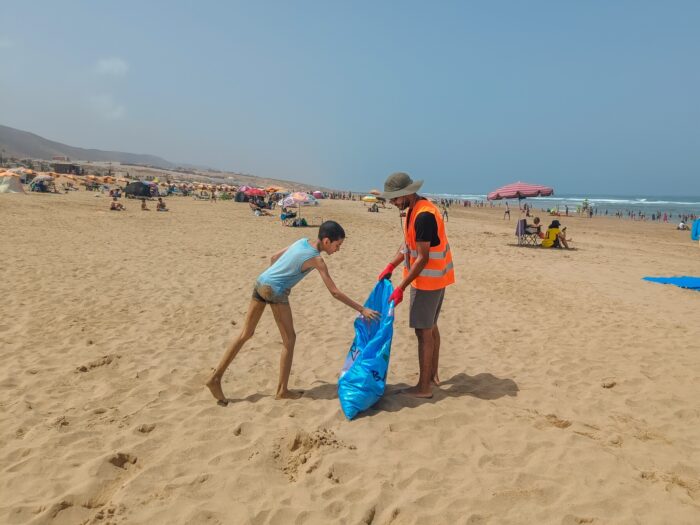
On the ground, associations are also beginning to see a growing awareness on the part of citizens. Saad Abid, president of the Bahri association, which has been campaigning for fifteen years to defend Morocco’s coastline, which is inundated with garbage, can testify to this: « I wouldn’t say that civic-mindedness is deteriorating or stagnating, but we can see that an effort is being made, whether by the authorities or by the awareness of certain citizens, through awareness campaigns, social networks, or the fact that we now know that it’s not right to throw garbage on the ground or on beaches », he stresses. « But there are always those who find excuses: ‘there’s no garbage can’, ‘it’s the authorities’ fault’, etc. », nuances the associative activist.
« In Morocco, there’s a culture of non-compliance with the rules; we can’t say it’s general, but rather widespread »
For Anace Heddan, Managing Director of the association Les Citoyens, which aims to encourage civic engagement among young people and restore the bond of trust between citizens and institutions, « there’s a culture of non-compliance in Morocco; you can’t say it’s general, but rather widespread », he believes. He takes as an example the degradation of public spaces by both beneficiaries and managers, « who pay no attention to detail and leave the spaces in a pitiful state ».
And yet, when members of his association meet with young people from all regions through « citizen cafés » to hear their grievances and propose solutions, among the main recommendations made by their interlocutors is the reintegration of citizenship education into school curricula from primary school through to high school. In other words, citizens « are more lucid about what’s going wrong », sums up the CMC Chairman, but also « less inclined to minimize or excuse certain behaviors ».
Whose fault is that?
« The fight against incivility must be comprehensive, combining education, awareness-raising, regulation and citizen involvement »
Looking for the causes or pointing the finger at those responsible for the lack of civic-mindedness is like asking who, the chicken or the egg, was created first. Was it the state, failing in its ability to ensure a clean and safe public space? Or the citizen, uneducated and « je-m’en-foutiste »? Or the school and the family, which have failed in their obligations? rachid Essedik sums up: « Incivility in Morocco is not the result of a single cause, but of a tangle of factors: weak civic education, weak law enforcement, rapid social transformations, economic difficulties and the cultural impact of new media. This observation shows that the fight against incivility must be global, combining education, awareness-raising, regulation and citizen involvement ».
The Managing Director of the association Les Citoyens agrees, saying that incivility is « the result of several factors and several phenomena that aggravate the situation ». First and foremost, in his view, is « the individualistic spirit that has taken root », particularly in schools and families, where children should be learning the basics of good citizenship. » We emphasize individual success, but not collective success », laments Anace Heddan. « Rachid Essedik adds : « Schools don’t always fully assume their mission of educating children about citizenship: school curricula deal with it in a theoretical way, without always succeeding in translating it into concrete everyday behavior.
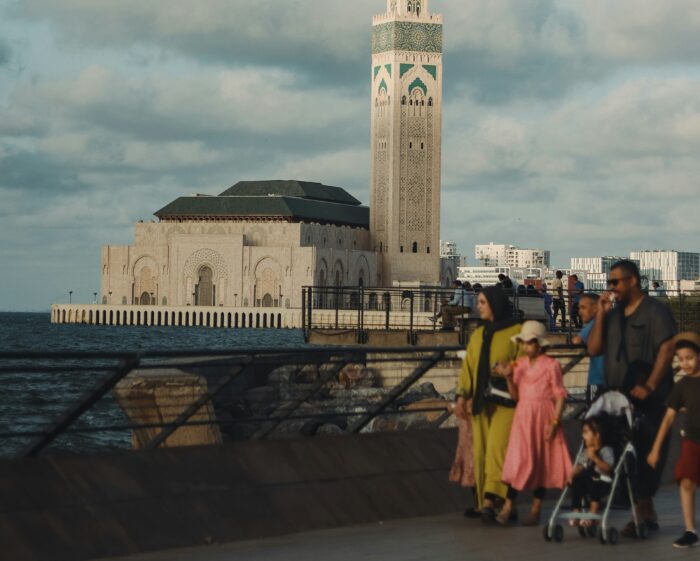
The normalization of lawlessness, including by the very people who are supposed to enforce it or serve as role models for citizens, is exacerbating the crisis of civic-mindedness. « When a gendarme, a policeman or an elected official doesn’t respect the law, or when we see acts of corruption and circumvention of the rules by those in positions of public authority, it’s normal for an average citizen to also become part of this system, » stresses the Citizens’ General Manager. « Rachid Essedik adds: « The lack of rigorous enforcement of the rules – whether in terms of cleanliness, traffic regulations or the occupation of public property – fosters a feeling of impunity and trivializes negative behavior.
« Micro-resistance
Another cause of the rise in incivility is the social and cultural changes taking place in Morocco: galloping urbanization, demographic explosion and increasing individualism « have contributed to weakening the traditional bonds of solidarity and social control mechanisms that once played a dissuasive role », stresses the CMC Chairman. The result: a rise in individualistic behavior, « marked by ‘every man for himself’, to the detriment of respect for collective rules ».
An observation shared by Driss Jaydane, writer, philosopher and essayist: « Moroccan society is undergoing a mutation, a moment that could be described – admittedly quickly – as the ‘departure from traditional society’, in its structures and landmarks ». Whereas family and school used to operate « according to fairly similar grammars » (respect for family hierarchies, respect for the teacher), today « this connivance is no longer there », he believes. In a society where hierarchies are based on money rather than values and merit, « civic education » cannot avoid the coarseness that the values of « money » spread.
Social and territorial inequalities, or a feeling of exclusion from decision-making on the part of certain citizens, can also fuel incivility. » Unemployment, job insecurity and inequality fuel a climate of frustration that sometimes translates into disengagement from collective norms, » explains Rachid Essedik. « In urban peripheries or marginalized villages, incivility is often a way of surviving: illegally occupying public space, cheating on transport or embezzling resources is less a transgression than a symptom of the absence of equitable arrangements, » observes Driss Jaydane. So, « the more society creates visible hierarchies – ‘civilized’ and ‘abandoned’ neighborhoods – the more it legitimizes transgression as a social language », he sums up.
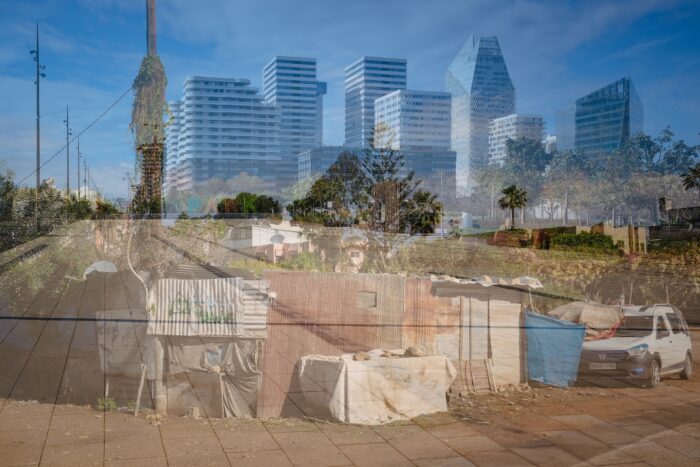
Incivility can therefore be read as « micro-resistance », continues the essayist: « not respecting the rule is a reminder that you are not a stakeholder in those who produce it. The relegated citizen expresses his exclusion by symbolically sabotaging the daily order. Throwing garbage on the ground, blocking a street, ignoring a red light: these seemingly insignificant gestures are tiny political acts. They say: ‘If the state forgets me, I’ll forget it too' ».
Monitor and punish?
So, to put an end to incivilities, should we « monitor and punish » more, to use the expression dear to 20th-century French philosopher Michel Foucault (1926-1984)? Driss Jaydane believes that « civic-mindedness should be experienced as a practice of the self, not as external submission ». For « disciplinary society produces obedient bodies, not free citizens. Surveillance and punishment may reduce incivility on the surface, but at the cost of diffuse resentment and obedience conditioned by fear », he adds.
On the other hand, environmental activist Saad Abid sees dissuasion and punishment as the lesser evil, and above all a quicker and more effective way of combating incivilities than the « long time » of awareness campaigns, which « sometimes take generations to be assimilated, whereas dissuasion has an immediate effect ».
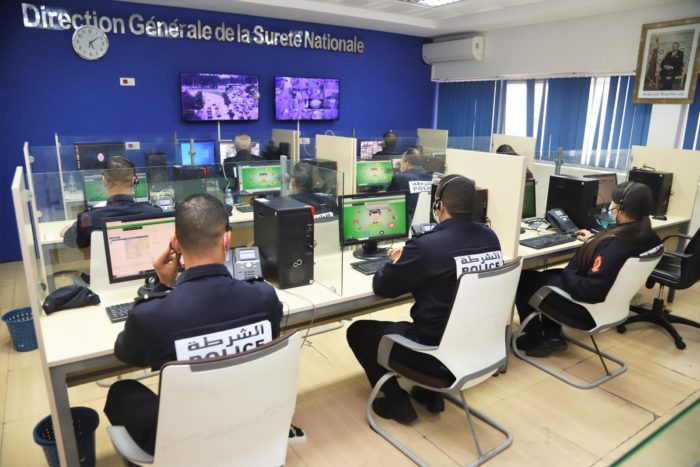
Finally, while the State is already implementing measures to guarantee citizens’ safety, notably by deploying extensive video surveillance systems in towns and cities, the president of the Bahri association points out that uncivil acts also affect safety: « Someone who cuts their foot with a piece of glass thrown in the sand, that affects their safety. So the Ministry of the Environment and/or the Interior need to train officials (police, gendarmes, caïds, moqqadems, auxiliary forces) so that they can issue fines. » The ultimate aim is « to have a generation of civilized people who not only consider public space to be their own, but also behave like model citizens, with or without fines, and understand that a clean society is everyone’s business. »
The Mondial 2030, a full-scale test
Lack of civic-mindedness could well be the downfall of the 2030 World Cup. In the run-up to the FIFA World Cup, citizens and commentators are calling for the event to become a catalyst for behavioral change. « The 2030 World Cup can be transformed into a laboratory for positive normalization. But for this to happen, we need to go beyond the cosmetic approach (one-off cleanliness, facade repression) and invent sustainable strategies« , notes Driss Jaydane. By combining citizenship education, the use of digital technology to raise awareness of the rules of good citizenship, community mobilization – notably with the help of civil society and sports federations – and symbolic valorization by transposing the positive values of sport, such as respect for rules, team spirit and surpassing oneself, to everyday life, « we can transform the World Cup into a founding moment of a new civic culture », concludes Rachid Essedik. [frame]
Written in French by Anais Lefebure; Edited in English by AngloMedia Group.


