

It’s not easy to spot the Safsaf Fort from the road connecting Zaïo to Berkane in the Eastern Rif region. It is accessed via a discreet path below the national highway, just before the bridge crossing the Moulouya River. Don’t let its fairytale, Thousand and One Nights appearance fool you. This fort doesn’t date back to the Middle Ages; it was actually built in the early 1900s.
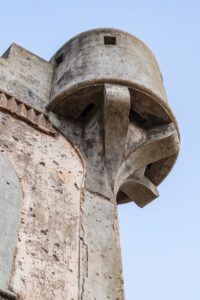
Built on the banks of the river, which at the time served as the border between the Spanish and French protectorates, the Safsaf Fort overlooks an ancient ford, a strategic crossing point on the route connecting northern Morocco to Algeria. At least until a bridge was built across the Moulouya River in 1929. While the French authorities did not deem it necessary to militarize the area—preferring to observe the region from a distance from their “eagle’s nest” at Tafoughalt—the Spanish, on the other hand, built several military installations there, including the small fort of Safsaf.
The structure, designed by architect Mariano Campos Tomás, was begun in July 1919 and completed on July 1, 1922. The building features a simple, square structure flanked by two equally square towers: one, facing northeast, monitored the ford, while the other, to the southwest, protected the fort’s entrance.
Built of reinforced concrete and exposed brick, adorned with Arab-Andalusian decorative elements, this little neo-Moorish gem is striking. At that time, however, bunkers were being built to protect against increasingly powerful artillery. This medieval castle with battlements and arrowslits therefore seems anachronistic.
However, this is by no means a mistake, but rather a recurring feature in the military heritage inherited from the Spanish. To mark their presence with a powerful symbol, they often sacrificed defensive qualities in favor of ceremonial architecture.“It had to be visible from the other bank of the Moulouya River and could be visited by French officers,” explains historian Antonio Bravo Nieto, a specialist in Spanish architectural heritage in Morocco.
Twenty-one bunkers in the thickets
Unfortunately for the symbol, the international bridge originally planned at the ford was inaugurated a few kilometers downstream. The fort was then assigned to an “indigenous” police unit. As the rumblings of World War II grew louder, Franco’s Spain—more rational in terms of military architecture—reinforced the area in 1939 with 21 bunkers.
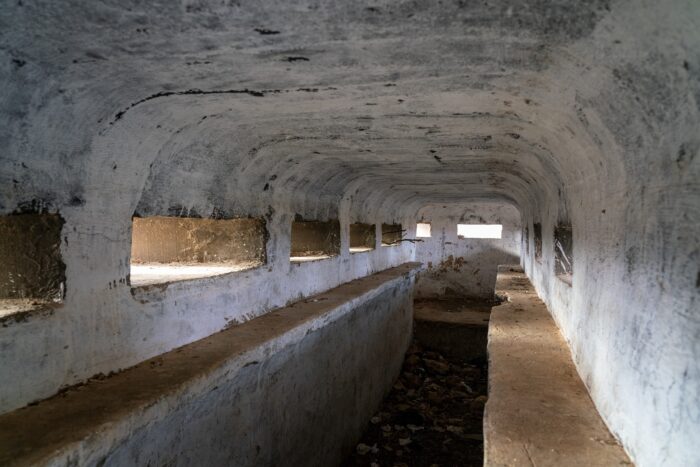
Designed by architect Luis Sicre Marasi, these bunkers all follow the same V-shaped layout, with the tip facing the enemy. Each is eleven meters wide and is identified by the letter F, followed by a symbol representing a tower and then a Roman numeral. The bunkers are arranged in small groups and protect several strategic points along the river to its mouth. Some still retain camouflage features, consisting of simple stone and cement cladding.
Other structures further enrich this unlikely site. First is the aforementioned international bridge, a metal structure spanning the Moulouya River. Its approach is flanked by several Art Deco-style buildings, likely intended for customs.
Finally, a few hundred meters south of the fort, lies the mysterious “Cortijo de Safsaf,” which looks as if it stepped straight out of an episode of Zorro: walled off, it is impossible to enter or obtain any information about it. Its name, which means “farm,” indicates its agricultural purpose: it may have housed stables for the cavalry.
A heritage to rediscover and preserve
With independence and the restoration of the kingdom’s territorial unity, the site lost all strategic interest. The condition of the access roads and the absence of more recent structures suggest that it was not reclaimed by the FAR but simply abandoned. Today, despite its architectural and historical significance, the Safsaf Fort remains largely unknown, if not ignored. It is neither signposted nor promoted. It is occasionally mentioned in blogs by 4×4 or motorcycle enthusiasts, but it is absent from tourist guides and does not appear on the Ministry of Culture’s list of national tangible heritage.
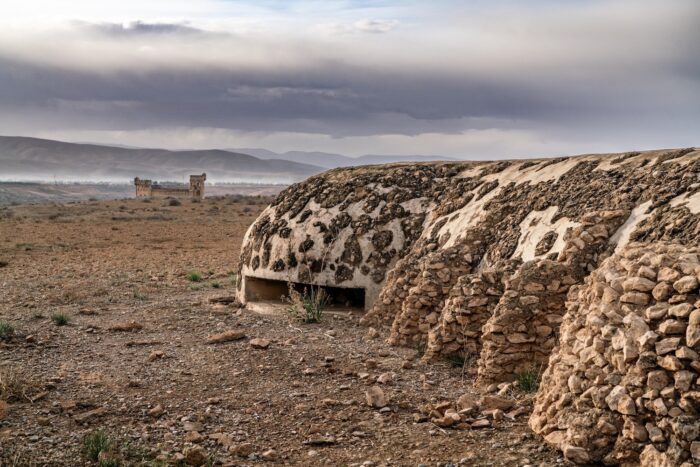
The Safsaf Fort is nonetheless worth a visit. Located in a veritable tourist no-man’s-land, it could become a destination in its own right. However, the site is in a state of severe disrepair and therefore requires urgent intervention. Following the example of many European countries that have undertaken to preserve the countless bunkers left behind by the Wehrmacht at the end of World War II, it is time to view the military legacy of the former colonial powers not as foreign structures, but as integral parts of Morocco’s history, landscape, and heritage.
Written in French by François Beaurain; edited in English by AngloMedia Group.


