

“The family is sacred” That remains true, but its structure is changing. Thirty years after publishing its first national family survey in 1995, the High Commission for Planning (HCP) has released its second.
Conducted between May and September 2025 among more than 14,000 households across the kingdom’s 12 regions, the survey confirms what recent population censuses had already suggested: the Moroccan family of 2026 bears little resemblance to that of three decades ago. Slowly but steadily, it is moving away from the extended, collective model toward a nuclear family structure and increasingly individualized life paths.
One fundamental finding, however, remains unchanged: the family continues to occupy a central place in Moroccan society. “As the true foundation of the social structure and the primary arena for socialization” it continues to fulfill “essential functions of socioeconomic support and contributes to the intergenerational transmission of values, norms, and cultural practices” the HCP notes.
The family also remains a buffer against crises, as demonstrated during the COVID-19 pandemic, the HCP adds. Yet this central role no longer guarantees stability, as the family model itself is becoming increasingly compact.
Fewer people under one roof
The figures speak for themselves: 73% of Moroccan households now follow the nuclear family model (a couple and their children), compared to 60.8% in 1995
The figures speak for themselves: 73% of Moroccan households now follow the nuclear family model, up from 60.8% in 1995. This confirms the dominance of households centered on a couple and their children. At the same time, the average household size has fallen from 4.6 people in 2014 to 3.9 in 2024, dropping below the symbolic “2-2” threshold of two parents and two children.
This transformation is more than demographic; it reflects changing ways of life. “The demographic composition of the family is shifting toward configurations characterized by fewer people living together and a relative tightening of family ties” the HCP notes. In other words, fewer people are living under the same roof, and relationships within families are evolving.
As a result, the share of extended families has fallen from 35.2% to 19.8% over the past three decades. Multigenerational households have followed the same trend, declining from 29% to 16.8%. Three generations living under one roof are becoming the exception rather than the rule.
The three-generation family living under one roof is becoming the exception
“The extended family, historically rooted in agricultural household economies and local solidarity, is becoming less functional in an urban context marked by wage labor, mobility, and housing constraints, with the dominance of affordable and social housing and the ‘two-bedroom/living room’ model” notes sociologist Bouchaib Majdoul.
The rise of the nuclear family is also accompanied by growing residential autonomy. More than half of married women now live in independent housing (55.7%, compared with 39.9% in 1995), although living with extended family remains common, particularly in rural areas.
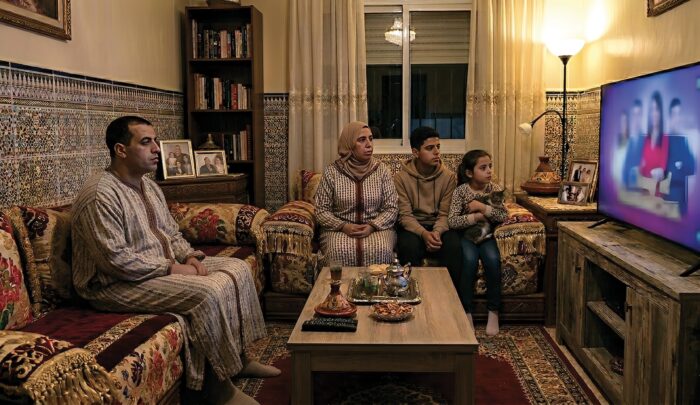
This trend is reshaping traditional family structures. Couples with children remain the dominant household type, accounting for 53.9% of households, but other family configurations are becoming more common. The proportion of childless couples has risen from 3.4% to 9.4%.
This increase, however, should be interpreted with caution. It reflects less the emergence of a child-free lifestyle than the effects of population aging. These households are primarily “empty nests,” whose children have already left home.
The age profile of household heads supports this interpretation: 72.8% are aged 60 or older. Single-parent households, meanwhile, account for 8.8% of all households, up from 7.3% in 1995, confirming their lasting presence in Morocco’s social landscape.
Out of sight, but still close to the heart
A decline in cohabitation does not mean family ties are disappearing. Rather, those ties are changing. “The decline in extended cohabitation reflects a gradual shift from solidarity based on living together to more distant forms of solidarity” the HCP notes.
“It is often the same parents, who grew up with traditional values, who today encourage their children to pursue long-term education, delay marriage, and seek a form of independence” emphasizes Khalid Mouna, an anthropologist”
The family network remains extensive, with an average of 54 declared relatives, including uncles, aunts, cousins, nephews, nieces, and in-laws, but the circle of active relationships is much smaller, averaging just 17 close relatives, or less than one-third of the broader network. An implicit selection takes place, centered on the closest relationships: parents, siblings, and children, in other words, the “nuclear family.”
The same logic applies to physical proximity. Geographical proximity is declining: only 45.4% of heads of household live near their father (compared to 53% in 1995) and 46.3% near their mother (compared to 63% in 1995).
Families are quite literally growing farther apart. Children are moving to different cities ;or even abroad; to pursue education and employment. “It is often these same parents, who grew up with traditional values, who are now encouraging their children to pursue higher education, delay marriage, and seek a form of independence” says anthropologist Khalid Mouna.
As distance increases, patterns of interaction evolve. Emotional support dominates long-distance family relationships, accounting for 87.3% of interactions, while financial transfers become more important and digital communication plays a growing role in maintaining family connections.
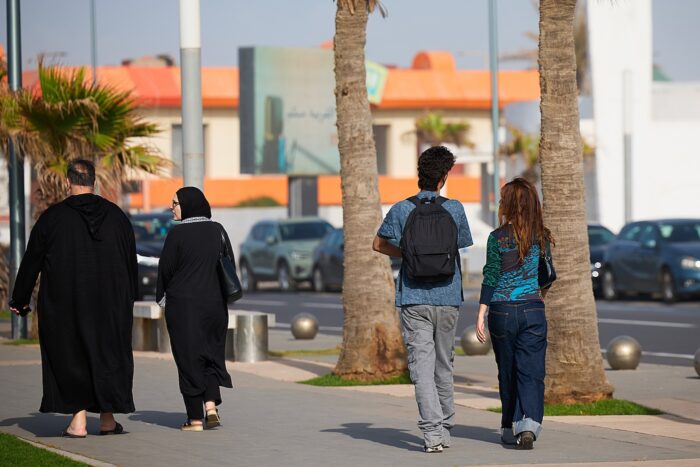
“Virtual communication has become firmly established as a means of maintaining family relationships” and “partially” compensates for the decline in residential proximity, the HCP notes.
A growing focus on the Individual
51.7% of single people do not wish to marry. The percentage of those who reject marriage rises to 59.8% among men, while it drops to 40.1% among women. A gap of nearly twenty percentage points that speaks volumes
Beyond these structural changes, the survey points to a deeper transformation: the growing individualization of life choices. Marriage is becoming less central to people’s aspirations, with 51.7% of single people saying they do not wish to marry. Yet this figure masks a striking gender divide: 59.8% of men say they do not want to marry, compared with 40.1% of women. A gap of nearly 20 percentage points that says much about the burdens marriage continues to place on those still expected to be the primary breadwinners.
Among single people who reject marriage, 54% of men cite economic and material constraints, including housing, income, and wedding costs, as the main obstacle. By contrast, only 7.4% of women cite financial reasons, with most instead pointing to continuing their education or feeling too young (49.2%). And when marriage does occur, it happens later than before: at an average age of 26.3 for women and 33.3 for men.
People are also remaining single for longer, with many continuing to live with their parents well into adulthood. By age 35, 16.5% of people have neither left the parental home nor married. This situation is more common among men (20.3%) than women (12.9%). Nearly one in six adults, then, finds themselves in a kind of limbo, neither independent nor married, reflecting the growing difficulty of transitioning into adulthood amid prolonged economic insecurity.
Fertility follows the same trajectory, standing at 1.98 children per woman, below the replacement rate. This suggests the issue is no longer purely demographic but increasingly economic. Among the 66.8% of women who do not want more children, nearly half (48.3%) cite financial constraints as the primary reason.
Attitudes within couples are also evolving. Decisions about contraception are now made jointly in 85.7% of cases, reflecting changing dynamics within the household.
A central family, but a more vulnerable one
Ultimately, the HCP report highlights the coexistence of two parallel trends. On the one hand, the family remains a deeply held social value. It “remains a central institution in the social perceptions of heads of households” associated with continuity and the transmission of traditions (38%), as well as emotional support and a sense of security (32%).
On the other hand, everyday practices are steadily moving away from this ideal. The concerns expressed by respondents are revealing: “the weakening of family ties” (24.9%), “physical and emotional distancing” (12.9%), and “the priority given to social success” (12.1%). In other words, the ideal of the family endures, but it is increasingly confronted by new realities: urbanization, mobility, economic pressures, and individual aspirations.
“Mutual support and solidarity among family members persist, reflecting a continuity in relational dynamics, even within a changing social framework”
“The family model is being reshaped from within. Despite these changes, the family as a structure is not being called into question. In fact, it remains a central institution, within which individuals from different social backgrounds, in terms of education level, income, occupation, or social class, continue to meet and interact” says Khalid Mouna.
“And mutual aid and solidarity among family members persist, reflecting a continuity in relational dynamics, even within a changing social context” adds the anthropologist.
The 2025 survey ultimately portrays a Moroccan family that is smaller, more autonomous, but also more vulnerable. Less cohabitation means less immediate protection. And while solidarity remains strong, it increasingly depends on indirect ;and sometimes fragile; mechanisms.
In this context, one major challenge emerges: adaptation. As the report emphasizes, the family “appears to be a social space that cushions vulnerabilities”. But for it to continue fulfilling that role, public policy must provide it with the necessary support.
Religion is losing ground to personal priorities
The HCP’s 2025 National Family Survey points to a profound shift in the values shaping Moroccan families. While religion has not disappeared, it is losing its central place to more pragmatic and individualized priorities.
When it comes to the values parents seek to pass on to their children, integrity ranks first (33.9%), followed by family values and roles (26%) and a sense of responsibility (12.1%). Faith and religious devotion account for just 8.9% of responses, cited more often in rural areas (11.1%) than in urban ones (7.8%). The same pattern appears in partner selection: moral values top the list (44.7%), followed by emotional compatibility (21.2%) and socioeconomic considerations (12.9%), with religiosity ranking fourth at 11.5%.
The trend is equally clear among single people who intend to marry. Only 7.1% cite social, cultural, or religious norms as a motivation, far behind the desire to start a family and have children (77.6%) and socioeconomic stability and security (9.6%). Likewise, when asked what family represents, only 14.6% of household heads describe it as “a religious duty” compared with 37.9% who see it as “a symbol of continuity” and 32.4% who view it as “a source of emotional support.”
Finally, when asked about changing parental roles within the family, only 8.8% of household heads say these roles are still primarily guided by religious values, while 48.2% believe they remain “traditional” with the father as breadwinner and the mother as homemaker. Beyond the figures, a new paradigm is emerging: family decisions are increasingly shaped by rational considerations ;economic stability and emotional compatibility; rather than religious ones.
Rural families are changing as well
One of the survey’s most striking ;and least discussed; findings is that the family divide between urban and rural Morocco has all but disappeared over the past three decades.
In 1995, 63% of urban households were nuclear families, compared with 58.1% of rural households, a five-point gap reflecting two distinct Moroccos: city apartments on the one hand, and douars where several generations still shared the same courtyard on the other.
By 2025, those trajectories had converged: 72.9% of urban households and 72.7% of rural households were nuclear families. The shift is no longer confined to the urban middle class; it has become a nationwide phenomenon. “The increase is more pronounced in rural areas” the HCP notes, even though urban areas continue to record slightly higher annual growth (3.6% compared with 2.4%).
The finding challenges the enduring image of rural Morocco as a bastion of large extended families and multigenerational solidarity. Wage labor, youth migration to cities for education, and the spread of the “two-bedroom/living room” housing model into smaller towns are reshaping rural life as well. Rather than resisting the transition to nuclear families, rural communities are adapting to it, with the gap between urban and rural areas steadily narrowing.
Politically, the message is clear. Public policies that were based, explicitly or not, on the assumption of an extended rural family caring for the elderly, children, or the sick, in other words, an informal welfare state, are seeing this foundation erode everywhere, all at once.
Written in French by Anaïs Lefébure, edited in English by Amina Kadiri


