

In this category, and according to a preliminary estimate by the Casablanca municipal council, the establishments included are hotels, clinics, restaurants and cafés, large retail outlets, and companies and schools equipped with a cafeteria.
La préfecture d’Anfa, champion local
According to a TelQuel count, the municipality of Casablanca is home to no fewer than 1,560 major household waste producers, according to a non-exhaustive list that will eventually be expanded over time. The prefecture of Casablanca-Anfa districts leads with a total of 982 units, significantly more than half, with a predominance of units dedicated to restaurants, hotels, and retail.
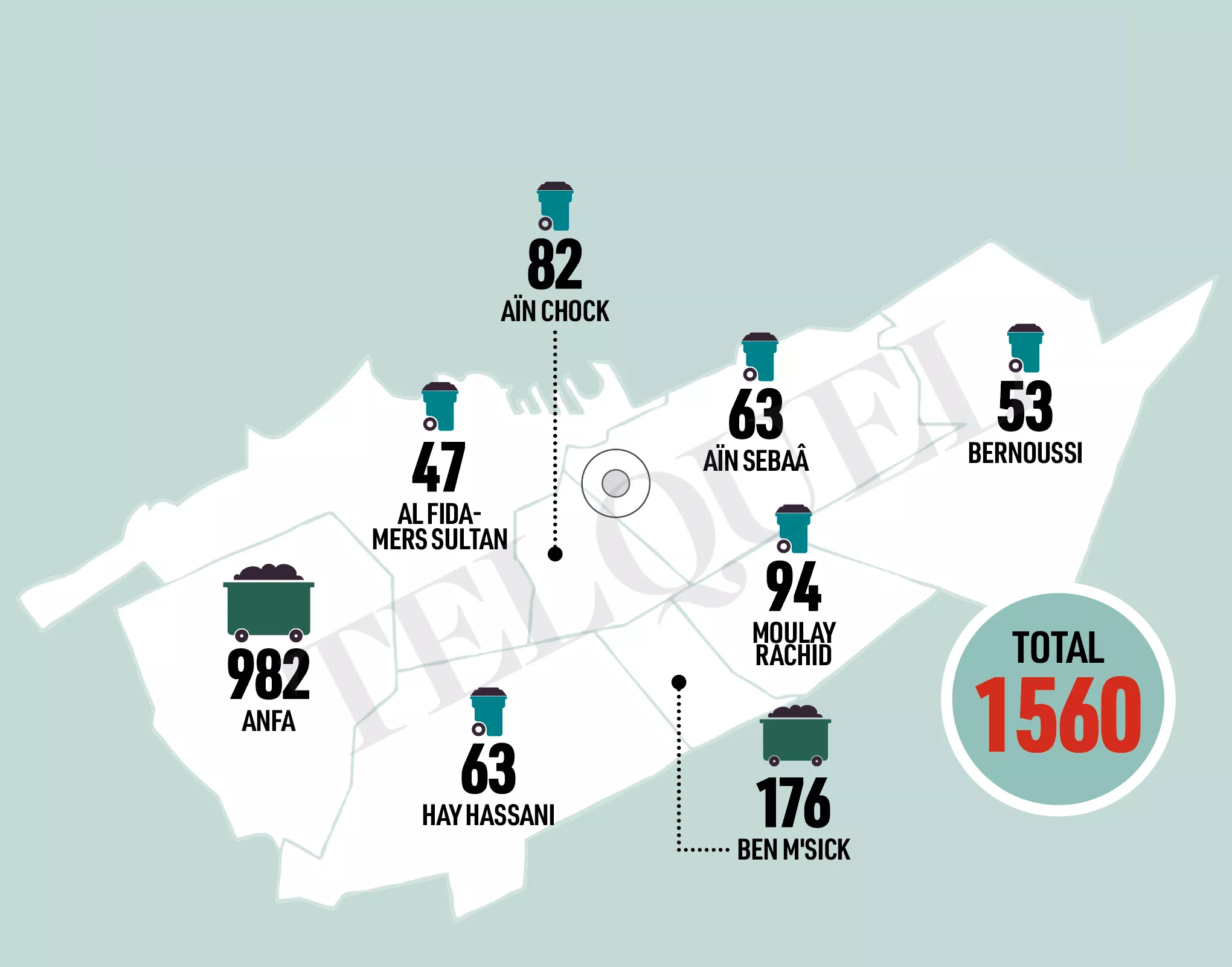
It is followed, though distantly, by the prefecture of Ben M’Sick with 176 major producers, a category made up mostly of cafés, snack bars, and restaurants. The prefecture of Moulay Rachid is no exception to the same observation, with its 94 units.
In a prefecture of districts such as Aïn Sebaâ, there are 63 major household waste producers, including 5 hotels and 20 BIM retail outlets. The Turkish brand also accounts for more than half of the units in this category recorded in the prefecture of Bernoussi: out of 53 major producers, 27 are BIM.
In the prefecture district of Aïn Chock, restaurants are also predominant with 30 establishments out of the 82 major producers recorded, compared to 7 clinics and 6 hotels.
A more transparent collection
According to the terms of reference, the collection, transport, and disposal of waste assimilated by major producers falls under the responsibility of the delegated operator. These services are included in the overall flat rate and do not give rise to any additional remuneration.
A special system is planned for this category to guarantee full transparency, real-time supervision, and comprehensive traceability, as the vehicles dedicated to this mission will be equipped with an onboard weighing system.
The collection procedures for major producers will be established on the basis of consultations around dedicated routes as well as the frequency and timing of pickups.
All operations relating to the services provided to major producers are archived and accessible to both the producers themselves and the delegated operator and delegating authority.
A gift for major polluters?
No payment will be requested from Casablanca’s major waste producers, and the terms of reference contain no coercive measures, nor any list of penalties.
As an example, major household waste producers in Paris are not subject to a special tax. However, they are required to sort biological waste, either by their own means or by using a service provider. In both cases, the « polluter pays » principle is respected. For industrial producers, the bill is even heavier as they are required to manage end-of-life products coming out of their workshops or factories.
The terms of reference of the municipality of Casablanca refer to authorized major producers, but nothing is specified regarding the method of designation of the units that fall into this category.
It should also be noted that the terms of reference do not provide for any taxation on the collection of inert and bulky waste, which the delegated operator will henceforth be required to process, just as it will be called upon to act urgently (within a 12-hour window) when a problem site is reported to it.
In its opinion on food waste in Morocco, the Economic, Environmental and Social Council (CESE) does not quantify the shares generated by major waste producers. The institution limits itself to informing us that 14% of the people it surveyed support the installation of anti-waste sections in supermarkets, offering products close to their expiration date at reduced prices. While 13% are in favor of donating food products close to their expiration date to charitable organizations.
Written in French by Mohammed Boudarham, edited in English by Eric Nielson


