

Few animals carry as much contradiction in Morocco as the donkey. For generations, it has accompanied farmers, traders, and workers, yet its name is more often used as an insult than as a symbol of resilience. Tucked away in the winding streets of Tangier’s old medina, the Donkey Museum seeks to challenge that perception. Through art, history, and environmental awareness, it invites visitors to look beyond the stereotype and reconsider not only the donkey, but Morocco’s relationship with its native wildlife.
The idea for the museum was born in 2012 before taking shape with its first artwork in 2014, created by artist Zack Browning. The piece later became the museum’s official logo. Twelve years later, the museum has grown into a collection featuring works by 156 artists alongside more than 400 books, magazines, scientific studies, and comics. Although the donkey remains its central symbol, the museum also highlights other species native to Morocco, including the Barbary macaque, the Greek tortoise, and the Mediterranean chameleon (Chamaeleo chamaeleon), reflecting founder Abderrahim’s belief that wildlife can play a greater role in the country’s cultural and tourism identity.
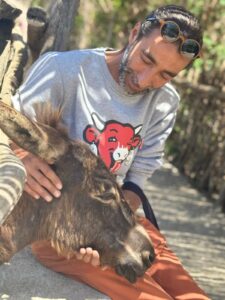
A symbolic place
For Abderrahim, however, the museum’s origins are deeply personal. « It is a tribute to my great-grandmother » he says. An Amazigh woman from the Khemisset region, she lived independently until the age of 113, accompanied by the animals she cared for, including a donkey that helped her with daily tasks. Her resilience and close relationship with the animal became one of the founding inspirations behind the museum.
His family story later intersected with academic research. While studying tourism, Abderrahim became interested in the way countries use animals to shape their international image. Australia is recognized through kangaroos and koalas, and in his view, that visibility has encouraged greater efforts to preserve the habitats those animals depend on.
Morocco, he argues, possesses its own remarkable wildlife but continues to present itself almost exclusively through camels. « We have storks, cedar forests, the Atlas Mountains, and donkeys » he says. « Why are we using only camels? » For him, broadening the country’s symbolic imagery is also a way of encouraging greater appreciation for Morocco’s biodiversity. If animals become part of a nation’s cultural identity, he believes, protecting the environments in which they live becomes part of the conversation as well.
Tangier was chosen precisely because donkeys have nearly disappeared from the city’s medina. As modernization continues to reshape Morocco’s urban landscape, the museum serves as a symbolic reminder of an animal that once formed part of everyday life. « There are no real donkeys in the museum » he says. « The Donkey Museum is a symbolic place to remember things »
« It is not easy to take an insult and try to make it a museum »
Yet the museum is about more than memory. It also seeks to reclaim a word that has long been associated with mockery. « It is not easy to take an insult and try to make it a museum » Abderrahim says. « It’s a hard fight »
That effort is often reflected in the public’s reaction. On social media, users sometimes tag friends and joke that someone has finally built them a museum. For Abderrahim, such comments only reinforce the importance of challenging the stereotypes attached to the donkey.
Misunderstandings extend beyond the museum’s name. Some visitors assume it has the capacity to support every artist or rescue every animal simply because it is a museum. Others insist on purchasing artworks displayed in the collection, reflecting what Abderrahim describes as the belief that « everything can be sold. » He refuses. Selling even a single artwork, he argues, would reinforce that mentality while depriving future visitors of the opportunity to experience the collection. The museum, he says, exists to preserve culture rather than treat art as merchandise.
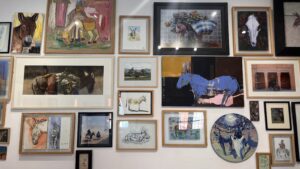
A community, not a shop
The museum’s commitment to supporting artists extends beyond preserving its permanent collection. Through its artist-in-residency program, it also provides space for new creative work. For the past four months, French artist Marceau has been living and working at the museum, where visitors can often find him painting or discussing his work.
According to Marceau, the residency has allowed him to step away from commissioned mural projects and devote himself to a more personal artistic practice. His contribution includes a mural painted on the museum’s rooftop, reflecting the museum’s commitment to supporting independent artists while encouraging dialogue about the relationship between humans and animals.
The museum’s unusual concept has attracted growing attention from both Moroccan and international media. Maintaining an independent cultural institution, however, remains a challenge. Rather than relying entirely on grants, Abderrahim supports the project through work in translation, communication, festival organization, and community management. The museum itself continues to grow gradually with the help of volunteers and artists in residence. « I don’t want to grow too fast » he says. « There’s no shame in working. The shame is in begging ».
« You can’t ask tourists to always come back for Tagine, Couscous, and camels, If you want them to come back ten times, you have to offer them ten different programs »
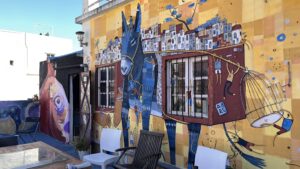
His philosophy also shapes the visitor experience. Instead of treating the museum as a place where people simply pass through, he encourages conversation, often spending time explaining the ideas behind the project and listening to visitors’ questions. « I’m not a shop » he says. « I give time to people ».
For Abderrahim, independent cultural initiatives like the Donkey Museum are essential if Morocco hopes to diversify what it offers visitors.
« You can’t ask tourists to always come back for Tagine, Couscous, and camels » he says. « If you want them to come back ten times, you have to offer them ten different programs »
In a city celebrated for its artistic and literary heritage, the Donkey Museum offers an unconventional perspective on culture, memory, and nature. By using art to tell the stories of the donkey and other native species, it invites visitors to rethink the animals that have shaped Morocco’s past and, perhaps, imagine a different future for how the country chooses to represent them.


