

Domestic work is productive work, essential to the functioning of capital but invisible because it escapes wage relations. » This sentence by Mariarosa Dalla Costa, Italian sociologist, writer and feminist activist, dates back to 1974. It is taken from her book co-written with Selma James, Women’s Power and Social Subversion. Fifty years on and it’s still relevant.
« In the event of divorce, a woman must be able to assert her rights, even if she has not been gainfully employed outside the home »
In Morocco, as elsewhere, women’s domestic work remains invisible and unrecognized. It is not included in the national economic accounts and those who benefit from it – primarily men – do not always consider it to be real work.
The proof? The criticism that has surrounded one of the key provisions of the new Moudawana, announced last December by the Minister of Justice, Abdellatif Ouahbi. Although the final text of the reform has yet to be unveiled, Morocco is in the process of introducing a new framework for property acquired during marriage. The aim is to move towards « valuing the wife’s work within the home, by considering it as a contribution to the development » of these assets, he explained.
« It is unacceptable for a woman receive no income in enabling her husband to build up his assets. » Moroccan women spend more than 4 hours a day on domestic chores. While the announced reform of the Moudawana begins to recognise… pic.twitter.com/1tXvOS2Vmb
– TelQuel (@TelQuelOfficiel) May 9, 2025
« Domestic work must be recognized as productive work, with real economic value, particularly regarding the division of property acquired during marriage. In the event of divorce, a woman must be able to assert her rights, even if she has not been gainfully employed outside the home« , explains Bouchra Abdou, Director of the Tahadi Association for Equality and Citizenship (ATEC), to TelQuel after a conference in Casablanca organized on the subject on the eve of May 1st.
A « job in its own right »
« Working at home often means enabling the husband to economise, devote himself to his career and build up his capital. The division of assets should therefore be equitable, at 50% each, taking into account the length of the marriage« , she maintains.
« It’s time to call women’s domestic work by its proper name: a job in its own right »
This feminist and human rights activist, also a founding member of the Democratic League for Women’s Rights (LDDF), concedes that if the couple have only been married for a year, for example, it’s an exaggeration to talk of a significant contribution to the value of a property. But after three years, an equal distribution becomes legitimate in the event of divorce.
She thus asserts that this « reality » must be formally recognized in the new Mudawana. « This is subject to debate in society, but there is an urgent need to recognize the physical and mental fatigue that this daily work represents for women« , she stresses. These women perform a multitude of tasks, « often invisible« , which support the balance of the home, continues Bouchra Abdou. « It’s time to call this work what it is: a job in its own right« , she concludes.

According to figures levied by the intersectional analysis of women’s participation in the Moroccan labor market, published in March 2024 by the Haut-commissariat au plan (HCP), 74% of unemployed women in Morocco are housewives. What’s more, 54% of these women state that childcare and domestic chores are the main reasons for their unemployment. According to this study, prevailing social perceptions, marked by gender stereotypes, reinforce this phenomenon and hinder women’s access to employment.
Going even further
Another HCP national survey, carried out in 2016, reports that 63% of Moroccans believe that « employed women compromise their children’s education« . So what about those who stay at home? According to the latest HCP figures on the subject, published in 2022, the proportion of women involved in housework is 92%, compared with 24% of men.
Women thus spend 4 hours 17 min a day on housework inside and outside the home, compared with just 38 min for men. This figure is only a slight improvement, since a study carried out ten years ago found that women were spending almost five hours on these tasks.
« This unpaid work represents indispensable services that contribute to the material well-being of individuals and households, without appearing in the gross domestic product (GDP) », says economist and professor at Mohammed VI Polytechnic University Larabi Jaidi, in a publication entitled Le travail invisible des femmes (Women’s invisible work), dated last March. « Hence the need to measure this domestic production in order to assess the true value of women’s essential contribution to the national economy, and to take into account the impact on household living standards« , stresses the economist, who was also a member of the Special Commission on the New Development Model.
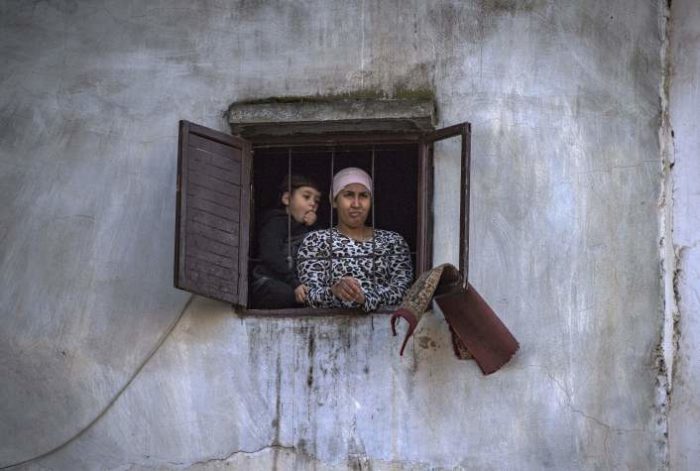
« It’s unacceptable that women, after years of marriage, receive no income in enabling their husbands to develop professionally and build up their assets« , insists Bouchra Abdou. All the more so as, according to her, it is also very often the woman who takes care of the elderly, a recognized and well-paid job in many countries. « The Family Code, but also the Labor Code, must recognize this contribution. We need to go further: create a specific social security or pension fund for housewives », she believes.
« Mom in the kitchen, dad in the garden »
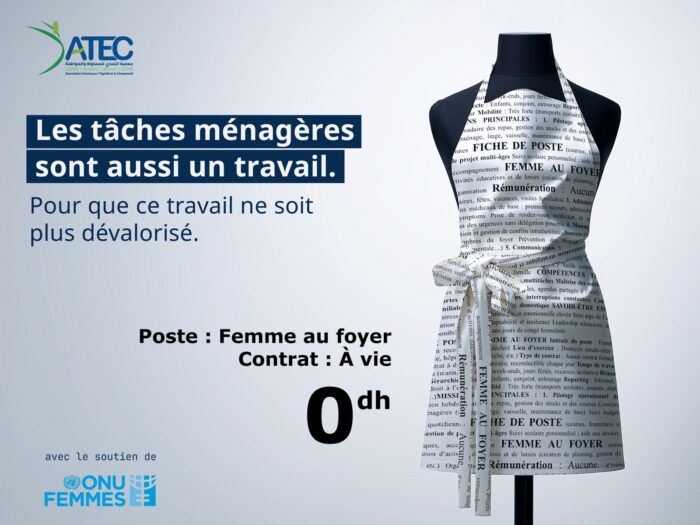
To push for a change in mentality, Abdou’s association, with the support of UN Women, launched a national campaign on Wednesday under the slogan ‘housework is work too’. The aim is to highlight the « essential but invisible » role played by women in the home. A job that includes childcare, cleaning, cooking, caring and education. « This inequality is a direct obstacle to their autonomy and access to a professional career« , points out Myriem Ouchen Noussairi, UN Women’s representative in Morocco.
« If the leaders themselves continue to hold chauvinist ideas, society will remain frozen »
She points out that the reform of the Moudawana also aims to bring « an egalitarian approach to family management« . « And we, by promoting the involvement of men and women in domestic and family responsibilities, are working towards greater equity within the Moroccan home« , she adds.
The campaign is based on a fictitious « job description« , printed on a manifesto apron, listing the multiple roles assumed by women in the home. To raise awareness, the apron was worn in the streets by women and men alike on May 1, during a march organized by ATEC in collaboration with the Confédération Démocratique du Travail (CDT), in the Derb Omar district of Casablanca.
For Bouchra Abdou, it’s only through awareness-raising, exchanges and education that mentalities can change. « Decision-makers need to open a public debate » to advance this recognition, and the Ministry of Education « needs to include these issues in school curricula so that children understand, from an early age, that cooking and household chores are not the preserve of mothers« , pleads the ATEC director.
« Stereotypes such as ‘mom in the kitchen, dad in the garden’ must disappear« , she adds. In her view, it’s these seemingly innocuous images that perpetuate inequality. « But all this can change, provided there is a real political will. If the people in charge continue to hold chauvinist views, society will remain in a state of stagnation« , she laments. In short, change depends on a strong commitment from legislators, politicians and all decision-makers.
Written in French by Ghita Ismaili, edited in English by Theodore Griffin.


