

The recent opening of the Cinémathèque du Maroc marks an important step forward in the study of national cinema, a field that still suffers from major historical blind spots. Among the figures unfairly pushed to the margins, Mohamed Laghzaoui occupies a singular place.
Today, his name is associated more readily with the history of the Istiqlal Party and independent Morocco than with the seventh art. Yet Laghzaoui was behind an extraordinary cinematic venture that carried him all the way to the red carpet of the Venice Film Festival in 1948.
Long ignored, this unexpected episode remains one of the most fascinating and least known stories in Moroccan cinema.
A cinema under colonial control
Until the mid-1930s, cinema in Morocco remained largely a colonial pastime. Films imported from Europe and the United States were screened in theaters built, managed, and frequented by Europeans. Little distinguished Moroccan cinemas from their French counterparts, whether in architecture, aside from retractable roofs adapted to the summer heat, or in programming.
There were indeed a few theaters frequented by Moroccans in the medinas of major cities: the Parisiana (later the Rio), the Medina, and the Imperial in Casablanca; the Apollo (later the Star) in Rabat; and the Boujloud and the Imperial in Fes. But these remain on the fringes. Small and poorly equipped, they continued to screen silent films for an audience with little interest in French-language talkies.
On the eve of World War II, the arrival of the first Egyptian films changed the game. Broadcast on the radio, the melodies of Oum Kalthoum and Abdel Wahab helped popularize this new cinema from Egypt. In the medinas, away from the large theaters in the city center, Moroccans (bourgeois, workers, and students) developed a passion for the seventh art, and the number of “indigenous theaters” grew.
By the end of World War II, Egyptian cinema, already seen as a form of resistance to French cultural dominance, took on new meaning by merging with nationalist sentiment. Images of a modern Arab country that had gained independence became symbols of hope for Moroccan nationalists. Movie theaters were transformed into genuine political arenas, where tension ran high and applause in honor of the sultan or the nationalist movement became commonplace.
In response to this growing Egyptian influence, the authorities founded the Film Service and the Moroccan Film Center (CCM) in 1944. Their mission was to regulate the industry and produce films aimed at colonial audiences, whom the authorities hoped to keep within the French cultural sphere. Morocco was imagined as a kind of new Hollywood, celebrated for its landscapes and natural light, while the first studios and the foundations of a local industry began to emerge.
Yet while Moroccans increasingly filled cinema seats, they remained almost entirely excluded from the industry itself. A handful of pioneers, such as Taïeb Sebti (owner of the Colisée in Oujda and the Bahia in Casablanca) and Mohamed Ben Mokthar (of the Imperial in Fez), were rare exceptions. Lack of capital and training played a role, but this exclusion was above all political. French authorities used shortages of materials and foreign currency as pretexts to deny Moroccans permits to build theaters or import Egyptian films. As nationalism intensified, the objective became clear: to keep Moroccans out of every aspect of the film industry, confining them to the role of spectators—and preferably spectators of French cinema.
Everything changed in 1947, when Mohamed Laghzaoui entered the scene on behalf of the Istiqlal Party and began fighting to secure a place for Moroccans in the film industry.
Mohamed Laghzaoui, pioneer of Moroccan cinema
For most Moroccans, Mohamed Laghzaoui’s name evokes the history of independent Morocco rather than cinema. He is remembered as the founder of the General Directorate of National Security (DGSN), a minister under Hassan II, director of the Office Chérifien des Phosphates (OCP), and later ambassador to France. But at the end of World War II, he was still a businessman from Fez who had made his fortune through a bus company.
To establish himself in the film industry, Laghzaoui created two companies. The first, Royale Sodifilm, launched on May 16, 1947, was a distribution agency specializing in Egyptian films and backed by around twenty Moroccan shareholders. The second, Studio Maghreb, was founded on July 5, 1947, alongside Si El Kébir El Fassi and 200 subscribers as a production company.
The creation of these companies came shortly after the sultan’s famous speech in Tangier, an event that would trigger the first major confrontation between nationalists and colonial authorities in the field of cinema.
The Turning Point of the Tangier Speech
The speech delivered by Sultan Mohammed Ben Youssef (the future Mohammed V) on April 10, 1947, in Tangier’s Mendoubia Gardens marked a turning point in Morocco’s struggle for independence.
“Morocco ardently desires to recover its full rights,” declared the sultan, without explicitly uttering the word “independence.”
The speech was filmed by several crews, including Chérif-Film, a Moroccan production company founded by French nationals. The company hoped to quickly screen the footage in theaters across the country as part of weekly newsreels. But the authorities were reluctant to authorize the images. After extensive cuts, a screening permit was finally issued on August 14, more than four months after the event.
By then, however, Resident General Eirik Labonne had been replaced by General Alphonse Juin, a hardliner who revoked the permit on August 21 and canceled screenings scheduled for the following day at Alhambra in Rabat and Moghreb in Casablanca. Chérif-Film demanded compensation and permission to distribute the footage elsewhere in North Africa, but the censors ultimately imposed a total ban.
The affair resurfaced in autumn 1947, when Studio Maghreb acquired the rights and produced two copies of the film, one of which was offered to the sultan. After months of obstruction, the footage was eventually screened clandestinely. A mysterious emissary ;suspected by intelligence services of having been sent by the sultan himself; reportedly carried the reel from city to city within nationalist circles.
It was only in April 1956, after independence, that the speech was publicly screened for the first time at the Imperial Cinema in Fez.
The episode served as a wake-up call for nationalists: gaining a foothold in the film industry would require confrontation with the authorities rather than cooperation through official channels.
The Battle for the Boujloud
In the spring of 1948, a wave of boycotts swept through cinemas. In Salé, Rabat, Casablanca, Fez, and Meknes, theaters frequented by Moroccans suddenly emptied, while those frequented by Europeans were largely unaffected. Initially, the origin and motives behind this boycott remained unclear, and the authorities suspected a connection to the First Arab-Israeli War.
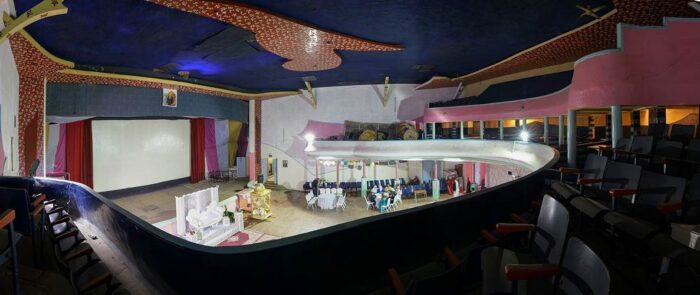
But in June 1948, after weeks of empty seats and deserted ticket counters, Mr. Lenté and his partners, the owners of the Boujloud Cinema in Fez sold the theater to a consortium of around forty businessmen ;almost all from Fez; led by Mohamed Laghzaoui. The real purpose of the boycott then became clear: it was designed to facilitate Moroccan acquisition of movie theaters and open the exhibition sector to nationalist interests. Behind the scenes, similar negotiations were already underway concerning the Apollo and Mondial cinemas in Meknes and the Colisée in Salé. Alerted in time, the authorities intervened to discourage the sales.
Although Laghzaoui failed to take over several theaters, the acquisition of the Boujloud represented a major victory. Founded in 1924 in the heart of Fez’s medina, the cinema occupied a central place in the city’s cultural life. With more than 1,000 seats, it had also been, until the opening of Alhambra in Rabat in 1945, the largest “indigenous cinema” in Morocco. The takeover of such a symbolic venue in the birthplace of the nationalist movement was perceived by the authorities as a direct challenge.
Every effort was made to prevent the Boujloud from reopening: delays in renewing its operating license, repeated health and safety inspections, and endless administrative hurdles. But Laghzaoui and his lawyer, Maître Jacob, managed to secure all the necessary permits and bring the cinema into compliance with regulations. Nothing, it seemed, could stop the reopening scheduled for Eid al-Fitr on August 6.
The Residency nevertheless refused to yield. The acquisition held immense symbolic value for the Istiqlal Party, and the authorities wanted to send a clear message to “nationalist circles and the sultan, who are watching closely to see how we resolve the Boujloud affair in order to determine their future boycott strategy.”[1].”
The Residency also understood that time was on its side. Every delay increased the financial pressure on Laghzaoui and his associates. Lacking a legitimate legal justification, the Pasha of Fez issued a decree on August 4, 1948, ordering the closure of the cinema for unspecified violations.The measure was arbitrary, but that was beside the point. As one internal memo put it: “First, we tie Laghzaoui’s hands by formally acknowledging his August 4 request and confirming receipt. We forward it to the Film Service, which reviews it, initiates a technical investigation, a counter-investigation, and a verification. We thus arrive at a much later date, replying that the matter is still pending[2].”
The blow was severe. Bankruptcy threatened the cohesion of the shareholder group. But within days, events took an unexpected turn.
The Sand Wedding in Venice
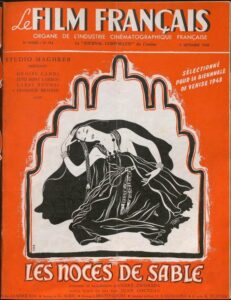
To understand this final act, one must go back slightly. In 1947, French director André (1910–1994) released *La Septième porte*, a film shot in Morocco in both Arabic and French versions. Critically praised, the film nonetheless failed commercially.
Undeterred, Zwobada pursued a more ambitious goal: making a film capable of appealing to audiences on both sides of the Mediterranean. He returned with a new project, Les Noces de sable (The Sand Wedding). Inspired by a Moroccan legend, the film tells the tragic love story of a prince and a caïd’s daughter, united only in death. From their graves spring waters that nourish the richest of palm groves.
Stripped of the cheap exoticism common in colonial cinema, the film sought realism. Zwobada enlisted photographer and anthropologist Jean Besancenot, while the cast reflected the Maghreb’s diversity: Tunisian actor Larbi Tounsi, Moroccan actress Itto Bent Lahcen, and Algerian actor Himoud Brahimi all appeared alongside French actress Denise Cardi, whose performance as a guedra dancer drew particular praise.
Finally, Les Noces de sable stood out for its minimalist narrative style. Almost entirely devoid of dialogue, it relied on voice-over narration that could be adapted according to the country of distribution, allowing Zwobada to avoid the politically sensitive issue of language. It was reportedly during the editing process in Paris that Zwobada met poet, painter, and filmmaker Jean Cocteau, who, impressed by the footage, offered to lend both his voice and his writing to the project.
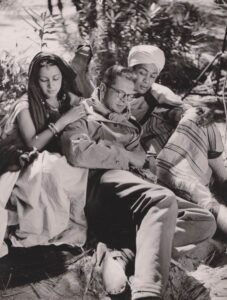
Initially rejected by the CCM, Les Noces de sable eventually found support through Studio Maghreb, which invested 40 million francs in the production (the entirety of the company’s capital) suggesting that Studio Maghreb may have been created specifically to finance the film. Filming began in January 1948 in the Tinmel region of the High Atlas, with Si El Kébir El Fassi, himself an Istiqlal member, serving as technical director.
Then came the breakthrough: in August 1948, Les Noces de sable was selected to represent Morocco at the Venice Film Festival. The selection alone was already a victory. But the film went further still, winning the Premio della Direzione Generale; which was described in the French language press as the “Medal of the Presidency of the Italian Council”. For Laghzaoui and Studio Maghreb, it was a sensation. Their names suddenly appeared across the French and Moroccan press.
It is likely that the film’s success in Venice strengthened Laghzaoui’s position and contributed to the eventual reopening of the Boujloud in October. At that point, it would have been difficult for the Residency to maintain a hard line against a nationalist entrepreneur returning from Venice with international acclaim. For the Residency itself, which had spent years attempting to promote a local film scene through the CCM, the success of Les Noces de sable was impossible to ignore. Resident General Juin did not hesitate to present the award as a colonial success story to his superiors.
Another indication of the connection between the two affairs came in autumn 1948, when negotiations supported by the Residency opened between Laghzaoui and French investors. On October 26, 1948, a memorandum of understanding was signed between André Zwobada, Mohamed Laghzaoui, French producer Guérin, and the National Bank for Commerce and Industry regarding film production in Morocco.
For the Residency, encouraging a local production industry had become more important than blocking nationalists from entering the distribution sector. But the truce was temporary. The battle over the Boujloud was merely postponed. Behind the scenes, the authorities continued devising strategies to weaken Laghzaoui and his associates. Without success. The Boujloud Cinema Company turned out to be profitable, the very scenario the Residency had feared. The theater had become both a nationalist gathering place and a potential source of funding for Istiqlal activities.
The same cannot be said for Studio Maghreb, whose success in Venice is not enough to guarantee profitability. According to Laghzaoui, *Les Noces de sable* was “sabotaged by the film authorities for political reasons, ” as stated in an undated letter from Laghzaoui to Zwobada [3]. The film was shown for only a few weeks in Paris and had a single screening in Morocco, in 1951 at the Cinéma Royal in Rabat, during a film club screening. Invited for the occasion, Zwobada, for his part, chose to blame the distributors and exhibitors who allegedly deemed his film too elitist.
Whatever the reasons, the film disappeared into obscurity. Never commercially distributed in Morocco, it is absent from the Moroccan Film Archive’s catalog and was not among the films returned to Morocco by France in early 2025. A visionary yet forgotten work, Les Noces de sable bears all the characteristics of a cursed film. Although it undoubtedly belongs to the tradition of colonial cinema, it also represents a singular attempt to create a film intended for Moroccan audiences. Researcher Abdelkader Benali describes it as “one of the first attempts at a truly Moroccan production” and evidence of a “clear intention (…) to create an indigenous cinema,” in Colonial Cinema in the Maghreb: The Colonial Imagination: A Trompe-l’œil (Cerf, 1998).
Yet film historians have generally favored Zwobada’s La Septième porte when discussing postwar Moroccan cinema natably the eponymous book by Ahmed Bouanani. As the first Moroccan financed film to win an award in Venice, however, Les Noces de sable deserves recognition as a milestone in the history of Moroccan cinema.
Written in French by Fançois Beaurain, edited in English by Amina Kadiri
Notes:
[1] Note on the Boujloud cinema in Fez issued by the Ministry of the Interior, September 27, 1948, CADN box 1MA/200/190.
[2] Memo addressed to Mr. Marcel Vallat, Director of the Interior, right-hand man of Resident-General Alphonse Juin. CADN box 1MA/200/190.
[3] Laghzaoui Collection.


