

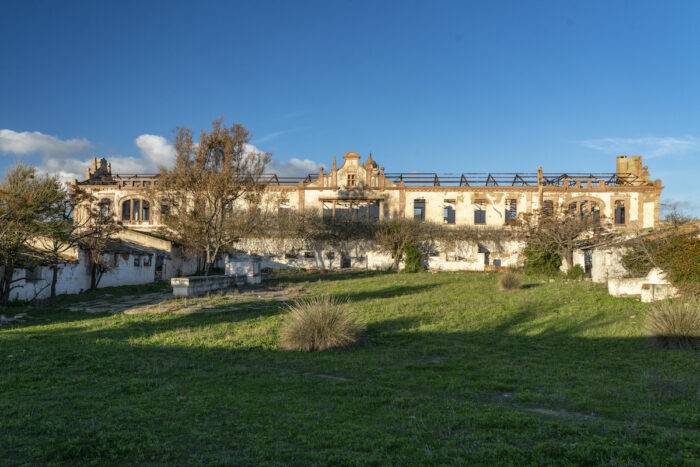
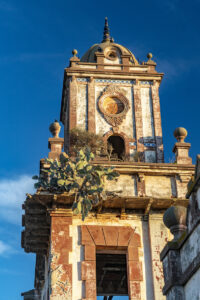
The road from Tetouan to Sebta is a long ribbon of asphalt lined with beaches and tourist resorts. In this seaside landscape, an anomaly catches the attentive driver’s eye. Driving toward Sebta, on the left at the entrance to Fnideq, stand a few ruins overlooked by a church. Welcome to Dar Riffien, a former Spanish garrison perched on a hilltop, which still seems to watch over the golden-sand beach located a few hundred meters below.
Dar Riffien holds a special place in the military heritage left by the Spanish in Morocco. More than just a garrison, it is a veritable small town whose history is linked to the Spanish Foreign Legion and its first commander, a certain Francisco Franco.
A Camp for Franco
It all began in the late 1910s. Returning from a stay in France and Algeria, the high-ranking officer José Millan-Astray dreamed of creating a Spanish version of the Foreign Legion. As the Spanish suffered setbacks on the Rif front, the idea of an “foreign” elite unit appealed to a command eager to limit Spanish casualties. The “Legion” (or “Tercio”) was thus established by royal decree on January 28, 1920.
Shortly after its creation, José Millán-Astray entrusted its command to Francisco Franco. Initially stationed in Sebta, the “Tercio” moved a few months later to a site near Castillejos (the Spanish name for Fnideq). Among the reasons cited for this move were the lack of space at the Sebta barracks, as well as the need to distance the legionnaires from the taverns and brothels where they had acquired a bad reputation.
It has not been possible to reconstruct the chronology of Dar Riffien’s construction, nor even to identify its architect—or, more likely, architects. According to historian Antonio Bravo, the only name we can be certain of is that of engineer Federico Martín de la Escalera. He is said to be responsible for a series of structures dating from 1923 to 1927, including the monumental entrance gate (now almost completely destroyed) where the morbid motto “Legionarios a luchar, legionarios a morir” was inscribed: Legionnaires to fight, legionnaires to die!
A veritable city
Franco was certainly not idle at Fnideq from 1920 to 1926. Under his leadership, the camp transformed into a city, and the Legion quickly forged a solid reputation as an elite force with iron discipline, though one that committed numerous atrocities. It was in 1921 that the Legion made history. While he was with his troops near Larache, Franco was summoned on an emergency basis to Melilla by Millán-Astray: the Spanish army was in disarray, and Abdelkrim El Khattabi was threatening the city following the disaster of the Battle of Anoual. Franco ordered a forced march and arrived in time to secure the defense of Melilla.
Then came the counteroffensive. Wounded in battle, Millán-Astray handed over command to Franco, who entered Nador and then Driouch as a victor. Crowned by his early successes, the future dictator made a name for himself in Spain and cemented his reputation. Grateful for the decisive role played by the Tercio during the Rif War, King Alfonso XIII and his wife traveled to Dar Riffien in 1927 to celebrate the victory.
With the end of the Rif War in 1926, the Legion’s story could have ended there, but that was without accounting for the Spanish Civil War. As tensions rose between Republicans and Royalists, Dar Riffien remained loyal to the Spanish throne. In 1931, following the proclamation of the Second Republic and the ousting of the monarchy, the legionnaires of Dar Riffien mutinied and raised the royalist flag. It took a regiment and several companies to bring the mutineers back into line.
But the Legion continued to distinguish itself, under the name Tercio de Marruecos (Moroccan Battalion): first in 1934 to quell the Asturian socialist revolution, then during the Civil War (1936–1939), where this corps formed the core of Franco’s African Army. The Legion then reached its peak (nine battalions in total).
On February 28, 1961, five years after Morocco’s independence, the Legion handed over the keys to Dar Riffien to the Royal Armed Forces. The camp has since been abandoned: its occupants have settled about a hundred meters higher up.
A train station, a library, and a farm
Dar Riffien stands out, however, for its architecture. It bears no resemblance to a military camp in the traditional sense: few elements betray its original purpose. Unfortified, the camp is a veritable self-sufficient town: the numerous buildings are arranged around a church. Equipped with running water and electricity, the town also has a train station, a library, and a farm that once housed“800 pigs, 550 sheep, 200 rabbits, 12 oxen, 165 goats, 500 chickens, 600 pigeons, and 145 ducks.” A true showcase for the Legion, it was frequently mentioned in articles of the time, which described it in glowing terms.
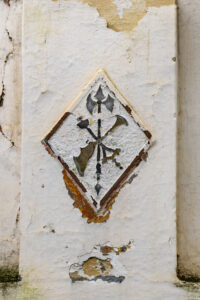
Today, nearly a century after its construction, the camp—abandoned and dilapidated—bears no trace of its past. Only a bas-relief depicting the Legion’s emblem—a cross-shaped crossbow, halberd, and musket—visible in the old stables, recalls the site’s original purpose.
Written in French by François Beaurain; edited in English by AngloMedia Group.


