

Morocco is not a country one spontaneously associates with destructive earthquakes. Yet its geography lies at the junction of active tectonic forces, where earthquakes—sometimes rare but violent—pose an ever-present threat. Between regular activity in the north and more sporadic but potentially devastating tremors in the Atlas Mountains, the kingdom is subject to seismic hazards that call for vigilance and prevention on the part of public authorities.
A Country at the Crossroads of Tectonic Plates
To understand earthquakes in Morocco, one must first look beneath the surface. The country lies near the boundary between the African and Eurasian plates, a complex contact zone where tectonic movements are both slow and continuous. This convergence, estimated at approximately 4 mm per year, generates stresses that result in deformations of the Earth’s crust and ultimately earthquakes as indicated in a scientific article published by geoscientist Dr. Antoine Poujol in the Journal of Geodynamics in 2014.

In the north, in the Rif region and the Alboran Sea, this plate boundary is diffuse but highly active. GPS data show that this region is moving southwestward at a speed of 3.5 to 4 mm per year, a sign of ongoing deformation, as indicated in another article published in the journal Earth and Planetary Science Letters. This dynamic explains the frequency of tremors in this area.
“When discussing the most vulnerable areas in Morocco, we must first clearly mention the north of the country, particularly the Rif, the Al Hoceima region, and more broadly the areas near the major active fault systems of the Rif domain,” explains Hamza Akka, a researcher in geology and seismotectonics. “This is a region that has already experienced significant events, notably on May 26, 1994, in Al Hoceima, and especially on February 24, 2004, in what experts describe as the most seismically active zone in Morocco. Research on the Pre-Rif and the Southern Rif Front also shows that this border region between Ouazzane, Fez, Meknes, and toward Rabat must not be overlooked in risk assessments,” adds Akka.
Further south, in the Atlas Mountains, the situation is different. Deformation rates there are lower, often less than 1 mm per year, according to a recent study published in 2026. But this apparent stability is deceptive as tectonic stresses are slowly building up there, potentially leading to rare but powerful earthquakes.“More broadly, we need to look at the entire Atlas axis, from the High Atlas to certain parts of the Middle Atlas, because recent scientific literature shows that the Atlas region is also a major seismic zone, even though it has long been less prominent in the collective consciousness than the Rif,” the researcher emphasizes.
The Rif, the epicenter of Moroccan seismic activity
Northern Morocco accounts for the bulk of seismic activity. The Rif, in particular, is considered the country’s most active region. This mountain range, an extension of the Betic-Rif arc connecting Morocco to Spain, is crisscrossed by a dense network of active faults.
Major structures such as the Nekor and Trougout faults play a key role in the release of tectonic stresses. Geomorphological and geophysical studies show that these faults are still active with measurable slip rates and regular seismic activity.
“When we look at the earthquake catalog for the past 30 years, we see an average of 15 to 20 low-magnitude tremors each week. This is both a good and a bad thing”
The Al Hoceima region illustrates this dynamic. It has experienced several major earthquakes in recent decades, notably in 1994 (magnitude 6), 2004 (6.4), and 2016 (6.5), generally at shallow depths between 10 and 20 km. These events, although moderate on a global scale, have caused significant damage due to their proximity to populated areas.
Scientists also point to the existence of seismic gaps—that is, fault segments that have not ruptured in a long time and could be the site of future earthquakes. This type of configuration increases the risk in certain areas of the Rif. “When we look at the earthquake catalog for the past 30 years, we see an average of 15 to 20 low-magnitude tremors each week. This is both a good and a bad thing. Because these small tremors allow tectonic stresses to relax and release. But this can also mean that tension is building up elsewhere, which could later result in a high-magnitude earthquake,” explains Akka.
The Atlas Mountains: Rare but Destructive Earthquakes
In contrast to the Rif, the Atlas mountain ranges (High Atlas, Middle Atlas, and Anti-Atlas) experience less frequent seismic activity. But when an earthquake does occur there, the consequences can be dramatic.
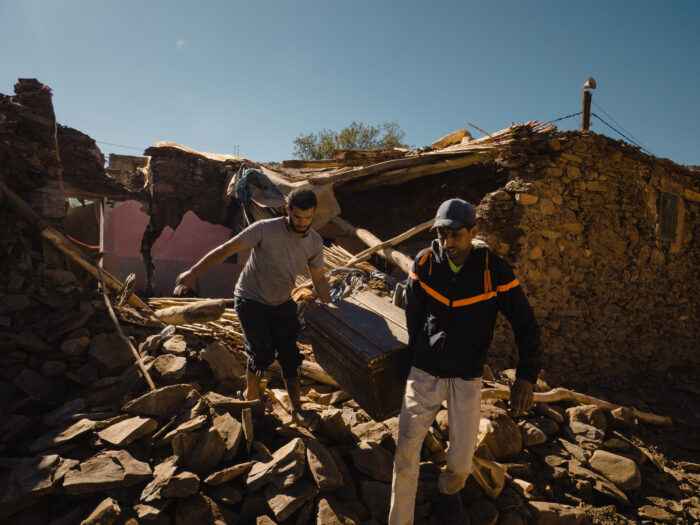
The 2023 Al Haouz earthquake, with a magnitude of 6.8, is a striking example. It occurred in an intracontinental zone, far from active plate boundaries, and was linked to a reverse fault buried deep within the thick crust. This type of earthquake, which is difficult to predict, serves as yet another reminder that low frequency does not necessarily mean the absence of danger.
Historically, the South has experienced several destructive events, including the 1960 Agadir earthquake (magnitude 5.9), which caused approximately 15,000 deaths. This tragedy remains one of the deadliest in the country’s history and has profoundly shaped perceptions of seismic risk.
“When an earthquake occurs, it is the vulnerability of buildings, the accessibility of affected areas, local preparedness, and crisis management that largely determine the scale of the disaster.”
These intraplate earthquakes are linked to the reactivation of ancient faults inherited from earlier geological periods, particularly those associated with the opening of the Atlantic. Their behavior is more difficult to model, which complicates risk assessment.
Hamza Akka explains: “The Al Haouz earthquake showed that we must remain very cautious given the complexity of active faults. Not all hazardous structures are necessarily clearly visible on the surface, nor is their exact behavior fully understood. This type of event serves as a reminder that a region can harbor significant active tectonics without this being immediately apparent to the general public.” He adds: “Al Haouz has highlighted something essential. Because beyond the fault itself, it is the vulnerability of buildings, the accessibility of affected areas, local preparedness, and crisis management that largely determine the scale of the disaster.”
A seismic history marked by major events
Morocco has a long seismic history, documented by both historical archives and geological studies. Several cities have been struck by earthquakes over the centuries.
In the 18th century, the 1755 Lisbon earthquake — one of the most powerful ever recorded in Europe (estimated magnitude of 8.5) — severely affected Morocco. Strong tremors were felt in Fez and Meknes, where a local earthquake, likely triggered in its wake, caused significant destruction.
“Historically, the city has already been struck by major earthquakes. On May 11, 1624, the Fez earthquake is described as one of the worst natural disasters in Morocco’s history. Then, the earthquake of November 27, 1755, often associated with the Meknes-Fez region, caused destructive effects in the region as well as along the pre-Rif ridges, confirming that this area is indeed one of the sectors to be taken seriously in a national risk assessment,” insists Akka.
Other notable events have been recorded, particularly in 1045, 1522, and 1755 in the Fez-Meknes region, with estimated magnitudes ranging from 5.8 to 6.5. These earthquakes demonstrate that seismic risk extends beyond the northern regions of the country. Hamza Akka points out that the structure of buildings and urban planning, particularly in historic centers that are often dilapidated, can exacerbate the devastating consequences of an earthquake striking the region.
More recently, in the 20th and 21st centuries, several earthquakes have left a lasting impression: Agadir in 1960, Al Hoceima in 1994 and 2004, and Al Haouz in 2023. All illustrate the diversity of seismic contexts in Morocco.
A risk unevenly distributed across the country
One of the defining features of seismic risk in Morocco is its highly varied nature. The country is not a homogeneous zone, and certain regions are significantly more exposed than others.
The north, particularly the Eastern Rif, is the most active zone. Conversely, the center and south exhibit lower, though still significant, activity. Seismic hazard maps clearly show this spatial gradient, with higher ground acceleration levels in the north and certain areas of the Atlas Mountains.
However, risk does not depend solely on hazard, that is, the probability of an earthquake. It also results from exposure (population density, urbanization) and vulnerability (quality of buildings, emergency preparedness). A moderate earthquake can thus have serious consequences in a densely populated or ill-prepared area. Conversely, an earthquake in a desert area poses no risk.
In any case, scientific data point to the conclusion that Morocco will remain exposed to earthquakes in the coming decades. The convergence of the African and Eurasian plates continues, and active faults continue to accumulate energy.
In the Rif, the frequency of earthquakes is expected to remain relatively high, with moderate-magnitude but potentially damaging events. In the Atlas Mountains, earthquakes will remain low, but the possibility of major events cannot be ruled out.
“We cannot predict an earthquake in the strict sense, that is, announce with certainty the exact location, exact time, and exact magnitude of a future event. Science cannot do that, neither in Morocco nor elsewhere”
Seismic hazard studies, whether probabilistic or deterministic, show that North Africa as a whole is a vulnerable region where earthquakes can cause significant human and economic losses. “We must be very clear on this: today, we cannot predict an earthquake in the strict sense—that is, announce with certainty the exact location, exact time, and exact magnitude of a future event. Science cannot do that, neither in Morocco nor elsewhere,” emphasizes Akka.
Faced with this reality, the challenge is not only scientific but also political and social. Risk reduction requires improving building codes, raising public awareness, and strengthening emergency response systems.
Between Vigilance and Education
Discussing earthquakes in Morocco requires a delicate balance. It is important to avoid both alarmism and minimization. The country is not constantly threatened by major earthquakes, but neither is it immune.
Hamza Akka remains confident, however, in the resources available to public authorities to mitigate the effects of a seismic disaster: “We have very important tools for monitoring, analyzing, and anticipating in the broadest sense: seismology, geodesy, the study of active faults, monitoring networks, satellite imagery, seismic catalogs, hazard maps, and damage scenarios. All of this allows us not to predict, but to better identify vulnerable areas, better understand the mechanisms at play, better track activity, and above all, better prepare for prevention and crisis management.”
Understanding the mechanisms at play, knowing the seismic history, and identifying risk zones are all essential elements for better preparedness. For while earthquakes cannot be prevented, their consequences can be mitigated.
“Risk culture must become a more prominent topic in our society. It should not emerge only after a tragedy, driven by emotion, and then gradually fade away”
“In my opinion, it is a mistake to believe that, since we cannot predict earthquakes precisely, there is nothing we can do. It is exactly the opposite: because we cannot predict them, we must invest more in prevention,” says Akka, adding: “Risk culture must become a much more prominent topic in our society. It should not emerge only after a tragedy, driven by emotion, and then gradually fade away. It must be integrated into schools, the media, communities, training programs, drills, public communication, and everyday life.”
In other words, “it’s not just about informing people of the existence of a risk, but about building a practical culture—what to do before, during, and after an earthquake, how to react, how to avoid rumors, how to protect the most vulnerable, and how to prepare schools and public buildings. For me, this is a major undertaking,” adds Akka.
Morocco is at the crossroads of two tectonic plates and illustrates a universal truth: the earth is in motion and it is up to humans to adapt to it. Hamza Akka ultimately advocates for convergence between scientific and decision-making circles: “We must strengthen the link between science and public policy. Morocco already has the knowledge, researchers, findings, maps, documents, and expertise. The real challenge is to better translate this knowledge into concrete action on the ground.”
Written in French by Amine Belghazi; edited in English by AngloMedia Group.


