

A few weeks out from the baccalaureate, family budgets are being put to the test. Between the unified regional exam scheduled for June 1 and 2, 2026 and the national exam set for June 4, 5, and 6, many parents describe unprecedented financial pressure tied to the proliferation, and above all the rising cost, of tutoring hours. An old phenomenon, but one that appears to have changed in scale, to the point of becoming, for some, an implicit condition of success.
A market in the grip of inflation
According to parents contacted by TelQuel, tutoring fees for group classes hover around 200 dirhams per month per subject, based on four sessions per month. A formula that appears accessible, but whose pedagogical effectiveness is increasingly being called into question. « The classes are often packed. In Casablanca, a French teacher organizes sessions at a training center with groups that can reach 100 students, » recounts one mother. She continues: « The session lasts almost two hours, but the environment is not at all conducive to learning. I enrolled my son, but in the end, he learns nothing. »
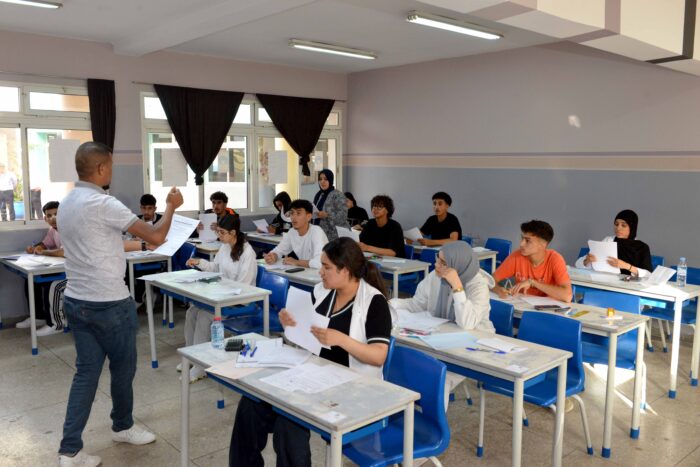
Faced with this reality, many parents are turning to more expensive formats, particularly individual lessons. This same mother explains that she ultimately opted for private sessions with the same teacher, billed at 400 dirhams each. Across all subjects covered by the first and second year baccalaureate exams, rates vary between 300 and over 500 dirhams for two hours of instruction.
In scientific subjects, demand is such that some parents speak of a genuine negotiation to secure a time slot. « Teachers are overbooked. You almost have to beg to find a spot, » confides one father. The result: as exams approach, the monthly bill can reach between 4,000 and 5,000 dirhams, on top of tuition fees at private institutions. « I’m a civil servant. Managing these additional expenses is becoming a real headache, » he adds.
Star teachers, rising rates
Social media now plays a determining role in shaping this parallel tutoring market. On Instagram, TikTok, and YouTube, some teachers have accumulated several thousand, or even tens of thousands, of followers. Explanatory videos, exam answer keys, methodological advice, and live sessions: these educational resources contribute to building genuine digital renown, which then translates into a commercial asset.
« We choose teachers almost the way you’d choose an influencer, » confides one mother, not without irony. « We look at their videos, their comments, their posted success rates. Then we try to book a spot, » she continues. In this context, reputation becomes a key factor in price-setting. The most followed teachers can thus afford to gradually raise their rates as demand intensifies.
Contacted on Instagram, a history and geography teacher explains that he offers several packages: 300 dirhams for a small group home session of five students, 500 dirhams for individual instruction, and 200 dirhams for online sessions with a larger number of participants. « Parents often prefer small groups to ensure better follow-up, even if it costs more, » he notes. A mathematics teacher, for his part, mentions rates of 400 dirhams for small groups, which can reach 600 dirhams for personalized instruction.
This logic of offer segmentation increasingly resembles that of a genuine educational services market. Some teachers offer « exam packs, » intensive programs spanning a few weeks, or even books compiling course summaries and corrected exercises. « You get the feeling you’re facing a structured commercial offer, complete with its promotions, waiting lists, and even its marketing strategies, » observes one parent.
From educational supplement to near-obligation
Beyond the question of pricing, it is the widespread recourse to these classes that raises eyebrows. « My daughter is brilliant, but I am obligated to find her teachers in every exam subject. It has become an obligation, » explains one mother. « With what she is taught in class, she cannot guarantee a good grade, » she continues.
“In our day, only struggling students attended evening classes, especially in science or foreign languages. Today, even a student who gets 18 out of 20 has to take tutoring sessions”
Some parents draw a contrast with their own schooling. « In our day, only struggling students attended evening classes, especially in science or foreign languages, » recalls one father. « Today, even a student who gets 18 out of 20 has to take tutoring sessions, including in Islamic education or history and geography, » he adds.
According to multiple accounts, this evolution is linked to a gradual inflation of baccalaureate averages and the increased selectivity of elite programs. « My eldest son achieved an average of 16. Despite that, he didn’t have many options for getting into grandes écoles or medical school, » recounts one parent. « Looking at the pre-selection lists, you quickly understand that there is grade inflation. I ultimately decided to send him to study in France. I don’t want to make the same mistake with my daughter, » she continues.
This pursuit of across-the-board excellence creates additional pressure on students. « When a young person chooses a scientific track, he cannot also be brilliant in every humanities subject. Otherwise, why impose a choice of path on him? » wonders another parent.
Suspicions of incentive-based practices
As accounts accumulate, a recurring criticism emerges: some teachers may be tempted to limit their in-class explanations to push students toward paid tutoring. « At school, students spend the session writing down the lesson without understanding anything, » claims one mother. « Teachers don’t always take the time to explain. Then they offer tutoring sessions to detail the method for answering exam questions, » she continues.
Another parent echoes this sentiment: « We are told that without following the recommended method to the letter, a student can lose points, even if he has mastered the subject. » For some, this standardization of answers raises broader questions about the quality of learning and students’ ability to develop critical thinking. « If a single method is imposed, it risks limiting the creativity and innovation of tomorrow’s leaders, » argues one father. This standardization of answers is gradually transforming academic assessment into an exercise in methodological conformity rather than a measure of real competencies.
Contacted by TelQuel, a French teacher who requested anonymity first calls for the debate to be put in context: « It is very difficult for us to cover the entire curriculum set by the ministry within the allotted hours, while also taking the time to explain each point in depth. »
He then points to what he considers structural constraints: « Beyond the density of the content, the ministry also imposes a fairly standardized response methodology for exams. This logic intensifies pressure on both students and teachers. »
He concludes that resorting to tutoring also comes down to individual choices: « Nothing prevents a teacher who has the time and energy from giving lessons in the evening or on weekends. It remains a choice, just as it is for higher education teachers who work at private universities or schools, or public doctors who practice at clinics. »
A new social divide?
“Imposing tutoring indirectly on students means creating a new social injustice. Everyone knows it, but no one seems to want to tackle the problem”
Behind these criticisms, the question of equity is surfacing. Widespread tutoring, sometimes provided without tax declarations according to some parents, would widen the gap between families able to absorb these expenses and those who cannot. « Imposing these tutoring sessions indirectly means creating a new social injustice, » laments one parent, noting that « everyone knows it, but no one seems to want to tackle the problem. »
Others see in this a form of tacit compromise that helps maintain relative social peace in the education sector, as strike movements have become rarer in recent years. « Before, only teachers of scientific subjects and foreign languages could realistically generate additional income through evening classes. Many others felt shortchanged, as their only resource was their salary. Today, with tutoring spreading to almost every subject, everyone has access to parents’ wallets. This inevitably helps ease tensions, » analyzes one parent.
A reading that, whether founded or not, illustrates the growing unease surrounding a system in which academic success now seems inseparable from substantial financial investment.
Written in French by Younes Saoury, edited in English by Eric Nielson


