

For me, and for Moroccans in general, this inscription means enormously. Honestly, I don’t understand why it took so long,” confides Zhor Raïs. For this haute couture caftan designer, who is celebrating 40 years of career this year, this recognition had been awaited for far too long.
She recalls the deep anchoring of the caftan in Moroccan society. “The caftan has existed for centuries: our grandmothers, our great-grandmothers, our kings, the entire royal court… everyone wore it, just like the djellaba or the gandoura,” she enumerates. “You only need to open a family album: all the women are in caftan. So truly, I don’t understand why the inscription took so long,” she continues.
But beyond the emotion, Zhor Raïs insists on what she believes is the very essence of the Moroccan caftan: its craftsmanship. “The DNA of the caftan is the mâalems and the mâalémates: those who do the akkad, the sfifa, the embroidery. They didn’t study, but they are true geniuses,” she says with admiration.
Artisans who create wonders
In her workshop in Casablanca, she invites us to closely observe the meticulousness of their work. “Look at the precision, the geometry, the patterns… the way they create embroidery and akkads,” she insists. This mastery, passed down from generation to generation outside any academic institution, is in her eyes the true treasure of the Moroccan caftan.
It is this same dimension that fueled her recent collaboration with Dalí Universe, on the occasion of her 40-year career, around a collection inspired by several sculptures by Salvador Dalí. A world first for a designer from the Arab-Muslim world. Dalí Universe brings together one of the largest private collections dedicated to the master of surrealism, including bronze sculptures, graphic works, furniture pieces, and even jewelry.
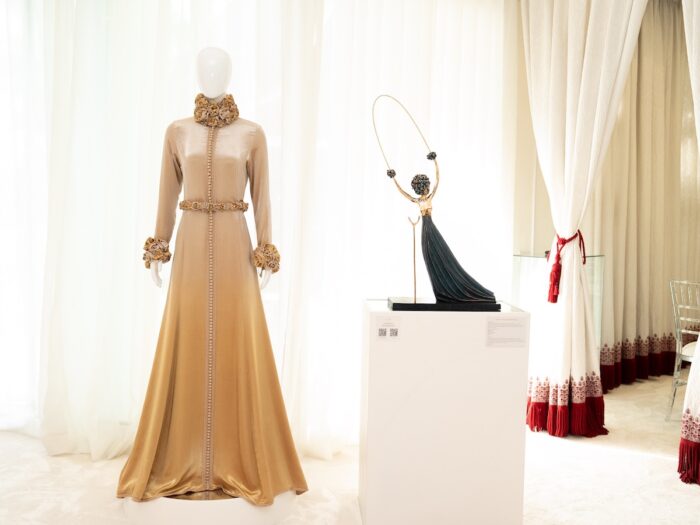
The designer even draws a parallel between the Catalan artist and her own artisans. “Why do I compare them to Dalí? Because he had the chance to study at the Fine Arts Academy. He created with his hands, but also with what he had learned. My artisans, meanwhile, have never been to school: they work with their hands and their minds, and yet they create wonders,” she says. Through this comparison, she highlights the intuitive, transmitted, and deeply inspired nature of Moroccan artisanal genius.
“Explain to me why this caftan wouldn’t have been accepted (by UNESCO, editor’s note)? It is 100% Moroccan, and no one in the world masters this know-how,” she declares with conviction. A statement that is anything but patriotic exaggeration, grounded instead in undeniable technical reality.
Techniques at risk of disappearing
It is precisely this technical specificity that makes the Moroccan caftan impossible to reproduce industrially. Zhor Raïs highlights what distinguishes artisanal work from mechanical production. “They can copy the embroidery, yes, even with new technologies, machines, software… They can make mechanical embroidery. But can they make the akkad? The majdoul? No. No machine can. These are techniques that rely on the human hand, and that are disappearing,” she warns.
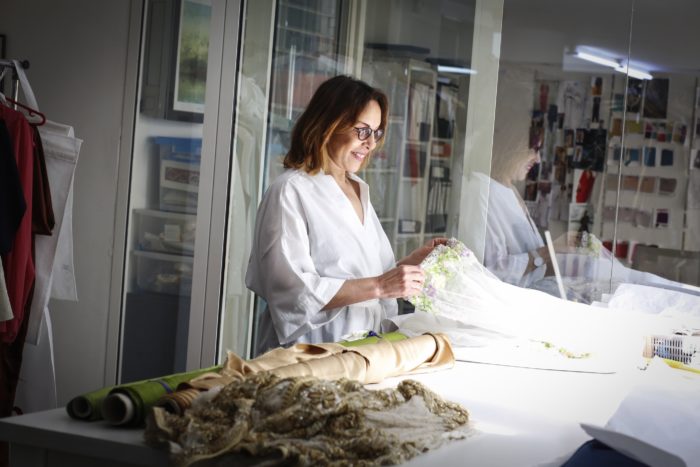
These ancestral techniques, transmitted orally and through practice in the workshops, constitute a living but fragile heritage. The akkad, the embroidered button that adorns the openings of the caftan, and the majdoul, that complex decorative braid, require dexterity and precision that only the human hand can achieve. Their creation can take hours, even days, depending on the complexity of the pattern. The sfifa, the braided trims that border the caftan, also requires know-how passed down from maâlem to apprentice.
But the designer points to a troubling paradox: while the caftan has just been recognized by UNESCO, the very skills that define it are threatened from within. “The problem is that today some artisans no longer want to work as before. And others become lazy because demand is high: they buy machines, produce computerized embroidery, then ask for the same prices as for a maâlem’s work. It’s not logical, it’s not normal,” she laments.
This drift reflects a growing tension between preserving artisanal excellence and the temptation of immediate profitability. A tension that the UNESCO inscription will need to help resolve, by revaluing authentic craftsmanship and establishing quality criteria that make it possible to distinguish it from industrial production.
Transmission as a priority
“The caftan is the soul of our craftsmanship, and seeing it officially inscribed confirms the richness of our heritage”
Fadila El Gadi, caftan designer and founder of the Salé Embroidery School, sees in this inscription far more than symbolic recognition. For her, it is a historic moment that pays tribute to generations of artisans who remained in the shadows. “It is an immense source of pride and a long-awaited recognition. It does justice to our history and especially to all the anonymous hands that embroidered and wove this heritage before us. The caftan is the soul of our craftsmanship, and seeing it officially inscribed confirms the richness of our heritage,” she says.
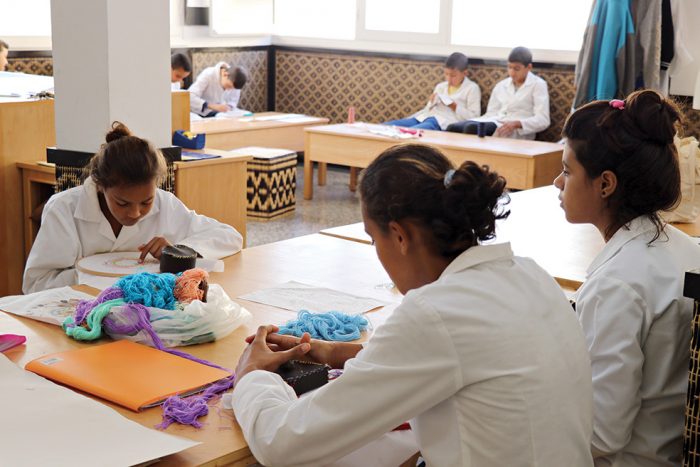
This international recognition comes at a crucial moment when the transmission of know-how has become a matter of survival for caftan craftsmanship. Fadila El Gadi is fully aware of this: “Such recognition brings new visibility not only to contemporary creation, but above all to the artistic trades that sustain that creation. It reminds us that the caftan is a craft of excellence that deserves to be protected, valued, and passed on.”
It is precisely this conviction that pushed her to create an embroidery school in Salé — an ambitious project aimed at preserving and transmitting these ancestral techniques to new generations. “In my case, it reinforces even more my conviction that these techniques must be preserved,” she explains.
Valuing the artisans
Ahmed Skounti, anthropologist and consultant to UNESCO, tempers the general enthusiasm by reminding people of the responsibilities that come with this inscription. “People are really happy. They are delighted with this inscription,” he observes, before adding: “It’s very good, but for us in Morocco, this is when the work begins. The inscription is the culmination of a process, it is not the final objective, it is not the end of the process itself.”
The anthropologist insists on a fundamental point: the true guardians of this heritage are neither institutions nor researchers. “It is neither the civil servants, nor the researchers, nor the civil society organizations. It is the artisans, the men and women. And I believe that now we must look at the social, economic, and symbolic status of the artisans who carry the caftan,” he stresses.
“Public policies must value the caftan artisans and guarantee them social rights so they can live with dignity”
Pour Ahmed Skounti, la reconnaissance internationale ne prend tout son sens que si elle s’accompagne de mesures concrètes en faveur des artisans. “La reconnaissance, c’est très bien, mais la reconnaissance de l’élément lui-même, sans la reconnaissance et la valorisation de ceux qui portent les savoirs et les savoir-faire, ça ne permet pas de répondre pleinement à toute la responsabilité qui se pose aujourd’hui pour le Maroc”, affirme-t-il. L’anthropologue appelle donc à une mobilisation des pouvoirs publics pour traduire cette inscription en politiques concrètes.”Il faut que les politiques publiques fassent en sorte que les gens qui travaillent dans ce domaine soient valorisés, bénéficient de leurs droits sociaux, de leurs droits matériels, pour vivre dignement de ce qu’ils font”, conclut-il.
This requirement lays the foundations for an ambitious program that should concern all the trades identified in the application file: establishing social coverage for weavers, pattern makers, button and sfifa makers, embroiderers; creating training centers to ensure transmission; economically valuing authentic artisanal work; combating the unfair competition of mechanized production passed off as craftsmanship; and above all, recognizing the central place of artisans in preserving this heritage.
Morocco now has an international label for its caftan, recognized as an “indispensable garment for occasions marking the life of Moroccans.” The challenge now is to transform this showcase into a true lever for development for the thousands of artisans who, in the shadows of their workshops, continue to embroider, weave, craft, and create a part of the country’s living history.
Written in French by Ghita Ismaili, edited in English by Eric Nielson


