

In the twilight of August 8, a wooden boat ran aground in a discreet cove in the Algarve, at Boca do Rio, in the municipality of Vila do Bispo in southern Portugal, depositing 38 people of Moroccan origin, including six minors and a baby. Their five-day journey at sea was costly: four people died.
The tragedy occurred just hours before Portugal’s Constitutional Court ruled that several measures recently adopted to reinforce anti-immigration policy were unconstitutional.
The event immediately gained momentum on social networks and reignited nationwide political discussions, fueling anti-immigration rhetoric among the far-right political class and on social media networks.
Yet the situation that unfolded on this Algarve beach is neither new nor isolated. Portugal and Morocco share a long history of migration. In the shadow of contemporary discourse, little-known historical episodes point to a reverse migratory movement.
When Portuguese ran aground in Morocco
During the first half of the 20th century, Portuguese left their coasts, notably from the Algarve, to try their luck in the south, heading for Morocco, then a French Protectorate. This happened under the dictatorship of the Estado Novo (New State), a right-wing corporatist regime established after the 1926 coup d’état that lasted from 1933 to 1974 and was led by Prime Minister António de Oliveira Salazar.
Period documents, newspaper articles and oral testimonies bear witness to these impromptu departures at sea, the shipwrecks that followed and the lengthy administrative procedures that followed.
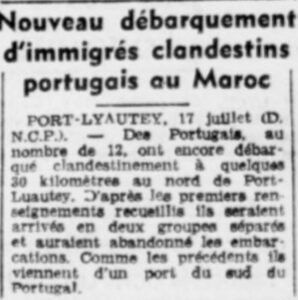
« In the 1950s, Portuguese people took old fishing boats, risked their lives and landed clandestinely on the shores of Port-Lyautey (Kénitra) or Rabat »
« From the same Algarve, it was the Portuguese who were emigrating clandestinely to Moroccom, » posted Portuguese historian Victor Pereira in reaction to the events of August 8 on Linkedin. « They took old fishing boats, risked their lives and landed clandestinely on the shores of Port-Lyautey (Kénitra) or Rabat. »
Pereira points out that these departures, far from being anecdotal, earned their perpetrators « frequent imprisonment in Morocco, and often imprisonment on their return to Portugal. » The Estado Novo regime criminalized clandestine emigration.
Pereira’s note immediately sets out a historical inversion: today’s cries of alarm find a counterpoint in a memory in which the Portuguese were, in turn, illegal emigrants and subjects of administrative repression.
Contacted by TelQuel, historian Farid Bahri places these phenomena in a broader, critical context. He first invites us to « put into perspective the scale of clandestine departures » of the Portuguese to the Maghreb in general: the major direction of Portuguese emigration was Latin America, led by Brazil, and on the African continent, Angola and Mozambique.
Nevertheless, Bahri does not minimize the existence of a flow which, between 1949 and 1953 in particular, i.e. shortly before Moroccan independence, saw « illegal immigrants arriving by the dozens on makeshift boats » along Morocco’s Atlantic coast.
Bahri’s explanation is based on a double logic, economic and political. Firstly, he notes the « quest for employment (mainly seasonal in agriculture) » and points to the vulnerability of the Algarve, « now a tourist region but extremely poor until the 1950s », which prompted many rural dwellers to try their luck.
Then he puts forward the political angle: under Salazar’s Estado Novo, the impoverishment of the peasantry was accompanied by a crackdown on all emigration deemed illegal, so it’s impossible to ignore that some departures may also have been the result of political opposition or exile.
A shared memory
Bahri nevertheless points to the lack of in-depth research on this subject: « no systemic, sociological, historical or demographic study has been carried out on this epiphenomenon. » In the absence of rigorous analysis, this dimension of transnational history remains essentially fragmented, perceptible mainly in the press of the colonial era and through journalistic « feuilletons » that have left their mark on the collective consciousness.

A case in point is the Mehdia shipwreck in August 1949, involving around thirty Portuguese migrants, including 6 children and 5 women. An event that left a lasting impression on the local population and colonial archives. In the same year, according to Bahri, a sensational alarm was called in Rabat when some forty migrants were intercepted in the middle of the countryside by the gendarmerie
The fate of these Portuguese between 1949 and 1953 also sheds light on the administrative machinery that would later be used in other contexts: at the time, any foreigner wishing to settle in Morocco had to present a certificate of accommodation and an employment contract to the French colonial authorities; illegal immigrants were « expelled by residential order » and, for many, deported to the Franco-Spanish border.
« Contrary to the epidermal reaction against a so-called invasion, carried by the Lusitanian far right, the tone in the protectorate press at the time was one of self-pity », explains Bahri.
« The Portuguese collective consciousness today also seems to overlook the transfer to Portugal of thousands of Moroccans, captured in the Atlantic plains and reduced to slavery from the 15th to the 18th century (see box below), to make this minor migratory episode (of Boca do Rio, editor’s note) into a storm in a glass of water, » said Bahri.
Moroccan slaves in Portugal
From the 15th century onwards, Portuguese expansion along the Moroccan coast was accompanied by intense capture and enslavement. As early as the capture of Sebta in 1415, military expeditions and raids from the strongholds of Tangier, Assilah, Safi and El Jadida brought back enslaved Moroccan prisoners to Portugal, where they were displayed on the markets of Lagos and Lisbon.
These captives made up an important part of the first contingents of slaves in the Lusitanian kingdom, before the Atlantic slave trade turned massively to sub-Saharan Africa. However, this practice was not unilateral: wars and maritime confrontations also saw many Portuguese fall into the hands of Moroccan dynasties, privateers from Salé or those from Tétouan, fuelling a system of captivity and reciprocal ransom that left a lasting mark on relations between the two shores.
[/frame]
Written in French by ElMehdi El Azhary; Edited in English by AngloMedia Group.


