

Nowadays, filling the fridge is a perilous budgetary ordeal. For the past three years, prices have been soaring on supermarket shelves and in small local shops. A phenomenon that has provoked indignation among Moroccan consumers. In a report just published, the Antitrust Council (Conseil de la Concurrence) has attempted to decipher this surge by tackling a complex and opaque subject: food distribution channels.
The Council’s opinion follows a self-referral dating back to January 2024. The aim: to identify the commercial practices and structural mechanisms that contribute to higher prices and unbalanced relations between producers, distributors and consumers.
A poorly organized key sector
The food retail sector weighs heavily in the national economy. It is the third-largest contributor to GDP and the country’s second-largest employer after agriculture. However, it suffers from fragmented governance, a fragmented legal framework, and a strong asymmetry between traditional and modern players. « The governance of the sector is marked by a multiplicity of players, penalizing the efficiency of its organization », notes the report, which cites a lack of coordination between ministries, local authorities and regulatory institutions.
Above all, despite the rise of supermarkets, traditional trade remains central to the distribution of food products in Morocco. It accounts for « nearly 80% of the sector’s sales and 99% of sales outlets« .
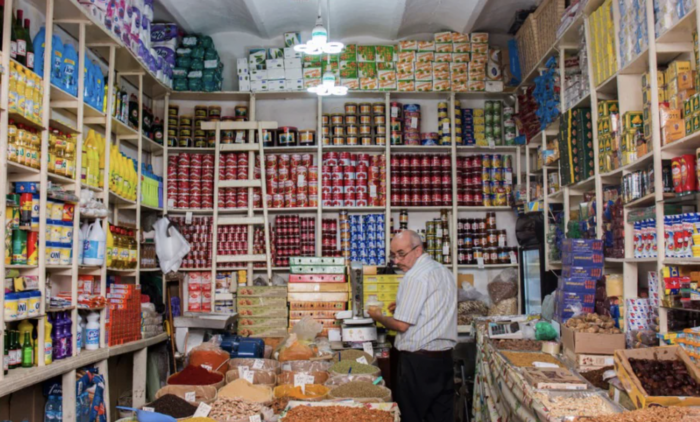
Retail is growing fast, but the market is oligopolistic: two groups alone control over 80% of the sector’s sales
This omnipresence is due not only to its flexibility and proximity, but also to its social function: « Grocers often offer easy payment terms, thanks to the famous free credit book« , emphasizes the Antitrust Council.
On the other hand, supermarkets are making rapid progress, but the market is oligopolistic: two groups alone control more than 80% of the sector’s sales.
Good margins
« Both distribution channels (traditional and modern) have passed on, overall, a higher increase in sales prices than the increase they have suffered on their purchase prices »
By analyzing three product families (dairy products, pasta and vegetable preserves), the Council notes a general increase in sales margins between 2021 and 2023. This increase is not due solely to higher raw material or transport costs. Of course, price increases and decreases by suppliers have an impact on selling prices.
However, the report points out that between 2021 and 2022, « players in both distribution channels (traditional and modern) have passed on, overall, with a few distinctive nuances, a higher increase in selling prices than the increase they suffered on their purchase prices, and similarly, a relatively smaller decrease between 2022 and 2023 than that applied by the various suppliers ». This will contribute to a significant rise in food prices.
In detail, the Antitrust Council’s investigation reveals the following figures: « The gross commercial margin in value at the level of the traditional circuit on dairy products increased by 10% between 2021 and 2022, and by 22% between 2022 and 2023. The increase was more sustained in the case of vegetable preserves (tomato paste and jam), with rises of 18% and 12% respectively. For the pasta and couscous (bulk) category, the gross margin rose by almost 20% in 2022 compared with 2021, before declining in 2023, although remaining above the level recorded in 2021 »
Back margin, the fatal weapon
In practice, supermarkets and hypermarkets use back margins. This is a kind of commission deducted from suppliers in exchange for services such as product promotion or listing.
This margin often represents a larger share than the front margin (the difference between the selling price and the purchase price). « Negotiations between suppliers and distributors progressively shift from the front to the back, in the form of off-invoice price reductions and commercial cooperation agreements, depending on the distributor’s purchasing power« , emphasizes the Council’s opinion.
This mechanism, which is not illegal per se, becomes problematic when it is imposed without justification, or used to squeeze out small competitors. The report warns: « Back margins can be exploited by large suppliers to drive out their competitors (…) who do not have the same financial capabilities. »
Large retailers rule the roost
The report also highlights tensions in commercial relations. Suppliers, especially small and medium-sized businesses, are suffering from excessive payment terms. In the modern circuit, the average payment term can vary between 50 and 73 days, depending on the brand, while the traditional circuit often pays in cash, or at very short notice.
This imbalance can be explained by the purchasing power of distributors, and the absence of a strict legal framework for certain practices. For example, a retailer can impose commercial cooperation services on its suppliers, such as financing a promotion or an event, without any guarantee of return on investment.
The Antitrust Council insists: « It’s not a question of prohibiting commercial cooperation, but of strictly regulating it ». It proposes to include « a clear definition of the notion of commercial cooperation in the Commercial Code. This definition will enable the players concerned to better comply with legal requirements, while facilitating controls and ensuring more effective and consistent regulation of the sector. »
Two-speed modernization
While mass retailing has established itself as a lever for structuring and competitiveness, traditional trade remains largely marginalized in public policies. The « Rawaj » strategy launched in the 2000s to modernize this segment has met with mixed results, involving just 22,500 shops.
Today, the Council is calling for a complete overhaul. In particular, it recommends supporting the digital integration of traditional retailers, creating regional logistics platforms, and setting up an economic intelligence system on prices and margins.
Above all, guaranteeing price and margin transparency is essential to restoring trust between the various players in the supply and distribution chain. Otherwise, grey areas fuel mistrust, and the absence of reliable data on prices and volumes prevents effective regulation of the sector.
« Available statistics remain fragmented, and do not cover all distribution channels. Even when such data do exist, they are often obsolete, based on earlier information, and remain poorly accessible to external parties, » laments the report. It adds: « This situation hinders the development of a coherent, up-to-date overview of the sector, thus limiting the ability of players to make informed decisions, and of potential investors to enter the market ».
In addition, the Antitrust Council stresses the importance of providing a better framework for commercial urban planning, to enable different types of business to flourish. Today, the establishment of superstores is hampered by the scarcity, cost and often unsuitability of land.
A call for proactive regulation
The Council’s report is not simply an observation, but a call to action. It outlines a new economic contract between producers, distributors and consumers. It also raises a central question: can we leave it to the market alone to regulate a sector as vital as food, especially in times of crisis?
The Council’s members answer in the negative. They call for unified governance, greater transparency and firmer control of distribution practices. Because behind every liter of milk or packet of pasta, economic, social and territorial balances are at stake. Balances that Morocco must protect. Or restore.


