

The Gibraltar agreement anticipates Sánchez’s plans for Ceuta and Melilla: co-sovereignty with Morocco, » asserts Alejandro Fernández, president of Catalonia’s Popular Party (PP), Spain’s main opposition party. According to Fernández, this scenario could even be presented as a « historic triumph« by the Socialist government. But what exactly is the situation? What is really at stake in this text, described by Madrid as « historic? »
Signed on June 11 in Brussels, the agreement was reached after several months of discussions between European Commissioner Maroš Šefčovič, Spanish Foreign Minister José Manuel Albares, his British counterpart David Lammy and Gibraltar’s Chief Minister, Fabian Picardo. At this stage, it is a « political agreement« defining the main principles of the future treaty between the European Union and the United Kingdom on Gibraltar, which remained outside the scope of the Brexit, reads the joint communiqué issued at the end of the meeting.
For « regional prosperity »
The stated aim is to guarantee « the future prosperity of the entire region« and economic stability in this area, where daily interactions between Gibraltar and Andalusia are intense. To this end, the agreement provides for the abolition of physical checks on people and goods at the border between Gibraltar and Spain
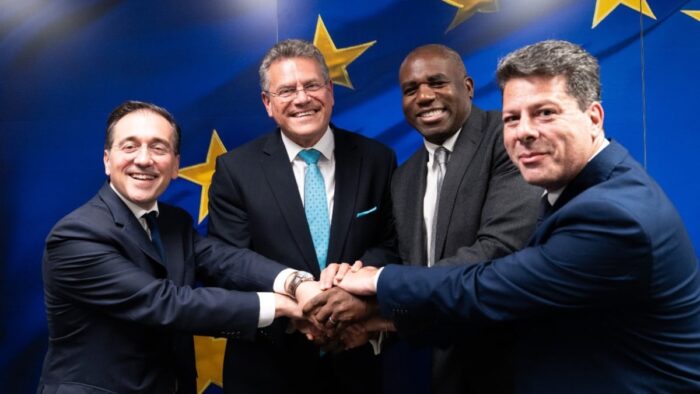
With regard to people, the parties have agreed to introduce double controls at the Gibraltar and Schengen borders at Gibraltar port and airport, in full cooperation between the EU and the British-Gibraltarian authorities. This control will be abolished at the crossing point between Gibraltar and La Linea for the thousands of people who cross every day in both directions. For the EU, all Schengen controls will be carried out by Spain. For the UK, full controls at Gibraltar will be maintained as at present.
On the trade front, the parties have agreed on principles aimed at establishing a specific customs union between Gibraltar and the EU. The agreement provides for close cooperation between the respective customs authorities and the abolition of controls on goods. Agreement has also been reached on the principles of indirect taxation to be applied in Gibraltar, notably on tobacco, in order to avoid distortions and contribute to the prosperity of the whole region.
In addition to customs and migration issues, the agreement also sets out commitments on state aid, the environment, taxation, social standards, the fight against money laundering, social security coordination and air transport. A regional cohesion fund will be set up to finance training and support employment in the area.
Questioning sovereignty
The joint communiqué does, however, make one important clarification: « This future agreement is without prejudice to the respective legal positions of Spain and the United Kingdom with regard to sovereignty and jurisdiction. » In other words, neither nation renounces its historic claim to Gibraltar.
Only 14 kilometers from the Moroccan coast at the southern tip of the Iberian Peninsula, Gibraltar occupies a highly strategic position at the junction of the Mediterranean and the Atlantic. This 6.8 km² territory has been attached to the United Kingdom since the 1713 Treaty of Utrecht which ended the War of the Spanish Succession. Madrid has never accepted this situation, which it regards as a persistent colonial anomaly in Europe. London, for its part, invokes the right to self-determination of the Gibraltarians, who have overwhelmingly expressed their desire to remain under British sovereignty in referendums (1967 and 2002).
In Spain, the sensitive issue of sovereignty immediately resurfaced in the political debate. In addition to Alejandro Fernández, who already sees this as a precedent for a possible sharing of sovereignty in Sebta and Melilia, the leader of the national PP, Alberto Núñez Feijóo, reiterated that his party would « continue to claim sovereignty over Gibraltar » and demanded that « any agreement must be submitted to parliament for scrutiny. » « The main opposition party should not learn about foreign policy decisions from the press », said Feijóo.
Vox, the Spanish Nationalist party, denounced what it called « a pact of shame« which, in its view, « perpetuates a colonial occupation« and constitutes a « betrayal. » Vox’s President, Santiago Abascal Conde, accuses the government of conspiring with London and describes Gibraltar as a « haven for illicit activities of all kinds. » Only the complete reintegration of the territory under Spanish sovereignty would be acceptable, according to Vox.
An « absurd« comparison
If, geographically speaking, Gibraltar’s situation is similar to that of Sebta and Melilia, where only fences mark the border, the comparison is much more delicate in terms of substance. In fact, this is the position defended by the president of Sebta, at odds with his party colleague Alejandro Fernández.
« It seems shameless and absurd to me to look for similarities between Gibraltar and Sebta »
Asked about the scope of the agreement signed on Gibraltar, Juan Vivas firmly rejected any attempt at assimilation: « The Sebta government has no knowledge of the agreement and therefore cannot comment on it. But what I would like to say, on behalf of the city’s government, is that it seems shameless and absurd to me to look for similarities between Gibraltar and Sebta. »
The man who has presided over the autonomous city since 2001 described those who defend this comparison as « radically mistaken », reaffirming Sebta’s legal and political position: « Sebta is not, has not been and never will be a colony. Sebta is undeniably part of Spain, is fully integrated into the European Union and has no tax haven. » Any parallel with the Rock is, in his view, « absolutely absurd, unfounded and meaningless ».
While the debate over Gibraltar divides the Spanish political class, the question of Sebta and Melilia remains a fundamental unresolved issue between Rabat and Madrid. Morocco still considers the two enclaves to be an integral part of its national territory, although this claim is rarely expressed publicly. Rabat generally favors diplomatic discretion on this sensitive issue, without abandoning its position of principle.
Recurring tensions
This Moroccan claim regularly resurfaces in diplomatic exchanges. On May 17, 2023, the Moroccan Ministry of Foreign Affairs sent a clarification to the European Commission, protesting against a dozen « hostile statements » made by the Greek Vice President in charge of immigration, Margaritis Schinas. Schinas had repeatedly asserted that Sebta and Melilia constitute « the border of Spain and the European Union ».
According to the Spanish daily El País, this Moroccan move had « particularly annoyed Madrid », as it violated the commitment of both governments to« avoid anything that offends the other party. » Pedro Sánchez reiterated this principle in his speech on February 2, 2024, at the opening of the 12th Moroccan-Spanish high-level meeting in Rabat, stating that the two countries had agreed to avoid anything that might offend their « spheres of sovereignty. »
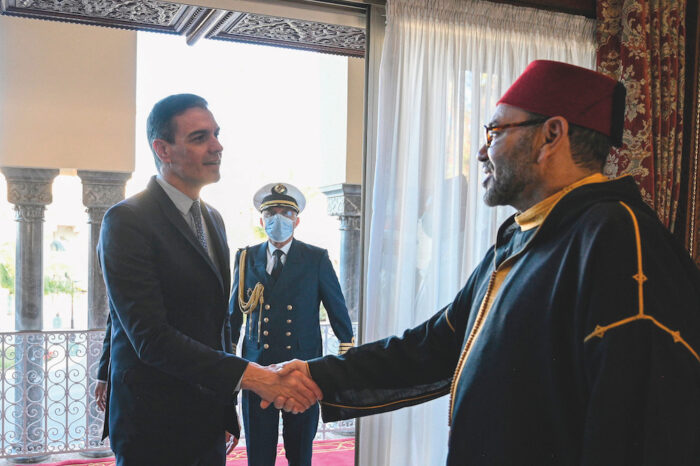
This diplomatic restraint is also evident in the public statements of officials from both countries. Asked in May 2023 by the EFE agency about accusations of electoral fraud in Melilia aimed at Morocco, Moroccan government spokesman Mustapha Baitas had ducked: « Spain is sovereign in this type of business.«
« The time will come«
On the Spanish side, Pedro Sánchez is taking a firm stance while avoiding provocation. On June 8, 2022, before the Spanish Senate, he stated that he had told King Mohammed VI that the Spanishness of the two enclaves « is not in doubt. » At a plenary session of Congress to take stock of relations with Morocco, he rejected the reference to the two enclaves as occupied territories, but carefully avoided arousing the ire of Moroccan authorities.
« The time will come for the matter of Sebta and Melilia, Moroccan territories like the Sahara »
Despite this diplomacy of restraint, certain statements occasionally remind us of the persistence of the dispute. In December 2020, the former head of the Moroccan government, Saâd-Eddine El Othmani, declared in an interview with the Acharq channel: « The time will come for the matter of Sebta and Melilia, Moroccan territories like the Sahara. » This prompted an immediate reaction from Madrid: Cristina Gallach, Spain’s Secretary of State for Foreign Affairs, urgently summoned Morocco’s ambassador, Karima Benyaich, to Spain.
These episodes illustrate the complexity of an issue in which both countries are trying to preserve their bilateral relations while maintaining their respective positions of principle. The agreement on Gibraltar, despite the speculation it has aroused, does not seem destined to upset this delicate balance between Rabat and Madrid.
Written in French by Ghita Ismaili; edited in English by AngloMedia Group


