

It is a few days before May 19. At the ONEE headquarters in Rabat, a flurry of officials—CEOs, ministers, diplomats, and heads of public institutions—are busy preparing for a meeting with strategic undertones.
Abdelmajid Iraqi Husseini, CEO of Taqa Morocco—the Moroccan subsidiary of the Emirati energy giant—is spotted among the attendees. Also present is Ayman Taud, head of Nareva, the energy arm of the royal holding Al Mada. Three ministers circle around them: Leila Benali for energy, Ahmed Bouari for agriculture, and Nizar Baraka for equipment and water.
The UAE ambassador, Alasri Saeed Ahmed Alshaheri, completes this high-profile cast, alongside Tariq Hamane, director general of ONEE; Nezha Hayat, the newly appointed president of the Mohammed VI Investment Fund; and Farid Saleh Farid Mohamed Al Awlaqi, chairman of the supervisory board of Taqa Morocco. This is no routine meeting. Its impact will become clear just a few days later.
On the morning of May 19, a press release from the Casablanca Stock Exchange announces the suspension of trading for Taqa Morocco. The stated reason: “pending major disclosures.” A terse phrase that sets the tone. Something significant is unfolding.
More than just a partnership, the deal aims to strengthen Morocco’s water and energy security
Around noon, the suspense ends. The announcement drops with a bang: a colossal partnership between Taqa Morocco, Nareva, the Mohammed VI Fund, and ONEE. Estimated value? Between 130 and 150 billion dirhams. A staggering figure that marks the largest private partnership agreement ever signed in the kingdom.
More than a partnership, the deal aims to bolster Morocco’s water and energy security. It also represents the culmination of a discreet diplomatic process, blending economic ambitions, political tensions, and royal arbitration. This is the story of the largest private partnership in the kingdom’s history.
Negotiations behind closed doors
To grasp the scale of this mega-deal, one must look back several years. Taqa Morocco, the subsidiary of the Emirati giant, has never hidden its appetite for expansion beyond its stronghold in Jorf Lasfar. Through its subsidiary JLEC, the company already supplies nearly one-third of the electricity consumed in the country, with 17% of installed capacity.
Taqa is already a key player in Morocco’s energy sector but clearly wants to go further: diversifying its operations, establishing itself in renewable energy, and capitalizing on its expertise in desalination—a field in which it has already proven itself through several projects in the United Arab Emirates. Through board meetings and press conferences, this ambition has been repeatedly emphasized by the company’s Moroccan leadership.
For a time, discussions opened around an alliance with the French group Engie, with whom Taqa already collaborates on projects in the Middle East.
Then a more direct strategy was adopted: entering major Moroccan infrastructure projects independently. Several energy-related projects were identified. It was in this context that high-level discussions began in the fourth quarter of 2023.
A state visit by King Mohammed VI to Abu Dhabi was on the horizon at the end of that year. It would be an opportunity to reaffirm the exceptional nature of the relationship between the two states and their respective royal families. Economic partnerships were expected to materialize that bond. Taqa’s projects were among them.
On the Moroccan side, the royal cabinet took the lead, focusing on state interests, sovereignty, and political considerations. Operational matters and financing were handled by Fouzi Lekjaâ, the delegate minister for the budget. Discreet and precise, he served as the government’s main point of contact for the project.
Nizar Baraka, minister of equipment and water, was brought into the loop when discussions expanded to include the management of the country’s water resources. Within Morocco, information circulated little. The circle remained tight. Other members of the government were not informed, in order to preserve the coherence of the negotiation.
On the Emirati side, one man was at the center of the decision: Mohamed Hassan Al Suwaidi. Minister of investment for the United Arab Emirates, chairman of the board of Taqa, CEO of ADQ—the Emirati sovereign wealth fund—and also chairman of Emirates Water & Electricity Company, he personifies Abu Dhabi’s strategic offensive. Al Suwaidi wields public investment tools as instruments of power.
On the operational front, Abdelmajid Iraqi Husseini, chairman of the management board of Taqa Morocco, took the lead. Once the projects were presented to Al Suwaidi and approved by the board of directors, he became the main point of contact for Moroccan partners for the next stages of discussion and negotiation.
“Hassan II built the dams. Mohammed VI will be the one to connect them,” confides a source close to the matter
Very quickly, the intentions become clear: to develop Morocco’s energy capacities—particularly wind and gas—and, above all, to structure the South–North electric corridor, a true energy highway linking Dakhla in the south to Casablanca in the center.
A 130 billion dirham partnership. Signed between Taqa and Nareva, it is the largest private deal in Morocco’s history. Its goal? To address the water crisis through massive desalination projects and the interconnection of water basins.
In this week’s feature report,… pic.twitter.com/oZMV1Rmphz
— TelQuel (@TelQuelOfficiel) May 26, 2025
But the project takes on a new dimension when, at the request of the Moroccan side—particularly the royal cabinet—the water component is added. Desalination projects are included, but more importantly, the long-discussed interconnection of dams through a “water highway” is revived. This project had been gathering dust in the equipment ministry’s files for decades. It was a project King Mohammed VI was determined to see brought to life. “Hassan II built the dams. Mohammed VI will be the one to connect them,” confides a source close to the matter. In December 2023, the bilateral initiative becomes a royal project.
Beneath Abu Dhabi’s chandeliers
On December 4, 2023, Mohammed VI is received with great pomp in Abu Dhabi. Qasr Al Watan, the presidential palace, sparkles with splendor. Escorted by a squadron of horsemen to the “Zayed” gate, the king is honored in accordance with the highest Emirati traditions.
In the central hall of the presidential palace, beneath a 37-meter-high dome, the Moroccan and Emirati national anthems echo. The massive chandelier adorned with 350,000 crystals seems almost to tremble. King Mohammed VI and Emirati President Mohammed bin Zayed then proceed together to the west wing, named “the spirit of collaboration.” A symbol in itself.
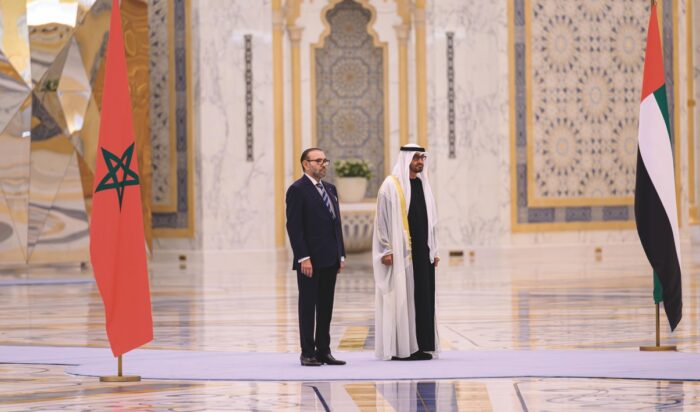
Several agreements are signed to strengthen Morocco’s energy and water infrastructure. Nizar Baraka signs the first agreement with Emirati energy minister Suhail Mohamed Al Mazroui, covering the joint construction of dams, desalination plants, and the interconnection of water basins.
A witness present in Abu Dhabi describes Mohammed VI as focused, deeply committed to seeing the agreements through, and “very pleased” with their realization
Leila Benali, in turn, signs a second agreement with Al Mazroui concerning the development of gas power plants. A third agreement focuses on modernizing the national electricity grid, including a high-voltage transmission line from the south to the north.
A witness on site describes Mohammed VI as focused, deeply committed to fulfilling the commitments, and “very pleased” with the implementation of the agreements.
Everything is ready for a launch in the first half of 2024. But during the early months of the year, a strategic challenge emerges: the project is technologically and financially dominated by the Emiratis.
To restore balance, the inclusion of a Moroccan player becomes necessary. That player is Nareva, the energy subsidiary of Al Mada. The choice is self-evident: “It was the only Moroccan actor credible at this scale. They know the terrain, the context, the constraints,” explains a source. Nareva is indeed the leading wind energy operator in Africa. It is also a 35% shareholder in the Safi coal-fired power plant, a $2.5 billion project developed alongside GDF Suez and Japan’s Mitsui.
During the first half of 2024, negotiations intensify. Ayman Taud for Nareva and Tariq Hamane for ONEE join the tight circle of stakeholders involved in the deal. Given the scale and strategic nature of the project, the senior leadership of the royal holding Al Mada is also involved. The discussions pick up pace: equity share, rate of return on investment (ROI), financing… Negotiations are progressing smoothly—until July 2024, when a judicial shockwave throws the entire process into disarray.
When the courts break the momentum
In the heart of summer 2024, the Casablanca Court of Appeal upholds a record judgment against Maroc Telecom—controlled by the Emirati group e& (formerly Etisalat)—in favor of Inwi: 6.3 billion dirhams for abuse of dominant market position.
In Abu Dhabi, the case is received very poorly. Jassem Mohamed Bu Ataba Alzaabi, chairman of e&’s board, criticizes a “difficult” regulatory environment. CEO Hatem Dowidar goes even further: “All options are on the table.” In diplomatic language, that’s a withdrawal threat. The Taqa–Nareva negotiations are frozen.
In Abu Dhabi, the judicial ruling is interpreted as a political signal. According to a source familiar with the bilateral talks, a dilemma emerges among Emirati leaders: “Either the ruling against Maroc Telecom is justified, meaning the company committed a real infraction. In that case—and given the severity of the violation and the size of the penalty—someone must be held responsible (namely the chairman of the board). Or the ruling is unfounded, which calls into question the impartiality of Morocco’s judiciary and jeopardizes all Emirati investments planned in the country.”
And as if that weren’t enough, the rift deepens in the fall. In October 2024, Morocco moves toward a strategic rapprochement with France. A “new chapter” opens in the Rabat–Paris relationship. Projects once expected to go to the Emiratis change hands. Among them: the Casablanca–Marrakech high-speed rail line, the subject of a memorandum signed in December 2023, which ultimately goes to Alstom. In Abu Dhabi, the decision is taken badly. By the end of 2024, everything seems blocked. But once again, an intervention by the king helps unlock the situation.
The royal comeback
In December 2024, Mohammed VI makes a private visit to the Emirates. On the sidelines of this visit, a closed-door meeting with Mohammed bin Zayed restarts the engine. Several messages are conveyed. The signal is clear: the deal must move forward. Negotiations resume—not only on the telecoms front but also on the expansion of energy and water capacity.
The intervention of Hicham Naciri, longtime lawyer for both the Al Mada holding and Taqa, helps reconcile viewpoints and finalize several agreements. In February 2025, Abdeslam Ahizoune, longtime chairman of Maroc Telecom’s management board, steps down. He is replaced by Mohamed Benchaâboun.
Inwi returns part of the fine—2 billion dirhams—that Maroc Telecom had been ordered to pay during the summer. The two operators even decide to join forces on a strategic project through the creation of joint subsidiaries to develop the kingdom’s telecom infrastructure: fiber optics, and the rollout of 4G and 5G networks.
The deal gradually takes shape. First, the equity stakes: 15% for the Mohammed VI Investment Fund, in coordination with other public entities, and the remaining 85% split equally between the two partners. Then the ROI: a closely guarded secret, though it is said to be “very favorable for ONEE” and therefore for the Moroccan state. Finally, the scope of the project: it includes the construction of several desalination plants with a combined capacity of 900 million m³, along with a major nationwide water interconnection program.
One of the key components is the doubling of interconnection capacity between the Sebou and Bouregreg basins. This system will allow water to be transferred from the surplus Sebou basin to the Bouregreg, which serves as a strategic hydraulic relay toward the Oum Errabia basin. Ultimately, this infrastructure aims to strengthen potable water supply in areas of central Morocco that are heavily affected by drought.
The project also includes the acquisition of the Tahaddart gas power plant (400 MW) and the addition of 1,100 MW in combined-cycle capacity. Two 1,500 MW HVDC (high-voltage direct current) lines will link the south to the center. Lastly, 1,200 MW of renewable electricity, generated by wind turbines, will be developed.
On May 19, 2025, everything is in place. The megadeal is announced via a press release from ONEE. No speeches, and few images from the signing ceremony.
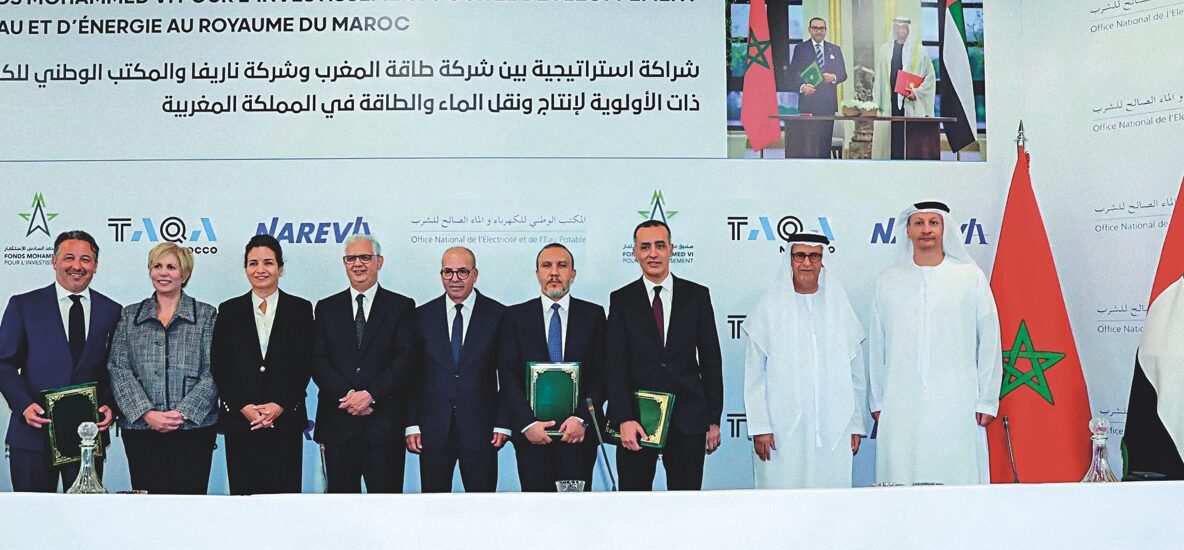
A deliberate sobriety that contrasts with the scale of what’s at stake. Despite the size of the project and its strategic importance, the head of government does not appear in the photo. Yet the governing coalition is evenly represented through Leila Benali (PAM), Nizar Baraka (Istiqlal), and Ahmed Bouari (RNI). Everyone has reason to celebrate.
The water component is slated for delivery by 2028. As for the electric highway, the target is 2030—even though some industry experts claim HVDC order books are filled through 2032. “The orders were prepared in advance,” confides a key player in the Moroccan–Emirati megadeal. On May 19, what was announced was far more than a contract. It marked another milestone in a partnership between two royal families who think in terms of decades. A megadeal—and perhaps the beginning of a new paradigm for private investment in Morocco.
Following the publication of this article, TelQuel was contacted by the management of Green of Africa, who stated that the future desalination plant in Casablanca “does not receive any subsidies” and that the consortium plans to sell the desalinated water at under 4.50 dirhams per cubic meter.
Written in French by Yassine Majdi, edited in English by Eric Nielson


