

On the road to Saïdia, roof tiles are piling up at the base of the building. Built in 1930 — or 1925, according to some sources — during the French Protectorate, the former Beni Snassen wine cooperative (Vinicoop) may not live to see its centennial.
Abandoned for years, the building is gradually being dismantled. The metal components are disappearing one by one, while the famous Marseille roof tiles covering the roofs are being looted to be resold.
For local heritage advocates, an entire chapter of Berkane’s history is being erased. They are trying to save what they consider one of the last remaining reminders of the agricultural and industrial history of the Oriental region.
When Berkane supplied the mainland
The history of this winery is closely linked to Berkane’s agricultural development during the first half of the 20th century. With the expansion of irrigated areas and investments in water infrastructure, the region gradually became a major wine-producing region.
At that time, the winery operated as a cooperative bringing together French settlers, Moroccan landowners, and members of the Jewish community living in the region. After independence, the complex continued its operations under the management of public agencies, notably the Agricultural Development Company (SODEA) and later the Agricultural Land Management Company (SOGETA).
For several decades, the grapes produced in the Beni Snassen vineyards supplied one of the kingdom’s largest winemaking facilities. According to activist Najib Bachiri, president of the “Man and Environment” association, which is active in the province of Berkane, the 1970s were the golden age of this industry. “At that time, we had reached our peak production level, just as post-independence Algeria was beginning to uproot its vineyards and scale back its operations. Berkane then took the lead to become the continent’s top producer,” Bachiri says.
The winery’s operations finally ceased in the late 1980s. The facilities were gradually abandoned, and only a few caretakers remained on site before the place was finally consigned to oblivion.
The winery dismantled piece by piece
Nearly a century after its construction, the winery still retains many of its original features. But this heritage is now disappearing before the eyes of those who are still trying to preserve it.
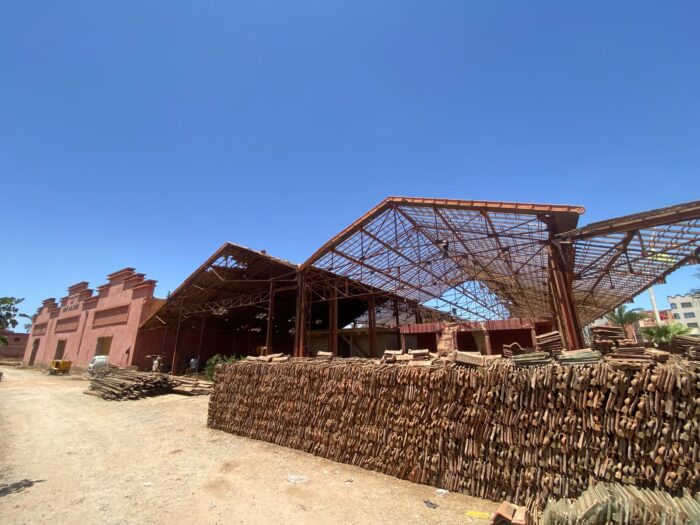
On site, dismantling of the roof has already begun. Several rows of tiles have been removed and stacked near the first building, leaving only the metal framework exposed. According to information gathered on site, the order to proceed with the demolition of the complex was given about a month ago, raising fears of its imminent disappearance.
The stacked tiles bear witness to a part of the site’s history. Manufactured in Marseille by Roux Frères, one of the major tile factories in the Saint-Henri neighborhood in northern Marseille, the tiles still bear the inscriptions “Brevetés S.G.D.G.,” “Henry-Marseille,” and “Roux-Frères.”
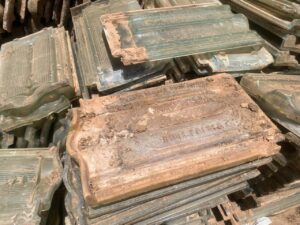
These machine-made terracotta tiles, produced between the late 19th and early 20th centuries, were widely exported to Morocco during the protectorate to cover administrative, industrial, and agricultural buildings. Their presence on the Beni Snassen cellar thus attests to the importance of the trade links that connected Marseille to eastern Morocco at the time.
The marking “S.G.D.G.,” standing for “Sans garantie du gouvernement” (No government guarantee), was a legal notation established by the French Patent Act of 1844 and abolished in 1968. These tiles have become historical records: they make it possible to date the building and identify the origin of the materials used in its construction.
The facades, meanwhile, bear other traces: religious symbols engraved into the structures—including crosses—inherited from the colonial period. For Najib Bachiri, these marks should not be viewed as remnants of colonial rule, but as testimonies to an era that is now part of the history of Morocco and the region.
“I don’t understand this desire on the part of certain officials to erase everything connected to our history under the pretext that it dates back to the colonial era. Destroying these buildings means destroying a part of our identity”
“I don’t understand this desire on the part of certain officials to erase everything connected to our history under the pretext that it dates back to the colonial era. Destroying these buildings is destroying a part of our identity,” the activist protests.
The looting is systematic: according to various accounts, materials are regularly stolen. But not everything has been stolen. According to Najib Bachiri, the site’s equipment and materials were auctioned off in late 2025 for approximately 1.5 million dirhams. However, “most of these items are over a century old. This is irreplaceable material that is no longer manufactured today,” laments the activist. “Seeing this heritage sold off at auction for a pittance is a true tragedy for the city’s memory, an irreversible loss for Berkane’s architectural history, ” he adds.
A preservation application stuck in Limbo
Faced with the risk of the building’s disappearance, the Académie du Patrimoine association has initiated an official procedure to protect the old cellar from demolition. On September 10, 2025, it filed an application with the Cultural Heritage Directorate requesting that the building be listed to ensure its legal protection.
In a press release issued on July 3, members of the association expressed concern over the alterations that are already damaging the cellar’s original architectural features. Once the listing is published in the Official Gazette, any demolition or alteration would make those responsible liable.
Many other sites, symbols of the region’s historical and cultural heritage, are also falling into disrepair. As such, the Heritage Academy is also campaigning for the listing of the former Tafoughalt barracks, the church in Saïdia, the Niora factory, the Berkane synagogue, the Sidi Mhand Aberkane mausoleum, and the Abi El Khair high school.
Turning a derelict site into a museum?
For Najib Bachiri, saving the cellar doesn’t just mean preventing its destruction. It also means giving it a new purpose. The community activist envisions, for example, a large museum dedicated to the agricultural history of the Oriental region, where the skills that have shaped Berkane’s economic identity would be showcased.
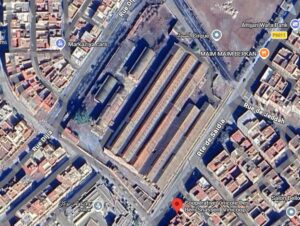
“Why not turn this place into an agricultural museum? In Barcelona, Madrid, or Paris, most tourists come for the history and culture. This site could also become a sales and exhibition space for our local products, such as honey or citrus fruits, thereby creating a link between heritage, economic development and tourist appeal,” suggests the activist.
Other advantages support this conversion. The site is located on a road that is very busy in the summer and benefits from a particularly favorable setting, surrounded by citrus groves and century-old olive trees planted during the colonial era. “If nothing is done, this heritage risks disappearing forever, stripping the city of Berkane of its soul and identity,” says Najib Bachiri.
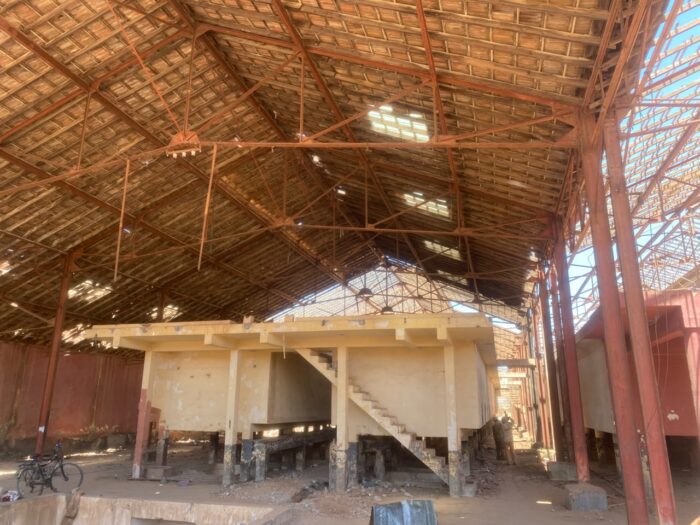
To date, the property remains part of the state’s private domain. The president of the Berkane Municipal Council, Mohamed Ibrahimi (PAM), explained that “once the property is transferred to the municipality, we will decide on the most appropriate use for it.” No mention was made about the ongoing demolition order. Time, however, continues to work against this remnant of Berkane’s industrial history.
Written in French by Amine Belghazi, edited in English by AngloMedia Group.


