

After the Turkish (BIM) and Egyptian (Kazyon) discount giants, it’s now the turn of local French retail brands to try their luck in Morocco’s retail market. Sixteen years after the failure of Hanouty Shop, his first attempt at retail, Moncef Belkhayat is making a major comeback in the sector.
On May 26, his group, H&S Invest Holding, signed a strategic partnership with the French company Casino, becoming the master franchisee (thus granting exclusive rights) of Monoprix and Franprix brands in Morocco. At stake: 210 stores scheduled to open within the next ten years, over 1,000 announced jobs, and a market position emphasizing “quality” and “proximity.”
A cake to share
This announcement shakes up an already-booming market, with competition among major industry names—Marjane, Carrefour, BIM, and Kazyon—continuously intensifying, driven by urbanization and evolving consumer habits. The once-dominant model of suburban hypermarkets is gradually giving way to compact store formats, designed for more frequent shopping at more affordable prices.
« What really works is anything related to essentials. Food products, proximity, quick formats… that’s where people keep spending, despite the inflationary crisis of recent years. By comparison, other segments hover around 1.5% to 3% growth, barely recovering from losses sustained over the past three years, » notes a member of the Moroccan Federation of Retail Commerce (FMCR).
This shift in consumer behavior is redefining priorities for all retail brands. The key challenge is no longer merely opening stores but placing them in the right locations, with the right offerings, at the right price. « In the past, people would do their major monthly shopping in a hypermarket. Today, they stop by the neighborhood supermarket every couple of days. It’s more spontaneous, more fragmented, and it completely changes the way brands need to think about their locations, » our source continues.
This change in habits becomes particularly meaningful in a market still heavily dominated by informal commerce. According to analysts at Attijari Global Research, traditional retail—primarily neighborhood grocery stores—still captures over 80% of market share, indicating significant potential for structured growth benefiting modern retailers. At this rate, the retail sector could achieve an average annual growth rate of 5.6% between 2023 and 2028 (still according to Attijari Global Research), driven by the rise of convenience formats and the growing influence of urban discount stores.
Cairo’s offensive
Among the new players betting on this potential, Kazyon has emerged as one of the market’s most aggressive competitors. Within a single year, the Egyptian brand has opened 120 stores across the Kingdom, averaging one new opening every 12 days. And the expansion is just getting started: 150 additional outlets are planned for 2025.
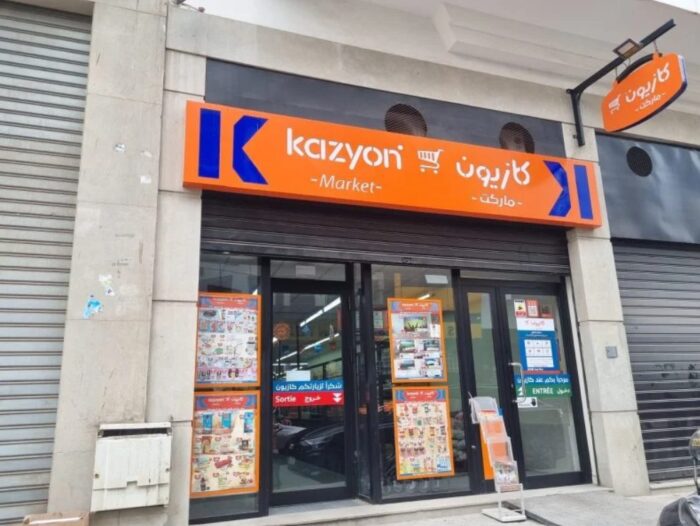
Its network stretches from Tangier to El Jadida, with a strong presence along the Mohammedia–Casablanca corridor, and locations in cities such as Kenitra, Salé, Rabat, Azemmour, Settat, and Berrechid. The entire operation is organized around its logistics platform in Mohammedia, designed to ensure rapid and cost-effective restocking.
This accelerated rollout is also supported by substantial financial resources. In March 2025, Kazyon Morocco secured $30 million (around 300 million dirhams) in funding from the International Finance Corporation (IFC), a subsidiary of the World Bank, to back its expansion plans.
The concept? Neighborhood hard-discounting: compact stores, a product range focused on essential items, 100% local sourcing, and an aggressive pricing policy. It’s a positioning tailor-made for densely populated urban areas and middle-class consumers struggling with purchasing power. According to the brand, its business model can offer an average shopping basket priced 30% lower than traditional supermarkets.
The plan is led by Mohamed Benmezouara, current CEO of Kazyon Morocco, who is no newcomer to the sector. Before taking the helm of the Egyptian brand, he oversaw the entry of the Turkish discounter BIM into the Kingdom and managed its operations for over a decade.
The Turkish counter-attack
Facing the offensive led by its former executive, BIM is determined to defend its position. After surpassing 800 stores in Morocco, the Turkish retailer announced last November an investment of one billion dirhams (approximately 96.7 million euros) over three years to strengthen its presence. A cornerstone of this expansion plan: a new logistics platform in Marrakech, operational at the time of the investment announcement. The stated goal: enhancing logistics, supporting the opening of new stores, and reaching 6,000 jobs by the end of 2025.
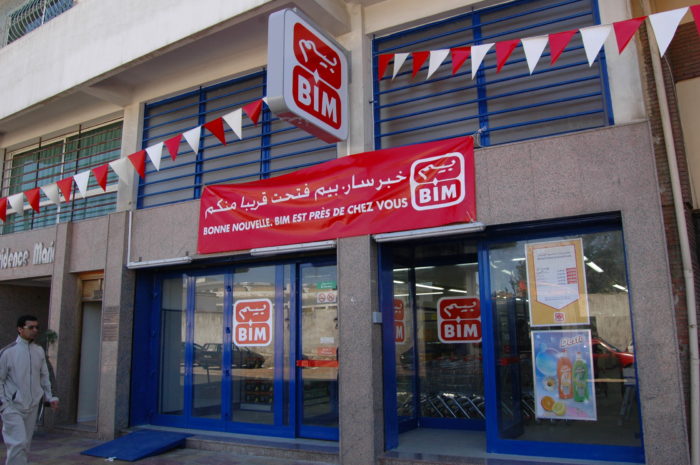
But behind this expansion effort lies another strategic challenge: local sourcing. Long accused by domestic producers of dumping and unfair competition, the brand was pressured into rethinking its business model. Under pressure from the Ministry of Industry, then led by Moulay Hafid Elalamy, BIM was required to thoroughly revamp its supply chain, aiming to raise the share of local sourcing to 80% for its private-label food products and up to 90% for textile products.
Marjane gets back in the race
Faced with the dual Turkish and Egyptian offensive, established players have no intention of remaining on the sidelines—starting with Marjane Group, a subsidiary of the royal holding company Al Mada, present in the Moroccan market since 1990. The group operates through its brands Marjane (hypermarkets), Marjane Market (supermarkets, formerly Acima), and Electroplanet (home appliances), which together generate annual revenues exceeding 11 billion dirhams.
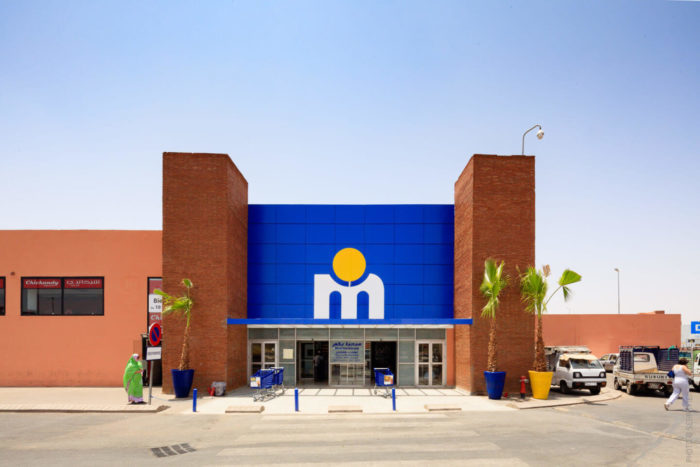
In recent years, the group has embarked on a significant strategic shift to modernize its offerings and enhance competitiveness. Through the expansion of Marjane Market, Marjane is gradually moving away from the hypermarket model in favor of smaller formats, better suited to new consumer habits.
At the end of 2023, it reached a new milestone with the launch of Marjane City, a network of neighborhood convenience stores. These stores, each about 300 m², aim to meet growing demand for “quick shopping, with a wide selection of products and an optimized customer experience.”
After a pilot phase in Rabat and Casablanca (six stores opened), the group plans to open between 40 and 45 stores annually in various cities throughout the Kingdom. Unlike BIM and Kazyon, which rely heavily on very low prices and predominantly grocery-focused product lines, Marjane City emphasizes fresh products—fruits, vegetables, meats—leveraging its own supply network known as “filière M.” This positioning allows Marjane to avoid direct competition with neighborhood grocery stores, while firmly establishing itself in the convenience segment.
LabelVie shifts into high gear
Another heavyweight in the sector, LabelVie continues to strengthen its position in the Moroccan market. In 2024, the group, listed on the Casablanca Stock Exchange, reached a new milestone by achieving record revenues of 16 billion dirhams, driven by the momentum of its brands Carrefour, Carrefour Market, and Atacadao. Building on this performance, the retailer announced a strategic plan for the 2024–2028 period, focusing on expanding its nationwide network.
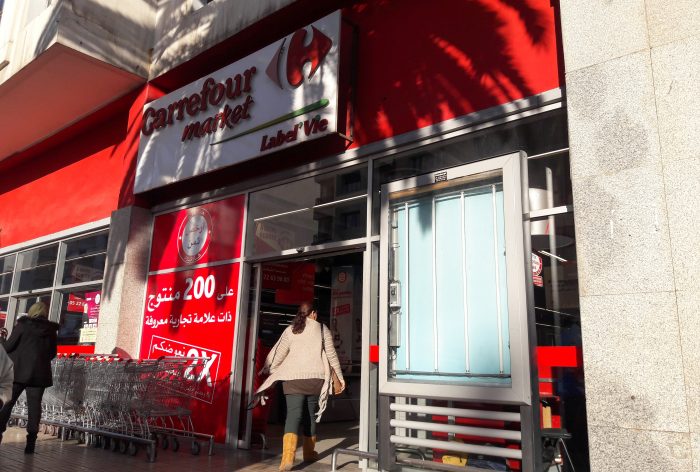
The stated goal is to grow from 270 retail locations to 953 stores within five years, emphasizing, like its competitors, convenience-store formats, which align closely with changing consumer behaviors. To achieve this, the group plans to open an average of 150 new stores per year. Development will target both major cities and smaller towns, where informal commerce remains dominant.
This expansion plan is accompanied by an investment program exceeding 7 billion dirhams, representing about 7.7% of anticipated annual revenue. According to management, this amount will be largely funded through internal resources to maintain financial stability and minimize reliance on debt.
Beyond borders
With the entry of new players and accelerated expansion plans from existing competitors, Morocco’s retail market has entered an unprecedented phase of competition. Convenience formats, regional logistics, local sourcing, competitive pricing—the race is underway, and each brand is refining its strategies to establish dominance, gain ground, and meet increasingly fragmented and demanding consumer expectations.
But the real challenge goes beyond simply gaining market share: it’s about establishing a business model capable of sustainably structuring a sector still dominated by informal commerce. In this race, the ability to balance profitability, accessibility, and local roots will make all the difference.
Beyond the local market, Morocco has also become a testing ground for the regional ambitions of international groups. For Casino, Kazyon, or BIM, successfully appealing to Moroccan consumers means validating a model that can be exported to other African markets. Within this dynamic, nothing prevents Moroccan players themselves—starting with Marjane, LabelVie, or H&S Invest—from eventually looking beyond their borders and considering their own continental expansion.
The Moroccan retail market is entering a new era. Shaken by the offensive from Turkish and Egyptian discounters, energized by the counterattack from established players, it now welcomes two major new contenders: Monoprix and Franprix. Enough to… pic.twitter.com/dAe1auJ1Rr
— TelQuel (@TelQuelOfficiel) May 30, 2025
The five big names in large-scale retail in Morocco
Marjane Group (Marjane, Marjane Market, Marjane City, Electroplanet)
- Around 150 stores in 30 cities
- New brand: Marjane City (goal: 40 to 45 openings per year)
- Over 11 billion dirhams in revenue
LabelVie (Carrefour, Carrefour Market, Atacadao)
- 270 stores in 2024
- Goal: 683 additional openings by 2028 (for a total of 953 locations)
- 2023–2028 investment plan: over 7 billion dirhams
- 16 billion dirhams in revenue in 2024
BIM Maroc
- More than 800 stores
- 2024–2027 investment plan: 1 billion dirhams
Kazyon Maroc
- 120 stores in 2024
- 2025 goal: 150 new points of sale
- Funding secured: 300 million dirhams (from the IFC)
H&S Invest Holding (Monoprix, Franprix)
- Launch planned for 2025
- Goal: 210 stores to open over 10 years
Written in French by Safae Hadri, edited in English by Eric Nielson


