

The big bosses are wavering between a wait-and-see approach and fear. Fear of what? « Of reprisals, » says a local industrialist, who insists on remaining anonymous. The head of government is said to hold a tenacious grudge and to be pulling out all the stops to silence any criticism levelled at him.
Our interlocutor tells us that, in the business world, whatever their size, companies sooner or later come up against « administrative obstacles » that require intervention to get things moving. To find oneself in the government’s crosshairs would considerably reduce the chances of finding a favorable outcome. Notwithstanding this, the Moroccan employers’ association remains silent, waiting for better days to come.
What about the CGEM?
Chakib Alj, President of the General Confederation of Moroccan Enterprises , was already voicing criticism of the Executive at a press conference in December 2023. He pointed the finger at the « slowness of reforms« , felt that the draft finance law sent « a mixed message to the business world » and called into question « investment decisions and intentions. »
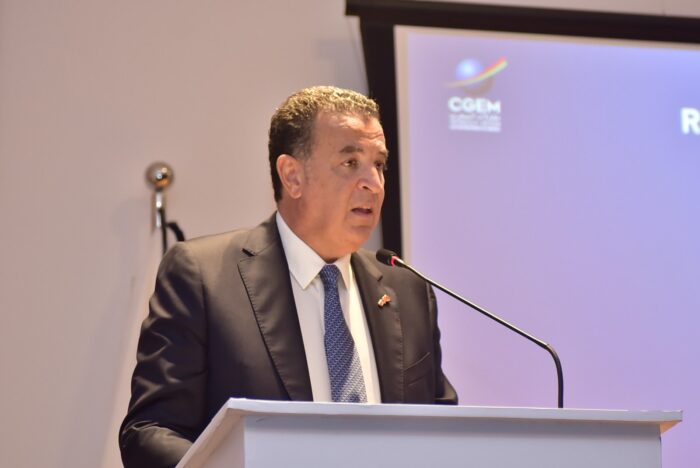
Some saw it as an act of ingratitude towards a head of government who had supported his candidacy for the presidency of the CGEM, and it also earned him a scathing response: « How can we talk about slowness when the investment budget, despite all these constraints, has increased to 350 billion dirhams?« , Aziz Akhannouch said in a speech to Parliament. « Where we may have been slow was in not raising the price of electricity to businesses! » he added.
« A form of fear has set in, as if criticizing has become difficult, even risky »
But is this an unprecedented sequence? Of an employer caught in the yoke of a government majority impervious to any form of disagreement? « It’s perfectly legitimate to express criticism, because the government is the emanation of an electoral choice, a power born of the ballot box« , explains economist Abdelghani Youmni to TelQuel. « A form of fear has taken hold, as if criticizing has become difficult, even risky, » said Youmni. « We sometimes get the feeling that there are two superimposed levels of power, which is worrying in a country that is trying to build a true democracy« .
For this specialist in public policy, « a government, by definition, is bound to evolve. It can be replaced by another, supported by a new majority. It does not embody the State as such. But, at times, there is a doubt: that of an attempt to superimpose a new state on the existing Moroccan state. »
« No malaise! » Youssef Alaoui, president of the CGEM group in the House of Councillors, contacted by TelQuel, asserts that the employers’ association and the Executive are « simply in different roles. » « The CGEM plays its role to the full when it seeks to move things forward more quickly. But we are not in charge. The Executive, for its part, may have other priorities to consider. »
In his view, it’s important to recognize that some issues have moved forward thanks to the current majority, such as corporate taxation – « which we’ve been talking about for 20 or 30 years » – or the right to strike. « It’s healthy for each party to regularly take stock, in full transparency, of what’s progressing and what’s still outstanding. »
Speaking of transparency, what about the 13 billion in subsidies granted to the red meat sector? « A political polemic that has no place here, » replies Alaoui, who is also a poultry farmer and served as President of the Interprofessional Federation of the Poultry Sector (FISA).
Dangerous links
Political elite and economic power: a forced marriage or a consensual alliance? For Hammad Kassal, the two have nothing to do with each other. « Ever since I joined the CGEM in 1995, I’ve noticed that most of the big bosses have always been close to parties like the USFP and Istiqlal. But they have always had the intelligence not to publicly display their political affiliations, and, above all, not to mix genres« , recalls Kassal, a founding member of the Moroccan Federation of PME-PMI and former chairman of the Employers’ Finance and Payment Deadlines Commission.
« The politicization of employers is a phenomenon observed in many countries around the world »
According to Youmni, the turning point came « in 2012 (precisely under the mandate of Miriem Bensalah-Chaqroun, editor’s note), when the CGEM was pushed into the political arena for various reasons and began to lose credibility. It gradually turned into a kind of thirteenth political chamber, where new leaders, driven above all by opportunism, lent themselves to the party game. » Youmni also points out that Morocco is the only country in the world where employers are actually represented in Parliament.
« The politicization of employers is a phenomenon observed in many countries around the world », adds Abdelghani Youmni. He cites the United States and France as examples, where « employers tend to politicize, acquire influential media and invest in social networks to influence public debate. » In Morocco, however, the configuration is different: « In a country in the process of building democracy and engaged in a dynamic of emergence, with a high unemployment rate, it would be wiser for employers to focus their efforts not on winning power, but on the country’s economic development. »
The bosses’ party, really?
The RNI, from administration party to bosses’ party? This perception is very much in the Moroccan imagination. The Union générale des entreprises et professions (UGEP), the oldest employers’ association, founded in 1957, is historically close to the Istiqlal party. However, the latter is not labelled in the same way as the RNI.
For economist Abdelghani Youmni, the reason lies in « sensitivities linked to the Istiqlal, which nevertheless had a certain ideological backbone. » In his view, « there has been a gradual shift from the figure of the entrepreneur to that of the businessman » in recent years. « There are still a number of entrenched industrialists, particularly in the agri-food, electricity and steel industries, who remain close to the values originally espoused by this movement, but there has been a notable shift from the logic of entrepreneurship to that of pure business. Similarly, the notion of profit or margin, historically linked to production, has gradually been transformed into a quest for profit and rapid added value« , he adds.
All the more so as employers are not a monolithic bloc. It is therefore difficult to place all business leaders behind the same banner, due to their political sensitivities (claimed or not), but also to their ways of running their business. « The problem with the CGEM is that it is neither sufficiently structured nor sufficiently mapped nationally« , says Youmni, who laments that « very few companies are affiliated to it: in Morocco, most industrial entrepreneurs have not joined the CGEM« .
And the business climate?
Although reforms are underway, structural challenges remain, such as the long-awaited reform of the administration and the thorny issue of corruption. The current government majority seems to be struggling with these two major issues. As far as transparency is concerned, some observers even point to a clear desire to slow down the pace, a blow to investor confidence. In six years, Morocco has dropped 26 places in the Corruption Perceptions Index. It ranks 99th out of 180 countries.
« There is little research to support the true extent of corruption, » Saad Taoujni, the new Secretary General of Transparency Maroc, tells TelQuel. « And yet, even the government spokesman claimed that the realization rate reached 76%. But 76% of what exactly? Where does this figure come from? On what basis is it based? The reality on the ground is very different, as we all know« , adds our interlocutor. « You only have to talk to someone to hear the same stories: ‘I was extorted’, ‘I had to pay to get ahead’, ‘I paid 100,000 dirhams to pocket a million’. Stories like these are everywhere. And sometimes, you even hear people boasting about having succeeded in a dubious transaction, as if it were a feat« , asserts the man who considers the ousting of Mohamed Bachir Rachdi as head of the Instance nationale de la probité, de la prévention et de la lutte contre la corruption to be a « sacking in disguise« .
While some believe that the business climate is deteriorating, that the signals sent to companies lack clarity and confidence, and that a malaise is setting in, others, like Youssef Alaoui, speak of an observation « totally out of step » with reality. « I see a country in full transformation in many cities – Fez, Casablanca, Rabat – and I see remarkable changes, » asserts the president of the CGEM group in the Chamber of Councillors, assuring us that « concrete investments (stadiums, freeways, the TGV…) are multiplying« . These are certainly « projects initiated by the royal vision, but they are being implemented by an Executive, with the private sector playing an essential role« .
« Everyone is free to see things in their own way: the glass half-empty or half-full. For my part, from what I’ve seen abroad, I’m proud of what we’re achieving, » concludes Youssef Alaoui.
Written in French by Bouchra El Azhari; edited in English by The AngloMedia Group.


