

« These rains have rekindled the hopes of farmers and delighted Moroccans in general, » said government spokesman Mustapha Baitas at his weekly press briefing in Rabat on Thursday March 20. Morocco, which has endured seven consecutive years of drought, has received abundant rainfall. It has even rained daily in several towns in the kingdom.
This « exceptional » rainfall has had a « positive impact on groundwater recharge », as well as on « water reserves in dams », points out Fouad Amraoui, professor and researcher in hydrology at Hassan II University, who was contacted by TelQuel. « This month’s rainfall brought in around 1.3 billion m³, which corresponds to almost 75% of the annual drinking water requirements of all the country’s urban areas », he said.
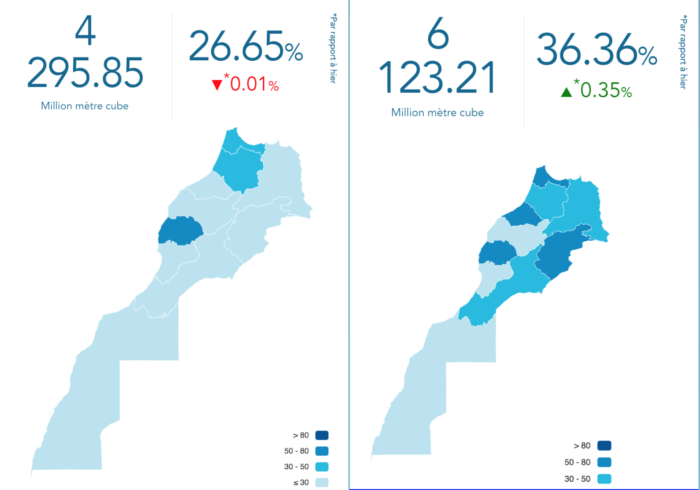
At the end of February, the national average filling rate for dams was only 27%. On March 20, 2025, it was 36.36%, with reserves reaching 6.1 billion m³, compared with just 4.3 billion m³ a year ago.
A sigh of relief
« Compared with last year, we’re in a much better situation, » said Amraoui, adding that Morocco « should have much less difficulty supplying drinking water next summer, as well as supplying irrigated areas which have suffered badly from the drought and have been forced to fall back on groundwater to save plantations ».
Mohamed Taher Sraïri, a lecturer and researcher at the Agronomic and Veterinary Institute Hassan II (IAV) in Rabat, also expects this improvement to « alleviate concerns. » It’s very important. Last summer, water supplies to major cities, particularly in southern Casablanca, Berrechid and Settat, were affected by water cuts », he recalls.
In the absence of precipitation, Nizar Baraka, Minister of Public Works and Water, raised the possibility of reducing the flow rate, or even cutting off water supplies in certain regions, as early as December 2023. A few days later, Interior Minister Abdelouafi Laftit sent a circular to regional walis and governors of prefectures and provinces, asking them to take action. He also decreed an« absolute ban » on certain « activities », including cleaning public roads and squares with water, filling public and private swimming pools more than once a year and growing aquavores. In addition, hammams, spas and car washes were closed three days a week.
Dams: the great hydraulic divide
Morocco is not out of the woods yet. « Although the Oum Er-Rbia basin’s filling rate has risen slightly, it remains one of the lowest » in the country, warns Sraïri.
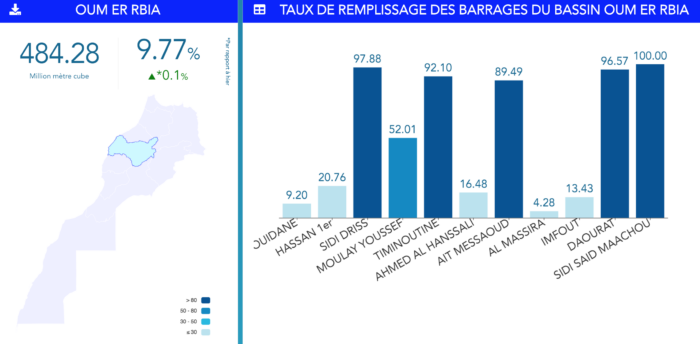
The Oum Er-Rbia basin supplies Casablanca in particular with drinking water, thanks to dams such as Al Massira. It also irrigates farmland in the plains of Tadla, Doukkala and other regions, supporting cereal, vegetable and tree crops. However, as of March 20, 2025, the filling rate of its dams did not exceed 9.77 percent. The volume of its reserves remains significant, however, at over 484.28 million m³.
« The water basins have contrasting situations: the water reserves of their dams vary greatly, » explains Amraoui. The Sebou comes first with 2,634 million m³, followed by the Loukkos with 1,110 million m³. The least well off are the Tensift basins, with just 123 million m³, followed by the Souss-Massa, with 163 million cubic meters, points out the professor. But « between now and the end of June, we could have further rainy episodes that will favorably change the current situation, which is already relatively satisfactory », he believes.
In addition to the rain, heavy snowfalls have also been recorded in recent days. On March 18, Nizar Baraka assured the public television channel Al Oula that snow cover had increased « remarkably », reaching 30,000 km² in recent days, compared with only 9,500 km² last year. « The area covered by snow this year is three times greater than last year. These are very important figures », explains Sraïri: « The snow will melt and help recharge the water tables, and some of it will fill the dams ».
The Minister also pointed out that, thanks to recent rainfall, the Oued Noun, Ziz and Ghriss regions are no longer under water stress. Cities such as Errachidia and Zagora now have sufficient drinking water reserves for two to three years. Despite these improvements, the national rainfall deficit is still 18% below the annual average, and regions such as Tensift, Souss and certain southern provinces are still severely affected by drought.
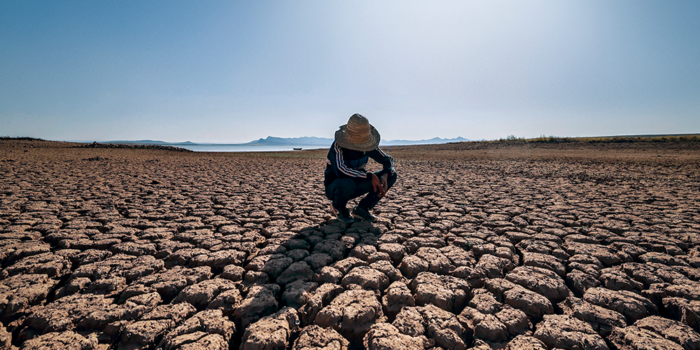
« We may have water releases (releasing a certain amount of water from a dam, ed. note) this year to irrigate areas like Tadla and the oases. This is very important for the plant cover, fodder and species such as the date palm, which has suffered greatly from drought in recent years », says Mohamed Taher Sraïri. Finally, although recent rainfall has made it possible to irrigate the oasis perimeters, it has not changed the primary situation. Morocco « suffers from a structural water shortage that has been exacerbated by the last seven years of drought », recalls the IAV teacher-researcher.
Drops of water in the ocean
The rain that has fallen in recent weeks hasn’t just filled the dams. Unfortunately, a lot of it has ended up in the sea ». To remedy this, the professor calls for « more viable » and « not as expensive » water harvesting techniques to be preferred to dams.
In his view, these measures could be applied to trees or watersheds. The IAV lecturer and researcher refers in particular to water capture by trees, which naturally slows down runoff, promotes water infiltration into the soil and reduces erosion. To optimize this natural process, trees can be surrounded byswales, shallow ditches that capture and store rainwater, allowing the roots to access it gradually. Ormulch the soil to retain moisture and reduce evaporation.
« In Morocco, we have local solutions that can be interesting for water storage and, above all, more viable than dams »
Similarly, the development of watersheds to slow the flow of water can be improved: dry stone dams or dikes, agricultural terraces used in the mountains to retain water longer and, in river beds and slopes, stone basins that stabilize the soil and retain water.
Last but not least, we should also mention the construction of underground micro-dams, which store water underground to reduce evaporation and allow it to infiltrate slowly into the ground, as well as infiltration wells to channel rainwater to the water table, and the construction of natural retention basins, similar to artificial lakes. » The State should introduce subsidies to encourage these techniques, » says Mohamed Taher Sraïri. » We always like big structures because they are expensive and require a lot of money », he regrets , « but we have local solutions that can be interesting for water storage and which are above all more viable ».
Dams without rain
Morocco currently has 154 dams, including 150 small and medium-sized ones, with a total storage capacity of over 19.9 billion m3 of water. These infrastructures play an essential role in supplying drinking water, irrigating agricultural areas and generating hydroelectric power. To combat water stress, a program has been launched to build 20 new dams by 2030. The aim is to increase storage capacity to 24 billion m3.
« Here too, there are questions to be asked. Will these dams, especially those planned for the most arid regions, be filled? » asks Mohamed Taher Sraïri. « Sometimes, a dam is built in such and such an area and it’s only afterwards that we realize that it doesn’t rain there », he said.
Professor Amraoui is more optimistic. » By 2030, when all the seawater desalination plants are operational, there will no longer be any transfer of water from dams to the coast, and all the water will be deployed locally for agricultural uses and for domestic supply to inland towns », he believes. For him, the connection between the Sebou and Bouregreg basins, the commissioning by the OCP Group of the Safi and El Jorf desalination plants, and the connection of the latter to Casa Sud, are « strong actions that will ensure a drinking water supply for this coastal axis ».
But can these projects protect Morocco from the effects of drought? We have to ask ourselves: is this just a drought episode that has lasted too long, or have we really entered a period of climate change? » asks Sraïri.
Ready for climate change?
A report published in early March by the American think tank Carnegie Endowment for International Peace takes a close look at the issue. While the Moroccan government has defined an ambitious program to exploit its renewable energy potential, effective climate adaptation requires greater involvement of independent local players, the report’s authors point out.
For them, there is no doubt that the adverse effects of climate change are having a major impact on vulnerable populations in Morocco, 93% of whose territory is arid or semi-arid. Desertification is progressing northwards, and droughts of increasing magnitude and frequency have exacerbated the phenomenon. Since 1980, Morocco has experienced twelve major droughts, the longest of which entered its seventh year in 2025. Heat waves have also multiplied, reducing agricultural yields and triggering forest fires that are depleting the country’s forest cover.
Yet the impacts of climate change have been amplified and exacerbated by short-sighted government policies and deep-rooted socio-economic inequalities, particularly in the agricultural and water management sectors, notes the think tank. Such is the case of the Green Morocco Plan, launched in 2008 by the current head of government and former Minister of Agriculture, Aziz Akhannouch.
The report points out that Morocco’s climate ambitions are limited by endemic governance problems, particularly in water management and the agricultural sector. Meeting these challenges is a question of both will and capacity, as it requires the widespread use of certain technologies, the implementation of regulatory and bureaucratic reforms, and raising public awareness.
A more sustainable and equitable strategy would focus on regulating water demand rather than increasing supply. This would involve cultivating crops that are better adapted to the country’s available resources, as well as regulating use by consumers, farmers and industries.
Thanks to exceptional rainfall in recent weeks, national dams now have over 6.1 billion cubic metres of water reserves, up 10% on the previous year. Despite this improvement, dam policy questions its… pic.twitter.com/t2MgCIUHxT-
TelQuel (@TelQuelOfficiel) March 25, 2025
Written in French by Ghita Ismali; edited in English by AngloMedia Group.


