

In 2030, Morocco will co-host the Football World Cup with Spain and Portugal. While this global event has given impetus to several strategic projects, it above all crystallizes the Kingdom’s ambitions: industrial sovereignty, ecological transition, and moving upmarket in sectors such as aeronautics and automobiles. But behind these major orientations lies a major challenge, undoubtedly the most crucial: that of skills.
On Tuesday November 25, in the auditorium of the Higher Institute of Commerce and Business Administration (ISCAE) in Casablanca, political, economic and academic decision makers drew this conclusion on the sidelines of the 41st edition of the Carrefour du Manager (Management Crossroads). Younes Sekkouri, Minister for Economic Inclusion, Small Business, Employment and Skills and a former doctoral student at the public institution, opened the debate on the challenges facing the kingdom in the run-up to this symbolic deadline.
The Safran effect
To illustrate the scale of these challenges, the Minister immediately took the example of Safran, one of whose Engineering Services sites adjoins ISCAE. Recently, however, the French aeronautical equipment manufacturer took a step forward by announcing two major investments in Morocco, including a plant capable of assembling 350 engines a year, the only one in the world outside France to produce this strategic equipment. A project of this scale could double the sector’s export sales from $2 billion to $4 billion.
« The first question I had to discuss directly with the Chairman and CEO of Safran was: what about skills? » confided Younes Sekkouri. For these companies, which outsource their « most precious, most strategic, most existential assets, » the immediate availability of qualified talent is non-negotiable. » The time-to-market in terms of resources must be very short, and the exercise must be carried out very quickly, » he insisted.
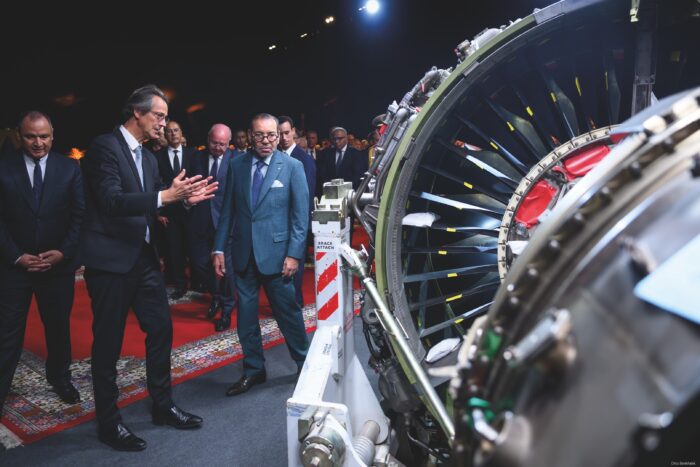
According to the Minister, this points to the ability of « our institutions to align a pragmatic, practical, ready-to-use offer for this kind of decision-maker » and constitutes a first strategic axis, on which Morocco has made great strides. « But we still have a long way to go », acknowledged Sekkouri.
This requirement reflects a fundamental turning point: Morocco is no longer in a mindset of low-cost subcontracting, but rather in a strategy of high value-added production. This positioning calls for much higher qualification standards.
Abdou Diop, Managing Partner of Forvis Mazars in Morocco, summed up the the dilemma well: « When we train ten engineers, the rest of the world is also eyeing our job market. » In his view, the Kingdom has become a talent pool for « aging » economies in search of skills, a dynamic that is creating unprecedented competition.
« We have to train not only for the jobs we need, but also for the jobs the world needs, because it’s a reality: jobs are globalized. »
The figures speak for themselves: after Covid, over 100,000 Moroccan workers in the tourism industry were recruited internationally by Spain, France, the Emirates or Qatar, according to Wissal El Gharbaoui, director of the Spanish group Planeta Training and Universities in Morocco. « We need to train not only for the jobs we need, but also for those the world needs, because it’s a reality: jobs are globalized, » said Abdou Diop, adding that Morocco is also becoming a crossroads attracting talent from the continent and beyond.
Putting things into perspective
Ali Moutaib, President of Halmo Group and former Director of Programs at the School of Economic Warfare (EGE) in Rabat, placed the discussion in a global perspective. For him, Morocco must first understand its place in an economic order that is in the midst of radical change. « If we don’t ask ourselves the question today about our situation, our place in this global perspective, we won’t be able to project ourselves and prepare our own weapons to face up to this competitiveness, » he warned.
« In 2018, it was said that AI would rather impact manual trades. Today, it’s more the so-called white-collar jobs, managers, administration, that are most at risk. »
In his view, three major trends are reshaping the employment landscape: climate change, which is having a lasting impact on agricultural trades; industrial transformation, which is making Morocco a creator of value rather than a mere subcontractor; and artificial intelligence, which is causing an « almost civilizational » upheaval in our relationship to information and work. The latter trend is particularly revealing. « In 2018, we were saying that AI was going to have more of an impact on manual jobs. We can see that the trend today is more towards the so-called white-collar professions: managers, administration, which are the most threatened. Conversely, craft trades, trades that require manual added value, are the most in demand, » he analyzed.
Hence his plea for an early upgrading of vocational streams, citing the examples of Switzerland, Japan and Germany, which have successfully created pathways of technical excellence. « There’s a job to be done in the collective imagination », he insisted, denouncing « a tropism we share with France » which consists in considering these streams as a Plan B.
Moutaib also insisted on two crucial challenges: promoting these courses of study from high school onwards, by rethinking the approach of HR departments and managers, and massively reinforcing continuing training. he stressed that « these technological transformations and these transformations in terms of work policy mean that we need to strengthen executive and professional training throughout the entire career path, » from top management to new recruits, if we are to remain competitive on the international stage.
Rethinking training
Faced with these challenges, rethinking training cannot be limited to companies. Wissal El Gharbaoui pointed to the urgent need to rethink learning methods, starting with the education system and academic courses. » Is it still relevant today to do 100% face-to-face learning? » she asked, referring to successful e-learning experiments that broaden access to knowledge. The question of guidance, often neglected, appears crucial. » A poorly understood or negotiated career path will determine so many things later on, » she warned, calling for greater support from secondary school onwards.
Karim Cheikh, Chairman of the Human Capital Commission at CGEM, denounced the bureaucratic red tape that paralyzes continuing training. Of the billion dirhams collected annually via the vocational training tax (TFP) and earmarked to finance employee training, less than 200 million are actually used, with only 1% of companies making use of continuing training.
« This situation can no longer continue », he said, announcing a reform underway to digitalize the system and make it more accessible. The new apprenticeship scheme launched at the end of October by the government as part of the Tadaroj program, with a ratio of 80% in the workplace and 20% in theoretical training, also aims to better connect school to the field.
Sekkouri spoke of the importance of intangible capital, which he described as a framework of trust, social dialogue and regulation that has had to be patiently built up. He recalled three years of « intense » negotiations to modernize the Labor Code, integrate teleworking and digital platforms, while managing social crises and a context of imported inflation. « To get to the Labor Code, to get to wage negotiations, we have to prune some subjects along the way, » he acknowledged.
« 2030 is an extremely important milestone, but it’s more a stage than an endpoint »
Beyond the encouraging economic indicators, including 90 billion dirhams in industrial investment and the 50% rise in FDI recalled by Karim Cheikh, the speakers insisted on a long-term approach. « 2030 is an extremely important milestone, but it’s more a stage than an end in itself, » summarized Abdou Diop.
Sekkouri concluded on a philosophical note, warning against « slack, » the strategic slide that causes us to lose sight of the essential in favor of the short term. « We mustn’t go into 2030 with a formal system of indicators, saying that everything is going well because Excel is good. We have to get there by paying attention to lived experience, » he warned.
For beyond the figures and pharaonic projects such as the Hassan II Grand Stadium, it is Morocco’s ability to transform its education system, develop its talents and create an environment conducive to their blossoming that will determine the success of its ambitions.
Written in French by Ghita Ismaili; edited in English by AngloMedia Group.


