

Almost exactly one year ago, on April 26, 2024, Bruno Le Maire, then French Minister of the Economy and Finance, called for the creation of a Franco-Moroccan working group to « work together to prepare the economic aspects of the 2030 World Cup. »
On April 24, this intention became reality. At the instigation of Laurent Saint-Martin, Minister Delegate for Foreign Trade and French Nationals Abroad, and Fouzi Lekjaa, Minister Delegate for the Budget and President of the Royal Moroccan Football Federation (FRMF), the first Morocco-France World Cup 2030 Business Forum established a joint task force.
The aim is to « nurture joint reflection, bring the two business communities closer together and enable the creation of business opportunities for French and Moroccan companies », emphasizes the French official.
The setting chosen for this summit meeting was no coincidence: the Mohammed VI Football Complex in Maâmora was the venue. Fouzi Lekjaa set the tone at the podium before a packed audience: « The World Cup is not just a soccer tournament. It’s a civilizational bridge, but also an economic one ».
« Exportable » cooperation
The signing of the framework agreement ratifying the creation of this « task force » took place away from the spotlight… or at least away from that of the Moroccan cameras. Laurent Saint-Martin, who is responsible for bringing this partnership to fruition, a year after Bruno Le Maire gave the go-ahead in Rabat, was quick to hail its completion: « I particularly appreciate it when we deliver on past commitments. It’s a perfect reflection of the friendship between our two countries ».
He also called for a « Franco-Moroccan brand » to be built around major upcoming international events: « We can turn our cooperation into exportable, structured, codified expertise. This World Cup must not be a one-off partnership, but the foundation of a shared doctrine that we can take to the international stage ». He also announced that a first meeting of the task force would be organized before the summer, thus affirming the determination of both parties to make this partnership a reality.
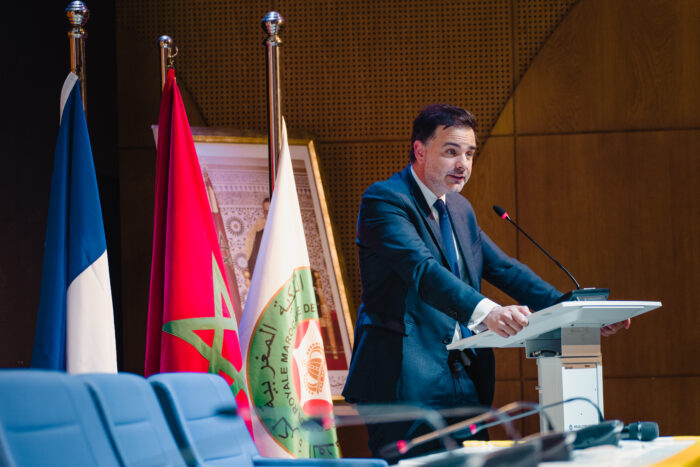
With a wink at national coach Walid Regragui who was present in the room, the French minister concluded with an image borrowed from the pitch: « The one-two is probably the best way to say that if tomorrow we can make our bricks of expertise complementary, the Franco-Moroccan brand will have something extremely powerful ».
Returning to recent events organized by France, from Euro 2016 to the Paris 2024 Olympics, he emphasized the convergence of the two countries’ trajectories, with Morocco soon to host the Under-17 Women’s World Cup and then the 2025 CAN, which « places its youth at the heart of this international dynamic ». A sequence that promises to be structuring for sport and the national economy.
Figures that speak to investors
Olivier Vincent, Executive Director of Export at Bpifrance, highlighted the scale of the economic prospects offered by the 2030 World Cup. For this investment banker, the event goes beyond the strict sporting framework: « The World Cup 2030 is a major lever for transformation for ecosystems and companies on both sides of the Atlantic. It means over 100 billion dollars of investment, 335,000 jobs created. And above all, skills to be developed, value chains to be structured together ».
Claiming an approach based on trust and co-construction, he adds: « International development is not about imposing, it’s about proposing. It’s about listening and innovating together. And he promises: « We have five years to succeed together. At Bpifrance, we’ll be there ».
Mehdi Tazi, vice-president of the CGEM, called upon to speak in the absence of its president Chakib Alj, then unfolded what looked like a roadmap for the French investors and decision-makers in the room. At the podium, the employers’ representative also looked beyond the upcoming sporting events. « Ambition cannot be limited to the organization of an event. It’s about building a shared, long-term vision that incorporates all the components of the economic fabric, including very small and medium-sized businesses, » he explained.
Morocco, a continental hub
In a deliberately seductive approach, Mehdi Tazi highlighted the Kingdom’s major structuring projects. « Morocco is now a strategic hub for Africa. The port of Nador will open in six months, and the port of Dakhla is under construction. Our airports, like our motorway network, are undergoing major transformation », he recalled.
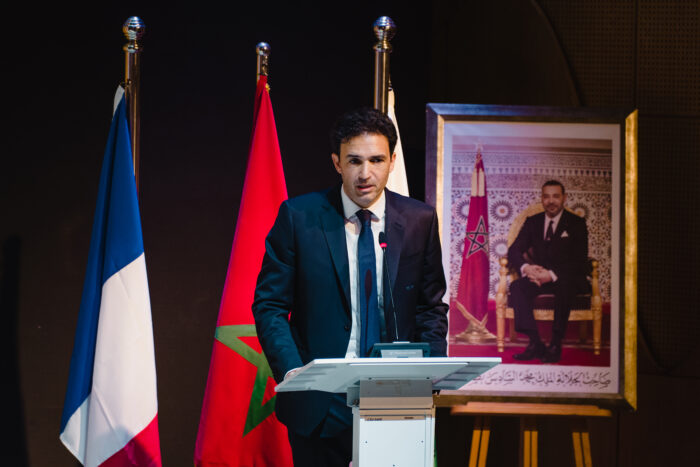
He also cited ongoing investments, involving French companies, in renewable energies in Guelmim and Laâyoune, as well as the future desalination plant in Rabat, set to become the largest on the continent. « We are living in a special moment, marked by rare political and economic stability. This is a strong signal for investors », he concluded. A heartfelt nod to his counterparts in France.
Fouzi Lekjaa was a fine strategist, at once the Kingdom’s treasurer and the boss of national soccer. In a committed tone, he pleaded for the construction of « shared solutions between the two countries », in line with the ambitions expressed by the heads of state. With the authority of a team captain, he concluded, halfway between political vision and passion for the game: « Long live Franco-Moroccan cooperation. And long live a Morocco-France final in Casablanca ».
Written in French by Younes Saoury; edited in English by The AngloMedia Group.


