

Gold is shining brighter than ever. It has seen three $100 rises in one week – a historic surge. The price of an ounce even exceeded 3,500 dollars for the first time at the opening of the financial markets on Tuesday April 22, before stabilizing at around 3,460 dollars. This rise was driven by anxiety in the market after Donald Trump imposed new tariffs. His repeated attacks on the Federal Reserve – accused of failing to lower interest rates – and escalating tensions with Beijing also played a role.
Far from being a mere speculative boom, this surge reflects, according to several analysts, a more profound reconstitution of global economic and geopolitical balances. As the old financial powers lose influence to emerging economies, the yellow metal regains its status as a strategic reserve asset.
A shift in global markets
The phenomenon dates back to 2020, according to precious metals analyst Laurent Maurel, interviewed by TelQuel. At the time, he was already anticipating a gradual but lasting rise in prices, driven by changing demand. And it’s no longer Western investors or investment funds that are leading the charge, as was the case at previous peaks in 1980 and between 2008 and 2011.
The momentum is now being driven by BRICS central banks, Chinese institutions, and even private investors in Asia. « What we’re seeing is that price rises now coincide with the opening up of the Chinese market. It‘s no longer New York or London that dictate prices« , stresses Laurent Maurel.
« Gold price rises now coincide with the opening up of the Chinese market. New York and London no longer dictate prices »
Yet not only central banks are buying gold: soaring prices have triggered a new surge in demand in China. Investors, financial institutions, refineries and private individuals are all turning to gold on a massive scale, whether through bullion, accumulation plans offered by banks, or ETFs (exchange-traded funds).
This renewed interest is due to the loss of confidence in dollar-denominated assets and growing uncertainty caused by the tense trading relationship between Beijing and Washington.
Laurent Maurel assures us that more price hikes are on the horizon. He anticipates a further surge in the coming weeks. « We’re going to get to $4,000 pretty quickly. Maybe even by this summer« , he predicts. In his view, as long as geopolitical pressure remains strong and Asian demand holds up, we can’t expect any change in the current trends.
A Moroccan paradox
But this global dynamic, spectacular though it is, doesn’t suffice in explaining what is happening on the Moroccan market. In Morocco, prices are increasing at a faster rate. This palpably affects the price of gold for consumers in the street – which is far more sensitive to local distortions than to global trends.
In Casablanca, Marrakech or Fez, a gram of unworked 18-carat gold currently trades at around 850 dirhams. Once shaped, the price generally varies between 900 and 1,200 dirhams per gram, depending on the extravagance of the product’s design.
This constitutes a price surge which exceeds international rates. According to industry professionals, it’s not based on any coherent economic logic.
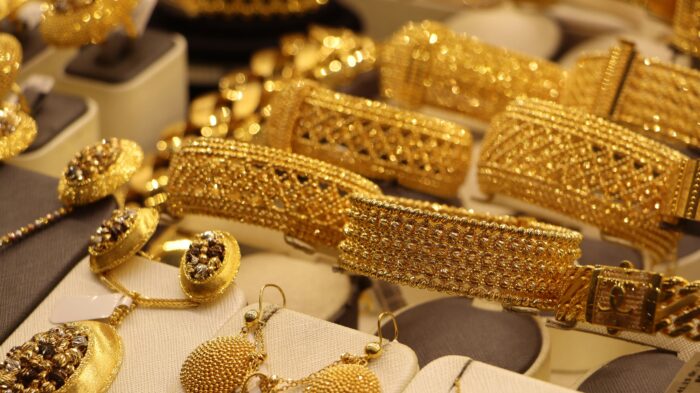
According to Driss El Hazzaz, president of the Moroccan Federation of Jewelers, this situation is above all the result of a disorganized market which is over regulated. Added to this are the poor logistics of locally produced gold and a lack of control over where gold is being supplied from. In theory, gold reaches the Moroccan market from four sources: recycling, national mines, formal imports and smuggling. In practice, it’s almost exclusively the latter which functions.
Recycling of antique jewelry covers only 15-20% of national demand. As for Moroccan mines, they export their entire stock, encouraged by advantages in the tax system. « These are mines that extract raw materials on Moroccan soil, but export 100% of their production. This is simply because it’s in their tax interests to do so, » laments Driss El Hazzaz. The export tax rate is only 17.6%, compared with 30% for domestic sales.
The stranglehold of smuggling
For formal importers, the constraints are similarly dissuasive. The Foreign Exchange Office allows only 30% of an order’s value to be transferred abroad – up to $18,000. However, foreign companies approved by customs authorities don’t accept advances and require payment in full, as the price of gold is traded in real time, and prices can vary several times a day.
« In Morocco, smuggling represents between 80 and 90% of the gold in circulation »
Faced with such regulatory mire, smuggling has become the main supply route of gold in the country. According to the President of the Moroccan Federation of Jewelers, it accounts for between 80 and 90 percent of all gold in circulation, leaving professionals at the mercy of informal operators who charge gross margins of up to 10%.
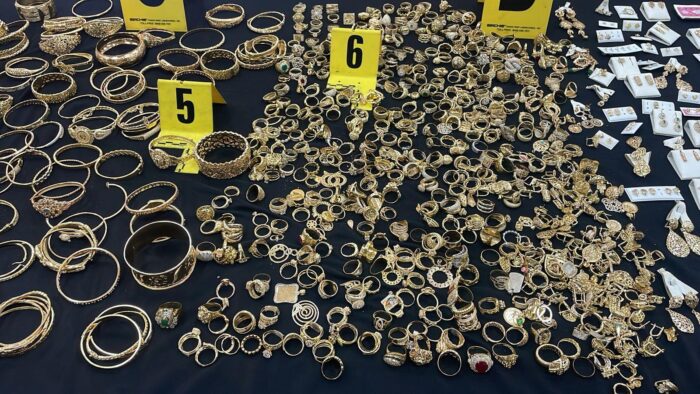
As a direct consequence, gold is more expensive in Morocco. And, in addition to international prices, internal market upsets are to blame. An inaccessible local supply, virtually impossible imports, smuggling that has become dominant… In other words, a perfect storm to disrupt the industry.
« We’re inadvertently encouraging money laundering. And that’s serious« , points out Driss El Hazzaz. He claims to have alerted the relevant authorities – the finance and industry Ministries and the Foreign Exchange Office – on several occasions, without ever obtaining a concrete response. « We’ve written, we’ve called… but to no avail. »
In this uncertain climate, nearly 50% of Moroccan producers have suspended their activities, waiting for prices to stabilize, claims Driss El Hazzaz. This is a major blow for a sector that provides a livelihood for over 67,000 people across the country, including manufacturers, retailers and intermediaries. Behind the shop windows, the heritage of craftsmanship and cultural know-how is being undermined. « If nothing is done to regulate the market and protect its players, we risk losing not only jobs, but an entire craft, a culture and an identity handed down from generation to generation », warns Driss El Hazzaz.
Written in French by Safae Hadri, edited in English by Theodore Griffin


