

Mohamed Hassan Bensalah walks into his office with a confident stride, ready for our meeting, radiating a sense of accomplishment. In June 2024, Holmarcom Group, under his leadership for three decades, completed the acquisition of Crédit du Maroc. The transaction is valued at 4.8 billion dirhams, or close to 5 billion, according to some sources.
The transaction led by Mohamed Hassan Bensalah transferred the French-owned bank—previously majority-held by France’s Crédit Agricole—under Moroccan ownership. This acquisition paved the way for a stronger “Moroccanization” of the financial sector. Just a few months later, another former insurance executive, Moulay Hafid Elalamy, followed suit by purchasing Société Générale Maroc from its French parent company.
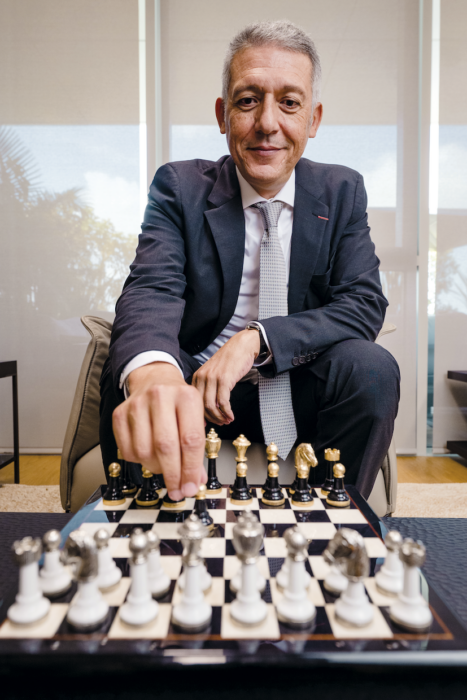
Mohamed Hassan Bensalah welcomes us to his new headquarters, located on Boulevard d’Anfa in Casablanca. The term is not exaggerated—Holmarcom Group owns a significant portion of this central axis of the city, which houses the headquarters of AtlantaSanad, the group’s insurance company, as well as the new headquarters of Crédit du Maroc.
The building itself is a sleek structure with glass façades. From the top of the edifice, he remarks, “I’m not entirely satisfied with the architecture. It’s not what I would have chosen, but you get used to it.”
Mohamed Hassan Bensalah is not one to speak often. His last interview with the media dates back to 2020, when he discussed the Atlanta-Sanad merger in our pages, which became the foundation of the group’s financial division. At the time, he hinted at the future acquisition of a local bank without explicitly mentioning Crédit du Maroc.
This time, he shares insights into the details of the acquisition and his ambitions for the group’s financial division. Looking toward the future, he is already envisioning the framework for international expansion, with a particular interest in the rest of the African continent.
You are welcoming us today at the new headquarters of Crédit du Maroc on Boulevard d’Anfa. During our last interview, you received us at Holmarcom’s historic headquarters in Derb Omar. Would you like to share your vision for the future of your group?
It’s mostly about the present. The future is something we are in the process of shaping. I wanted to showcase the progress made since our last interview. Back then, we discussed the merger of Atlanta and Sanad Assurances and the development of our financial division. That development is now continuing with the acquisition of Crédit du Maroc.
During our last interview in 2020, you were already mentioning the idea of acquiring a bank. A deal was already in the works…
“We withdrew from Crédit Agricole du Maroc because the bank had specialized in areas that didn’t necessarily align with our strategy.
We have always invested in the banking sector. We did so in the past by acquiring stakes in BMCI (of which Holmarcom remains a shareholder) and Crédit Agricole du Maroc. We withdrew from Crédit Agricole du Maroc because the bank had specialized in areas that didn’t necessarily align with our strategy.
We then acquired a stake in CIH, where we remain shareholders to this day. The banking-insurance combination has always been one of the cornerstones of the financial system. I’m not inventing anything new—this is a global observation.
As for us, we began preparing seriously in 2019, the year we undertook a strategic restructuring of our financial division, which at the time consisted only of Atlanta and Sanad. That was when we established the organization and structure necessary to integrate a bank.
Why choose Crédit du Maroc? For example, we know that just a few months after your deal was announced, Société Générale was put on the market…
Crédit du Maroc is a bank with solid fundamentals and significant potential. The decision was made based on the conditions proposed at a specific moment in time”
It was a matter of opportunity. There was a convergence between the willingness of a seller and the interest of a buyer. We had to be agile, “go or no go.” We analyzed the situation and identified an opportunity. Crédit du Maroc is a bank with solid fundamentals and significant potential. The decision was made based on the conditions presented at a specific moment in time.
As for Société Générale, it is also a bank with strong fundamentals. However, we took advantage of an opportunity that aligned with our vision.
The choice of Crédit du Maroc was certainly based on strong economic rationale, but I won’t hide the fact that the bank’s deep Moroccan roots also played a role in our decision. »
How long did it take to reach an agreement?
Discussions began before the COVID-19 health crisis and lasted for about a year, at the end of which a deal in principle was reached. Then the pandemic struck, and we each had to manage our own pressing priorities.
Once the agreement was in place, we entered into an exclusivity arrangement. This phase also lasted for a little under a year, during which we discussed the framework of the agreement, the sums involved, and how to make the bank more autonomous, as its operations were heavily dependent on the French banking group.
Investing in banking is a guarantee of profits…
Sometimes, it is necessary to distinguish between perception and reality.
What was your perception at the time, and what was your reality?
Without any bad puns, banking is a reassuring sector. But when you enter it, a colossal amount of work is required. Regulations evolve constantly, there are commitments to honor, and there are significant capital requirements to ensure solid fundamentals.
What do you mean by that?
Since the official announcement of the acquisition, we’ve had to launch numerous projects. This included developing a new visual identity and a new positioning, while managing the transition process between Paris and Casablanca through the joint efforts of the teams from Crédit du Maroc, Crédit Agricole, and Holmarcom.
Every step of the process was completed within the agreed timelines, down to the exact day. The executives at Crédit Agricole couldn’t believe it! After all, we’re talking about fully achieving the autonomy of a bank in less than 18 months.
Throughout this period, there was a shift in the company’s dynamic, an acceleration of digital transformation, improved commercial performance, and a change in governance—all while continuing daily operations.
The acquisition of Crédit du Maroc took 18 months and was carried out in two phases. Why? According to our information, it was Bank Al-Maghrib that insisted on a gradual transfer of power over time…
It was a tripartite decision. The third party was the central bank, our regulator, which believed that the transition should be done gradually. At one stage of the negotiations, we even considered the possibility of a slower transition.
It was the central bank that stepped in, saying, “We want you to remain involved for a certain period to ensure the transition is as effective as possible.” And that’s exactly what happened, Hamdoulillah. The regulator’s well-informed choice turned out to be the right one.
What did this transition period allow for? Was it an adaptation of the new management team to the requirements of the banking sector or a transfer of information systems from France to Morocco?
The central bank wanted a transition characterized by full support from the French group. This required addressing the disentanglement of IT systems and everything that comes with it. There was also a need for a period of adaptation and for the new operator to take full control of the sector.
All of this was implemented within a framework that both Crédit Agricole and we fully embraced. The vision behind this process was extremely well thought out and contributed to the success of the operation.
Since you took the helm of Crédit du Maroc, the bank’s communication has focused on your “strategic vision.” What does it entail?
“Crédit du Maroc will benefit from constant and ongoing support from the group to grow. We aim to gain market share and do so intelligently”
Our vision is to make Crédit du Maroc a leading player in the banking sector within the kingdom. I’m not speaking in terms of segmentation, but in terms of ranking. Holmarcom Group has always managed its growth effectively, and Crédit du Maroc will benefit from the group’s constant and ongoing support to develop. We want to gain market share, and we want to do so intelligently.
In the long term, our goal is to rank among the top 4 or top 5 banks in the market. We also aim to further develop bancassurance within Holmarcom’s financial division by strengthening synergies between our subsidiaries.
Precisely, what do these synergies consist of?
An exclusive distribution channel for AtlantaSanad will be established once the terms binding Crédit du Maroc to its current insurer come to an end. Similar initiatives have already been implemented with BMCI and CIH, and thanks to the integration of Crédit du Maroc, we can continue to develop bancassurance with a platform better suited to our ambitions, especially since the life insurance market continues to grow.
You will be able to fully develop your ambitions by 2026. Until then, Crédit du Maroc remains bound by an agreement with Sanlam…
The deadline is clear, and we are doing everything to prepare for it as effectively as possible. The banking/insurance pairing within our financial division is meant to last—it is its very raison d’être. Our decision to invest in a bank was precisely because we are confident in the mutual development of these two activities.
For some, your acquisition of Crédit du Maroc and Moulay Hafid Elalamy’s acquisition of Société Générale represent a « Moroccanization of the financial sector. » What is your perspective on this?
Moroccanization is an important concept. Now, let me be clear—I’m not saying we should close our doors to foreign companies. On the contrary! But it’s crucial that a significant part of the economy is in the hands of locals. Today, one of the key economic notions is sovereignty. We now talk about food sovereignty, energy sovereignty, financial sovereignty…
However, for the older generation, the term “Moroccanization” may evoke memories of the 1970s, which don’t necessarily carry a positive connotation. The difference today is that Moroccanization is primarily driven by the private sector. That said, international companies must continue to coexist with Moroccan companies, especially to challenge and stimulate them. This is essential.
However, the new logo of Crédit du Maroc doesn’t look very Moroccan (the bank’s new visual identity is blue, white, and red)… Let’s be honest.
Even if we had acquired a Moroccan bank, we would have chosen the same colors! It just so happens that this was a French bank. Whether that was fortunate or unfortunate depends on how you see it.
For the record, the colors simply represent our financial division. You’ll also find them in the visual identity of AtlantaSanad Assurance.
You now have one foot in banking and the other in insurance. Tradition would suggest that you expand, particularly toward the rest of the continent…
The answer to that question is very simple: yes, and it will depend on the opportunities.
Is it the competition in the continental market that makes you say that?
There is strong competition on the continent, but Moroccan fundamentals are solid. That being said, we need to step outside of an established framework. Morocco is inherently a good market. However, if we have the ambition to become an international player, we should not impose barriers on ourselves. In the fields of banking and insurance, we cannot limit ourselves to Morocco.
Expansion into the rest of the continent remains a crucial step in this international development. It is one of our development priorities and an imperative that must be adhered to. But it’s a market in constant evolution, where opportunities can arise overnight. In some countries, we will have to start « from scratch, » while in others, we may be able to take advantage of divestment opportunities.
The Path of a CEO
1993: Becomes CEO of Holmarcom Group
1996: Acquires a 7.8% stake in BMCI
1997: Creates Regional Air Lines
1999: Acquires Sanad Assurances
2006: Acquires Somathes
2007: Lists Atlanta Assurances on the stock exchange. Acquires a 12% stake in CIH
2008: Launches Mass Céréales Al Maghreb
2009: Creates Air Arabia Maroc
2010: Launches the Captingis real estate project
2011: Creates Yellowrock
2013: Launches a real estate project in Dakar
2014: Acquires Juice & Nectar Partner
2016: Acquires Denia Holding. Atlanta Assurances establishes itself in Côte d’Ivoire
2018: Les Eaux Minérales d’Oulmès is impacted by the boycott movement
2020: Merges Atlanta and Sanad Assurances
2022: Holmarcom acquires a majority stake in Crédit du Maroc
Written in French by Yassine Majdi, edited in English by Eric Nielson


