

The food-processing industry is a major contributor to Morocco’s economy, generating 191 billion dirhams in annual revenue and comprising 2,600 companies that directly employ more than 206,000 people. Its energy footprint, however, is far from green. Food-processing industries alone account for nearly 20% of Morocco’s total industrial energy consumption, equivalent to approximately 380,000 metric tons of oil per year.
Speaking at the National Forum on Decarbonizing the Food-Processing Industry on June 29, Minister of Industry and Trade Ryad Mezzour reiterated why the sector must decarbonize. First, Morocco, which lacks hydrocarbon resources, has embarked on an energy transition. Second, it must remain capable of meeting the requirements of international partners whose decarbonization targets are set to become increasingly stringent, as under the European Union’s Carbon Border Adjustment Mechanism (CBAM). Finally, the minister raised the issues of competitiveness and production autonomy.
With this in mind, a roadmap has been drawn up to move from collective awareness to the implementation of concrete measures.
From awareness to action
Developed in collaboration with the National Federation of the Food-Processing Industry (Fenagri), the Ministry of Industry and Trade and other stakeholders, the roadmap was presented by Léo Genin, a partner at management and technology consulting firm BearingPoint. The action plan identifies five priorities that could turn the climate transition into an advantage: resilience, competitiveness, market access, green finance and brand image.
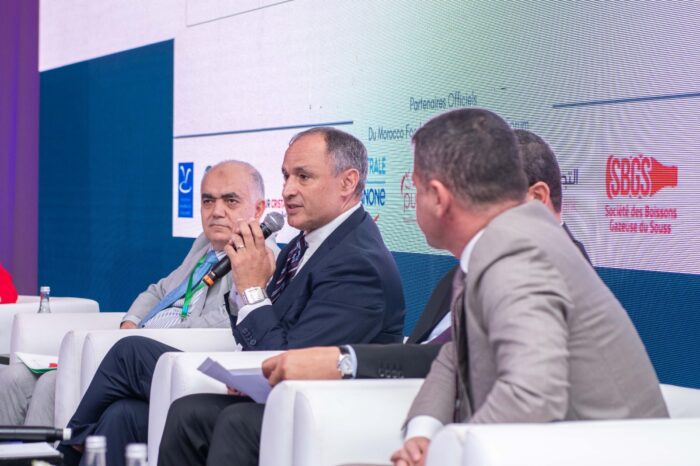
Decarbonization is not merely an industrial project, but “a genuine driver of competitiveness and value creation,” noted Amine Kibal, technical director at Lesieur Cristal, during the forum.
To that end, the study covered all segments of Morocco’s food-processing industry, as well as the entire value chain, from upstream agricultural production to waste management, including transportation, processing and packaging.
Across the entire value chain, carbon emissions were estimated at 28 million metric tons of CO₂ in 2024, including 4 million metric tons generated directly by food-processing companies. By comparison, the cement sector emits 9.5 million metric tons of CO₂, while Morocco’s total territorial emissions stand at 109 million metric tons.
Agriculture, the largest source of emissions
No less than 75% of these emissions come from upstream agricultural production. “Some sources of emissions are linked to the way animals generate greenhouse gases, including issues related to the management of cattle waste,” Léo Genin explained. Processing and packaging come next, accounting for 14% of emissions, particularly through energy use and refrigeration, followed by waste and packaging materials at 5%.
These figures are in line with those observed in other regions, Léo Genin explained. “We must take into account the significant emissions associated with how raw materials are produced, whether poultry, livestock, grains or plant-based products,” he said.
Three segments account for two-thirds of the sector’s emissions: red meat, poultry and dairy. In terms of energy-related emissions, more than 50% come from the sugar, dairy and poultry industries because of their energy-intensive processes and reliance on carbon-based energy sources.
Three pathways to 2040
After providing an overview of the sector, the consultant outlined three scenarios through 2040. The first is a business-as-usual scenario, based on trends observed in recent years and projected through 2030 and 2040. Without the introduction of new measures and with production volumes continuing to rise, this scenario would lead to an increase of more than 50% in CO₂ emissions.
A second, operational scenario takes into account measures that companies can implement directly using technically proven solutions. Energy performance would be improved through greater energy efficiency, alternative fuels, and the use of renewable energy. Léo Genin cited the capture of CO₂ from boilers, a practice already adopted by several Moroccan companies. “Companies have direct control over these measures, which account for nearly a quarter of this scenario’s potential impact, with a reduction of 2.2 million metric tons of CO₂,” the consultant continued.
The investment required under this scenario is estimated at approximately 8 billion dirhams between 2027 and 2040. Of this amount, 5.4 billion dirhams would be allocated to upstream agricultural production and waste management, which are particularly significant sources of emissions across the value chain. Investments in energy and refrigeration are estimated at 2.2 billion dirhams. Funding needs are lower for packaging and transportation, with estimated capital expenditures of 200 million dirhams for packaging and 250 million dirhams for transportation.
The final scenario is aligned with Morocco’s Nationally Determined Contribution (NDC) 3.0, which sets out the climate action plans adopted by countries to reduce greenhouse gas emissions. By going further, emissions could be reduced by 37% by 2040. This scenario would include electrifying fleets used to transport products and significantly expanding the use of renewable energy, with an initial transition through liquefied natural gas (LNG), which produces fewer emissions than other fossil fuels such as coal or fuel oil.
Preparing for the carbon tax
These measures would strengthen the position of a country with a long agricultural tradition at a pivotal moment, as the European Union’s CBAM is expected to be extended to food and agricultural products. With the carbon tax estimated at around €80 per metric ton of CO₂, Moroccan exporters have every incentive to prepare.
“Climate and carbon risk are becoming economic and financial factors. A project’s economic performance is influenced by its carbon emissions,” said Asmaa Faaris, CSR director at Eaux Minérales d’Oulmès. The situation is now clear: the issue extends beyond climate constraints. These environmental restrictions are primarily a driver of competitiveness rather than an obstacle.
Written in French by Salomé Krumenacher, edited in English by Eric Nielson


