

Livestock numbers are at a record high, but the model is under pressure. The latest figures from the Moroccan livestock sector show that a quiet transformation is underway. Between 2016 and 2025, red meat production in Morocco showed mixed trends: sheep meat production increased from 186,299 to 258,489 tons, and goat meat production nearly doubled. Conversely, beef production declined, falling from 275,184 to 238,197 tons. At the same time, annual per capita consumption, around 15 Kg, has remained virtually unchanged.
These trends reflect less a growth in production than a rebalancing of the system. “Morocco has a significant advantage: its breeds were developed in their places of origin, which gives them a strong ability to adapt, ” said Saïd Chaitibi, director of the National Association of Sheep and Goat Breeders (ANOC). Chaitibi spoke at a conference on the future of national livestock farming and its contribution to food sovereignty held on April 22 on the sidelines of the 2026 International Agricultural Show in Morocco (SIAM). For the challenge is not merely to increase livestock numbers, but to modernize livestock farming in order to improve its output.
Productivity, a New Strategic Lever
Long considered secondary, “numerical productivity”—which encompasses indicators such as fertility, prolificacy, and mortality—is now emerging as a decisive factor. “Improvement isn’t just about the animals’ weight. It also depends on reproductive performance,” explains Chaitibi.
The latest livestock census, conducted in 2025, is revealing: with an average productivity of 74%, the national herd could stagnate or even decline. On the other hand, raising this productivity to 120% would allow for increased production without increasing the number of animals.
The equation then becomes strategic: to meet an estimated demand of 11 million head per year, Morocco would need more than 14 million breeding females at current levels. An improvement in productivity would reduce this need to approximately 9 million. A significant difference. “This would help alleviate pressure on grazing lands and reduce dependence on forage resources, which are currently a major source of tension, ” the official emphasizes.
“While the national livestock population has suffered a decline, supervised farms have generally held up”
Successive crises—droughts, COVID, soaring prices—have weakened the sector but also highlighted the protective role of professional organizations. “The national livestock population has declined, but supervised farms have generally held up,” observes Chaitibi. Between 2020 and 2022, ANOC membership thus remained stable, without any significant decline.
The trend reversed in 2023, driven by rising prices and herd rebuilding strategies. It accelerated in 2025, with exceptional measures, notably the call to suspend the Eid al-Adha sacrifice and the ban on the slaughter of breeding females. As a result, the sheep and goat population now stands at 30.6 million head. But for industry professionals, this recovery remains fragile and must be part of a sustainable approach.
Science to the Rescue
Agricultural research is emerging as a key driver. At the French National Institute for Agricultural Research (INRA), research pursues a dual objective: improving productivity while strengthening the system’s resilience. Among the major advances, genomic selection is opening up new possibilities.
More precise and faster, it enables the identification of animals best adapted to climatic conditions. A large-scale effort has thus enabled the complete sequencing of more than 300 sheep and goats and the identification of nearly 440 genes linked to environmental adaptation.
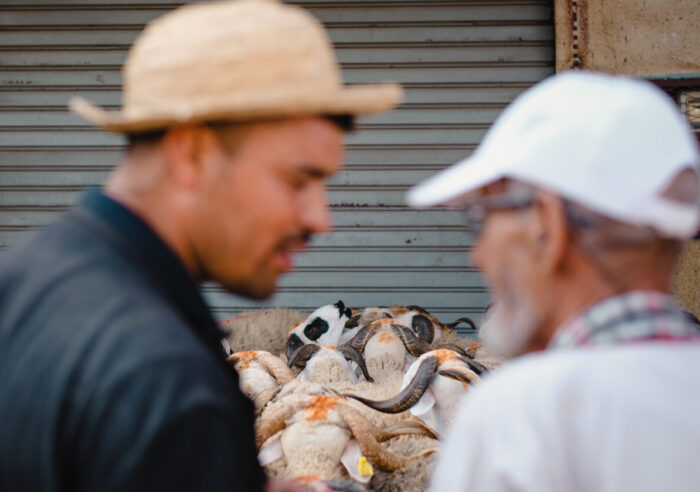
INRA has also developed sheep breeds, such as INRA 180, the result of a cross between the hardy Timahdit breed and the D’man breed, known for its fertility. There is also the Deroua breed, resulting from a cross between the D’man and the Boujaâd. Gradually being introduced among breeders, these breeds show promising performance, with a prolificacy of up to 1.8 lambs per birth.
Another key factor: reproductive biotechnologies. Artificial insemination techniques now enable fertility rates of 65 to 70%, facilitating the widespread adoption of genetic advances.
But“genetics alone is not enough. The sustainability of livestock farming relies on an integrated approach, combining reproduction, nutrition, animal health, and resource management, ” explains Bouchra El Amiri, research director at INRA.
The challenge of feed
And it is indeed the issue of feed that is the focus of concerns. Water scarcity, the degradation of grazing lands, and rising input costs are undermining the entire system. To address this, researchers are exploring alternative solutions: utilizing byproducts from the agro-industry, developing forage crops adapted to arid conditions, or incorporating forage shrubs into emergency rations.
Technological innovations are also supporting this transition. Satellite monitoring systems now allow for real-time monitoring of pasture conditions, while sensors (GPS, accelerometers) provide a better understanding of animal behavior and their energy needs.“We can no longer produce as we did before. Nothing can be left to chance,” emphasizes Chaitibi.
Technical expertise, genetic improvement, and resource optimization are terms used as the Moroccan livestock farming industry enters a new era. It is an era that is more demanding but also more structured. This shift has been made necessary by climate pressures and the growing need for food sovereignty. It remains to be seen whether this transformation can be carried out on a large scale. For beyond innovations and performance, it is the sector’s ability to disseminate these practices to all livestock farmers—including those who are not part of organized structures—that will determine its future.
One thing is certain: producing more will no longer be enough. From now on, we must produce better, and above all, more efficiently.
Written in French by Ghita Ismaili; edited in English by AngloMedia Group.


