

December 2016. While consolidating its return to the African Union, Morocco moves closer to other African countries, notably Nigeria. King Mohammed VI lands on December 1 in Abuja, the third stop of a royal tour, after Ethiopia and Madagascar. For several months, significant discussions have been taking place between the two countries regarding the fertilizer market, supported by the future fertilizer production projects of the Moroccan giant OCP.
Beyond these discussions, the visit provides an opportunity to outline and officially announce a titanic project, revealed exclusively by the Moroccan monthly Economie Entreprises: a gas pipeline linking Nigeria to Morocco. On December 3, 2016, King Mohammed VI and the Nigerian president, the late Muhammadu Buhari, sign a bilateral agreement to bring this massive project to life.
Few details are disclosed, but the project is estimated at several billion dollars. On the financial side, another agreement is also signed: Tarik Senhaji, then executive director of the Ithmar Capital fund, and Uche Orji, chief executive of the Nigeria Sovereign Investment Authority (NSIA), announce their support for the Morocco-Nigeria Gas Pipeline project.
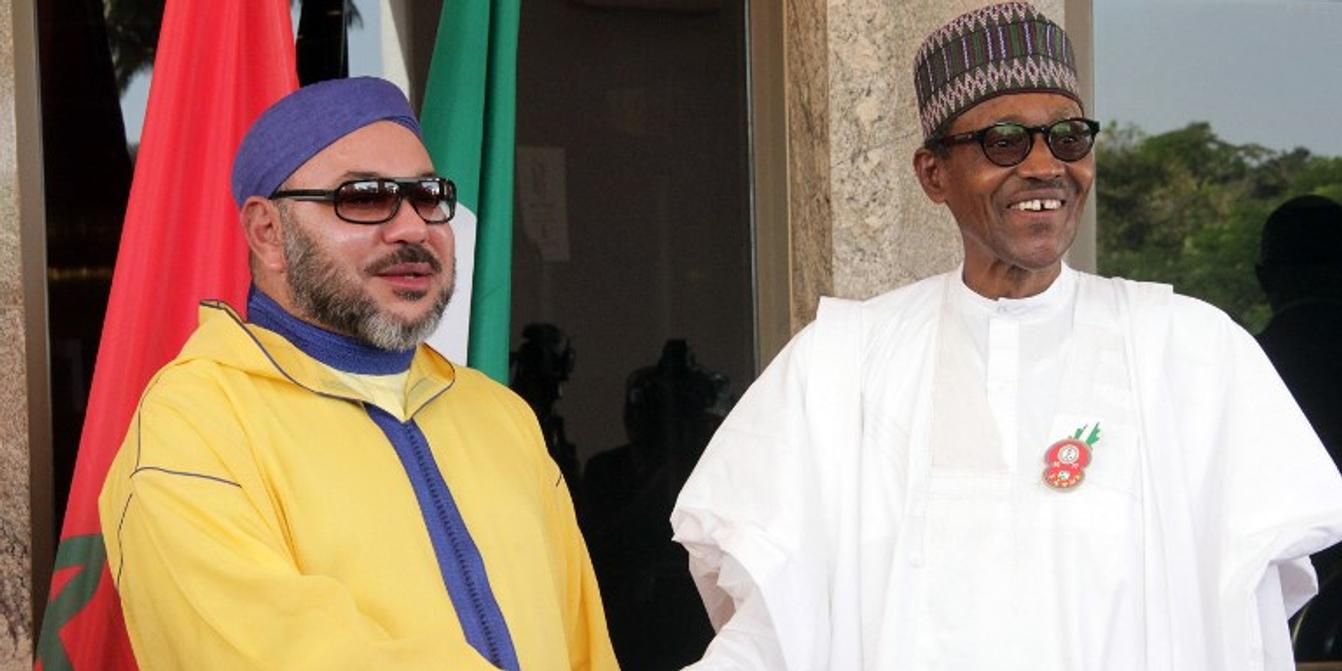
Mohammed VI and the Nigerian president, Muhammadu Buhari, signed an agreement for the construction of a gas pipeline between Nigeria and Morocco in Abuja in December 2016. The titanic project was already estimated at the time at several billion dollars. Six months later, on May 15, 2017, a new agreement-signing ceremony in Rabat officially formalizes the project. The national oil companies, the National Office of Hydrocarbons and Mines (ONHYM) and the Nigeria National Petroleum Company (NNPC), are mandated to lead the project. Feasibility studies are launched on that occasion.
Series of formalizations
In the following years, institutional agreements continued to be signed among the 13 host countries of the gas pipeline, as well as ECOWAS. Meanwhile, on the ground, the project moved forward with positive results from the feasibility study in 2018, followed by the feasibility and Front-End Engineering Design (FEED) studies finalized in March 2024.
Since then, ONHYM, led by Amina Benkhadra, and at times the Ministry of Energy Transition and Sustainable Development, through the voice of Leila Benali, have occasionally announced that the project is progressing well, that the necessary stages have been validated, and that a new phase is imminent. But launched ten years ago, without the first shovel in the ground and without a real official deadline, the project appears nebulous.
Questioned on the matter by TelQuel, Mohammed Benzaria, director of ONHYM’s midstream subsidiary, named OMCo, in charge of the Atlantic Africa Gas Pipeline (GAA) project, explains this lack of communication: “We cannot make announcements all the time. When we reach an important milestone, we make an announcement.” But the project is moving forward, and it is progressing well, he assures.
An intergovernmental agreement to come
The next step is imminent, we are told once again. The terms of the intergovernmental agreement, which define the rights and obligations of each country involved, were adopted in December 2024 at an ECOWAS summit. The official signing by the heads of state is expected to take place without delay.
Moreover, the meeting also provided an opportunity to formalize the name of the infrastructure: out with “Morocco-Nigeria Gas Pipeline,” in with the “Atlantic Africa Gas Pipeline,” designated by the acronym “GAA,” and “AAGP” in English.
This agreement will also allow for the creation of a political body: the High Authority of the Gas Pipeline, a coordination tool among the thirteen concerned states. The agreement will also designate the company dedicated to the project, which will, in turn, be responsible for financing and constructing the gas pipeline.
Beyond the grand signing ceremonies and administrative matters, where does this project stand in concrete terms, intended to transport gas over 7,000 km from Nigeria to supply Europe? The distance, which would make it the second-longest gas pipeline in the world, is now a resolved issue, with the detailed route provided by ONHYM to TelQuel.
The Morocco-Nigeria gas pipeline is expected to strengthen the kingdom’s energy sovereignty and position it as an indispensable exporter to Europe. New details on a strategic project worth 200 billion dirhams.
📑 Sommaire : https://t.co/NOIIFshaXN
🛎 Abonnement :… pic.twitter.com/P74i5WNBPs— TelQuel (@TelQuelOfficiel) February 17, 2026
The gas pipeline will start in southern Nigeria and will run offshore along the West African coast to Morocco, near Dakhla. Once on Moroccan territory, the pipeline will be onshore but will continue to follow the coastline, where the industrial hubs are located, until it connects with the Maghreb-Europe Gas Pipeline (GME) in the north of the kingdom.
In total, the offshore section stretches over 5,100 km, and 1,760 km for the onshore portion. This combined onshore-offshore route is explained by economic, political, legal, and security considerations, Mohammed Benzaria tells us.
In total, the offshore section stretches over 5,100 km, and 1,760 km for the onshore portion. This combined onshore-offshore route is explained by economic, political, legal, and security considerations, Mohammed Benzaria tells us.
First sections as early as 2031
To manage a project of such length, the gas pipeline is divided into three sections: the southern segment, from Nigeria to Côte d’Ivoire; the central segment, from Côte d’Ivoire to Senegal; and the northern segment, from Senegal to Morocco. Among these three parts, the first gas deliveries concern the southern and northern segments and are expected in 2031.
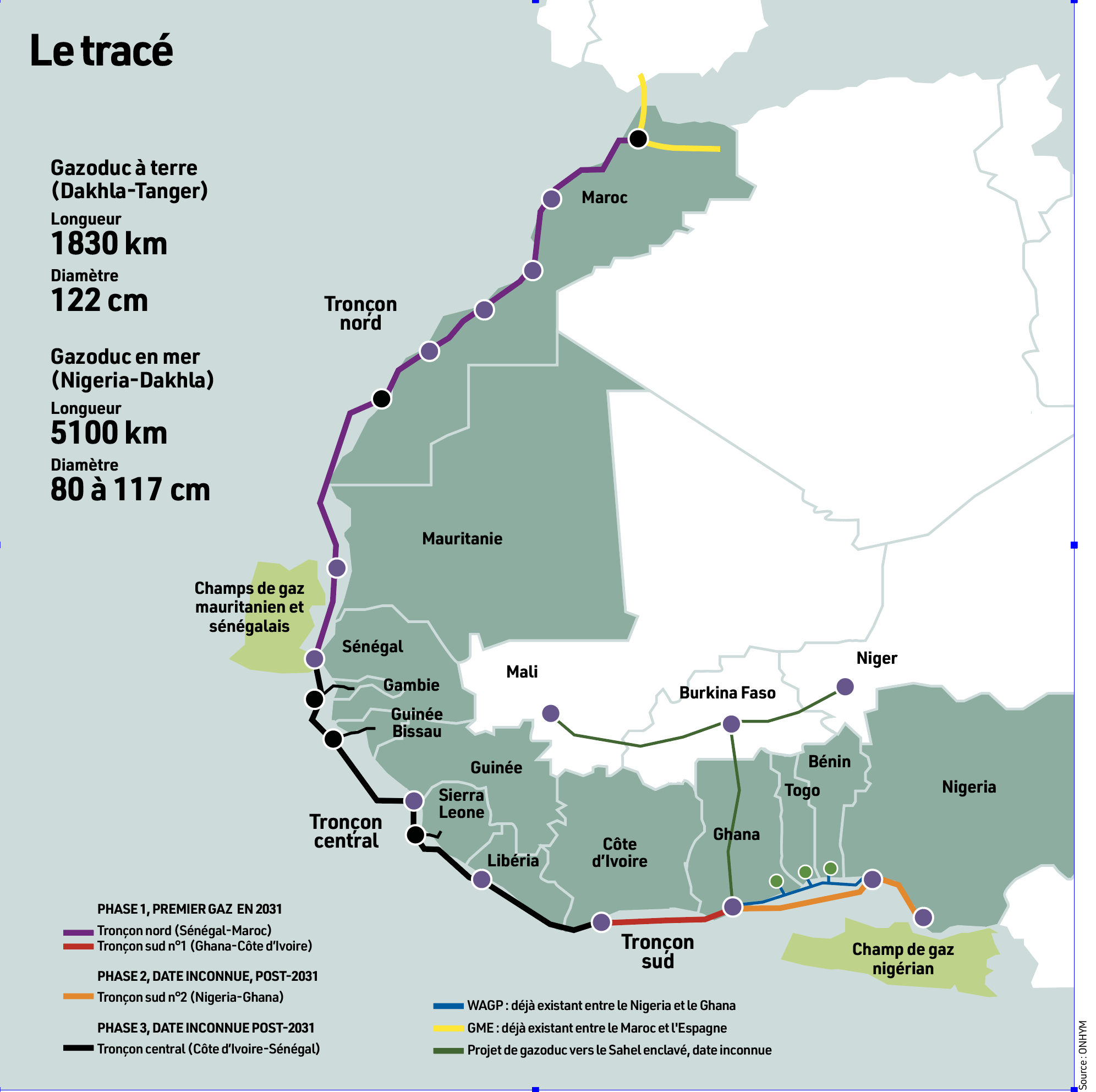
At the level of the southern segment, the project will be able to benefit from existing infrastructure, with the West African Gas Pipeline (WAGP), which links Nigeria to Ghana. “One of the first phases will consist of extending this WAGP pipeline to Côte d’Ivoire. The GAA is being built in parallel with the WAGP,” details Mohammed Benzaria.
According to documents provided by ONHYM to TelQuel, the first phase will include the installation of the gas pipeline from Takoradi (Ghana) to Abidjan, and from Kayar (Senegal) to northern Morocco. This initial portion will address Côte d’Ivoire’s urgent and growing gas needs by connecting it to the existing WAGP. The segment from Brass (Nigeria) to Takoradi, built in parallel with the WAGP, will follow.
“To build a gas pipeline of this size, it takes approximately between six and ten years”
As for the northern segment, it will secure Morocco’s gas supplies and will also allow Europe, through the connection to the GME, to diversify its sources. These initial needs will then be covered by gas fields in Senegal and Mauritania. For these initial segments, Mohammed Benzaria confirms that the first cubic meters of gas will be delivered in 2030/2031. The central segment will follow, completing the southern and northern sections by 2036.
“To build a gas pipeline of this size, it takes approximately between six and ten years,” the same source indicates. Once completed, the pipeline will have a maximum estimated capacity of 30 billion cubic meters (bcm) per year.
To supply it at full capacity, Nigeria will have to exploit new offshore resources, which are significantly larger in volume, ONHYM specifies.
At what cost
But before these first cubic meters of gas, a crucial question remains: how to finance such a project? In March 2024, the Front-End Engineering Design (FEED) phase had made it possible to estimate the overall cost at $25 billion. Last December, on the sidelines of the Dakhla Africa Logistics Forum, Mohammed Benzaria announced in the press that the amount had been reduced to $20 billion. A reduction in the total cost was made possible in particular by taking a closer look at the logistics component.
Each segment is studied as an independent project, with its own economics
“The logistics component was estimated at a very significant amount — just under one-third of those $25 billion — and we worked to minimize these costs by optimizing, for example, the locations for pipe deliveries,” shares the director of OMCo. He nonetheless recalls that each segment is studied as an independent project, with its own economics. For the launch of the initial phases, the amounts will be much lower. For now, ONHYM is working to reduce these costs as part of an optimization phase in order to reach the final investment decision (FID). This is hoped for, at the latest, by the end of this year.
Participation of development banks
Regarding investors, little information has emerged. The first name associated with the mega-project, the sovereign wealth fund Ithmar Capital, has not spoken publicly on the matter since the signing of the agreement. According to corridor rumors, Ithmar Capital could eventually participate in the project, although this is not included in the base plan.
From what is known, several entities have expressed interest. Mohammed Benzaria mentions sovereign wealth funds, international pipeline operators, as well as development banks. Among them are the Islamic Development Bank (IsDB) and the OPEC Fund for International Development (OFID). As reported in the press, the African Development Bank (AfDB) was also supporting the project. Questioned by TelQuel, the AfDB responded that it could not comment on any potential financing or involvement in the GAA.
Without speculating on potential investors, the project will only see a real boost on the ground once the FID (final investment decision) is taken. “The tender documents are ready. In order to execute and sign the contracts with the company that will be selected, we need to take the FID,” explains Mohammed Benzaria. 2026 is therefore shaping up to be a pivotal year for ONHYM’s teams, who will align the various workstreams around the GAA: technical, commercial, institutional, and financial.
Securing a new energy source
“It has been a long process, but we are reaching the implementation phase,” reassures Mohammed Benzaria
“It has been a long process, but we are reaching the implementation phase,” reassures Mohammed Benzaria. Ten years of studies, negotiations with thirteen countries, and the search for investment…
But concretely, what advantages will Morocco gain once this mega-pipeline is completed? Mohammed Benzaria cites two: an alternative source of gas supply and a role as a regional energy hub. Connected to Mauritania at the level of Dakhla, this entry point, which is expected to come into service within five years, will provide a third source of gas for the kingdom. Currently, it depends solely on the Maghreb-Europe Gas Pipeline (GME), which transports gas from Spain. Within one or two years, Morocco will also be able to rely on the new gas terminal at the Nador West Med port.
On Moroccan territory, this new energy source, crucial for industry, will compensate for a Moroccan weakness. “Morocco has an entire economic and industrial strategy, notably attracting industries. But what is missing is energy,” points out Anas Abdoun, an energy and geo-economics expert. This energy, more reliable and more competitive, should also interest our neighbors across the Mediterranean.
At the interface between Africa and Europe, Morocco will be able to assert its role as a regional energy hub between the two continents. While African industrialization is not among the main reasons for these massive works, the possibilities of exporting gas to Europe are more than attractive. Once connected to the GME, the GAA will provide an additional source of supply for European countries.
“For Europe, we will make this gas available at the entry point of the GME. Moreover, we already have expressions of interest from potential European gas buyers for significant volumes through this infrastructure,” notes the director of OMCo. Especially since the GAA’s transport tariffs demonstrate its competitiveness compared to LNG, the gas resource on which Europe has mainly relied since the decline in Russian gas imports.
About the producing countries
With Africa’s largest gas reserves, on the order of nearly 6,000 bcm, Nigeria’s export opportunities will diversify beyond liquefied natural gas (LNG)
On Abuja’s side, this project will, of course, enable Nigeria’s emergence as a gas hub. With Africa’s largest gas reserves, on the order of nearly 6,000 bcm, Nigeria’s export opportunities will diversify beyond liquefied natural gas (LNG). This gas pipeline will help the country strengthen its regional influence, as well as ensure long-term gas monetization, Damilola Hamid Balogun, a consultant in strategy, energy transition, and green growth, tells TelQuel.
The latter also confirms that Nigerian gas is well-positioned to stand out as a reliable alternative, particularly for electricity generation and industrial uses in regions suffering from energy deficits. Benzaria also adds that the gas transported will have the advantage of being clean and economically attractive.
Beyond importing, the infrastructure will also allow all producing states to inject their export-bound gas, notes Mohammed Benzaria. Nigeria is not alone in exporting gas. Senegal and Mauritania have significant gas potential, whether through the Greater Tortue Ahmeyim (GTA) field off the coast of both countries or the Bir Allah gas field near Mauritania.
But before seeing this gas pipeline run across the Atlantic, supply Europe with gas and drive West African industrialization, $20 billion must still be put on the table, and above all everyone must be brought into agreement.
Environment: a gas pipeline with “green” ambitions
Other countries along the route, endowed with isolated gas fields, “are forced to practice flaring, a practice that consists of burning associated gas to prevent it from being released into the atmosphere. Having infrastructure that runs nearby makes it possible to inject that gas into the network instead of burning it,” specifies Mohammed Benzaria.
By preventing this practice, the gas pipeline is part of environmental protection, according to ONHYM. A pipeline of more than 5,000 kilometers crossing an ocean that hosts notable marine biodiversity may raise questions about environmental compliance. But Mohammed Benzaria assures that this issue is at the heart of the project, which must meet stringent environmental requirements for two reasons, he tells us.
Beyond “Morocco’s desire for this gas pipeline to meet the highest environmental standards,” Mohammed Benzaria also mentions the participation of development banks, which are subject to strict requirements. “These requirements are set by environmental standards that prevent us from passing through protected areas, from disturbing the environment, and oblige us to compensate all entities that would be impacted by this project,” he specifies.
A long-term project
2016 Launch of the project following the visit of King Mohammed VI to the late Muhammadu Buhari, the former Nigerian president.
2017 Signing of the cooperation agreement for the gas pipeline between ONHYM and NNPC to launch the feasibility studies and move the project toward the final investment decision.
2018 Signing of a declaration before King Mohammed VI and Nigerian President Muhammadu Buhari, confirming the positive results of the feasibility studies. Transition to the Front-End Engineering Design (FEED) phase.
2021-2023 Signings with ECOWAS and the oil companies of the host countries of the Atlantic Africa Gas Pipeline.
2024 Approval of the terms of the intergovernmental agreement (IGA) by the heads of state of ECOWAS, consolidating the legal and political framework of the project.
2026 Signing of the IGA by the heads of state to implement the project on the ground.
End of 2026 Final investment decision (FID).
2031 First gas deliveries with the initial active segments: from Mauritania to Morocco and from Ghana to Côte d’Ivoire.
Before 2036 Commissioning of the complete Atlantic Africa Gas Pipeline, from Nigeria to Morocco.
Written in French by Salomé Krumenacher, edited in English by Eric Nielson


