

Over the past eighteen months, we’ve heard many announcements of Chinese investment in the battery value chain. In autumn 2023, CNGR Advanced Materials sealed a strategic alliance with the Al Mada fund to set up a precursor site at Jorf Lasfar, the future COBCO.
In the spring of 2024, cathode specialist BTR New Material Group obtained the green light from Rabat to build a 50,000-ton plant near Tangiers, while a few weeks later, Hailiang and Shinzoom announced twin leaf copper and anode units in the same industrial zone.
After a salvo of announcements from Chinese manufacturers, one of them has finally materialized. The result of a Moroccan-Chinese partnership between Al Mada and CNGR, COBCO is building the first gigafactory for electric battery components on the Atlantic seaboard at Jorf Lasfar. Back… pic.twitter.com/NXv3Z1wXbo
– TelQuel (@TelQuelOfficiel) June 30, 2025
On June 7, 2024, Gotion High Tech unveiled a gigafactory project in Kénitra, with the ambition of delivering its first modules in 2026. Today, one of those promises has taken on a whole new dimension: the COBCO joint venture is moving from speeches to the first tons off the production line.
That’s why June 25, 2025 may well be a new milestone for Moroccan industry. On that day, in the Jorf Lasfar industrial zone, the focus will not be on OCP, but on a plant that is the only one of its kind in Africa. COBCO, the fruit of the union between the royal holding company Al Mada and the Chinese company CNGR, is inaugurating its first production line for NMC (nickel-magnesium-cobalt, see box) precursors, essential components for the batteries powering the global electrical revolution, and electric vehicles in particular.
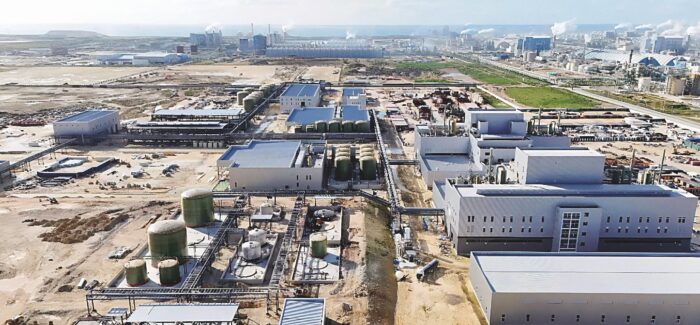
Eventually, the plant should produce 120,000 tonnes of NMC precursors and LFP cathodes (see box below), also essential for the manufacture of batteries for electric vehicles. Enough to equip nearly a million vehicles every year. The COBCO plant at Jorf Lasfar marks a turning point: it becomes the first plant of this size to operate outside Asia.
By 2030, the global battery market is expected to reach $440 billion. Within this value chain, the global market for NMC precursors is currently estimated at $15 billion.
And this first plant puts Morocco in a good position to take its share of these strategic markets. With an investment of 20 billion dirhams, this plant positions the country as a big player in the battery industry.
A strategic partnership between Al Mada and CNGR
The story of this alliance began in the shadows. We don’t know who initiated contact, but we can guess when. In March 2023, our colleagues at The Desk revealed negotiations between the Al Mada Group and Chinese precursor manufacturing giant CNGR Advanced Materials.
Listed on the Shenzhen stock exchange, the company has a market capitalization of almost 40 billion dirhams. Headed by Deng Weiming – China’s 63rd richest man, according to a 2021 Forbes ranking – its customers include European carmakers, Tesla, LG Chem and Samsung SDI.
CNGR’s choice of Morocco is based on a number of factors: the country’s geographical position, offering access to European and American markets; its stable political environment; its competitive industrial costs; and its free trade agreements with the European Union and the United States.
These agreements enable precursors produced at Jorf Lasfar to benefit from price advantages in these markets.
« Between 20% and 40% of the value of an electric vehicle comes from its battery »
The Chinese group intends to capitalize fully on these markets thanks to a specific feature of the electric vehicle industry. « Between 20% and 40% of the value of an electric vehicle comes from its battery », points out an industry specialist.
The choice of Morocco facilitates CNGR’s access to these strategic markets, since the plant’s production is expected to be tax-free. This vision is echoed by Thorsten Lahrs, Head of Europe at CNGR, who proclaimed to the specialist media Benchmark Minerals in the summer of 2024 that Morocco represents an industrial « sweet spot ». He points to the country’s efficient logistics, competitive costs, stable political environment and geographical proximity to European markets.
Creation and rapid development of COBCO
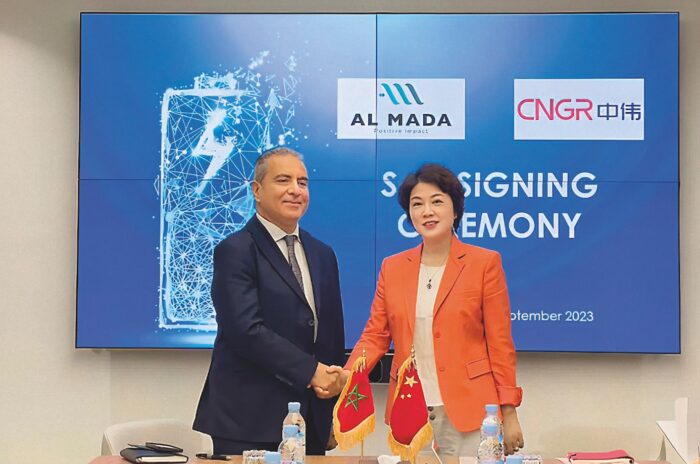
In September 2023, Al Mada and CNGR formalized their partnership with the creation of the COBCO joint venture. The Jorf Lasfar site is selected for its logistical and industrial advantages.
The chosen industrial zone offers several advantages. First and foremost, its immediate proximity to the OCP industrial complex for the future production of LFP (lithium-iron-phosphate) cathodes. The COBCO plant also benefits from access to desalinated water – a crucial resource for industrial processes – and to clean electricity, available in sufficient quantities.
COBCO plans to use 80% green energy by 2025 and to run entirely on renewable energies by 2026, thanks to agreements with developers. This approach meets European requirements concerning the future carbon tax on products manufactured outside the European Union. The plant can source its raw materials from OCP for phosphate and from Managem (an Al Mada subsidiary) for cobalt.
Contracts for the construction of the plant will be negotiated from November 2023, one month after the creation of COBCO. The first on-site mobilization – the actual launch of the worksite – was launched in January 2024. The project is developing at an unprecedented pace, as COBCO mobilizes the expertise of CNGR’s partners to build the plant.
Suppliers are identified by the Chinese giant. Nearly a year after the start of construction, commissioning began in January 2025. A feat in Morocco, but a daily reality for Chinese industrialists.
Tomorrow’s ecosystem taking shape
On June 25, COBCO completes the first phase of its development. The plant can now produce 40,000 tonnes of NMC precursors.
Assuming a floor price of $10 per kilo of NMC precursors, and an annual production capacity of 40,000 tonnes, the COBCO plant could generate annual sales of $400 million. According to our information, the Moroccan-Chinese joint venture plans to double this capacity to 80,000 tonnes per year in the medium term, depending on the evolution of the order book.
The plant’s future is shaped by two complementary strategic projects. A production line for LFP cathodes will enhance the technological offering, responding to growing demand for these safer, longer-lasting batteries. At full capacity, the plant aims to supply 25% of the Euro-American electric battery market.
A 30,000-ton-per-year black mass recycling unit is also planned. Black mass contains strategic metals such as lithium, nickel and cobalt. COBCO is in talks with battery suppliers and customers in Europe and the USA to acquire this material.
COBCO’s official launch is part of a wider movement of players in the Moroccan battery industry. The almost simultaneous installation of major battery players – such as Gotion High Tech, specialized in the production of battery cells, BTR for cathodes and anodes, and Shinzoom, which is developing its anode production at Tanger Tech – outlines the contours of a Moroccan battery ecosystem.
For the time being, the company seems to be primarily export-oriented, but does not rule out synergies at local level. This ecosystem is also being strengthened by the transfer of technology and know-how, which is taking concrete form: several Moroccan managers have benefited from in-depth training in China.
It’s a method reminiscent of the skill-building model that has contributed to the development of the Moroccan automotive industry.
In addition to the jobs directly created and the exportable value generated, COBCO is paving the way for a new industrial sector in Morocco.
This installation places the Kingdom in a global battery market estimated to be worth $440 billion by 2030, going beyond a simple investment of 20 billion dirhams. From the signing of the agreement between Al Mada and CNGR to the inauguration of Jorf Lasfar, COBCO illustrates the development of a new industrial dynamic.
The electric battery for dummies
Electric battery :
This is the energy « reservoir » of electric vehicles. It stores electricity and releases it to drive the motor. It’s the equivalent of the internal combustion engine in a conventional car… only much more complex.
NMC precursor :
A precursor is a chemical powder used as a raw material in the manufacture of a battery’s cathode. In the case of NMC batteries, this precursor is composed of three metals: nickel, manganese and cobalt.
Cathodes :
The cathode is one of the two main parts that allow electricity to flow inside the battery, with the other electrode called the anode. In a rechargeable battery, electricity flows between the cathode and the anode, depending on whether the battery is being charged or discharged.
There are a number of different cathode chemistries, including :
– NMC (nickel-manganese-cobalt)
– LFP (lithium-iron-phosphate) [/frame]


