

The executive order signed on Monday, May 12 by Donald Trump, aimed at forcing a drastic drop in drug prices in the United States, may at first glance seem like a strictly American issue. However, its ripple effects on global market balance will certainly be felt in countries like Morocco, where price-setting systems, dependence on imports, and limited bargaining power with international laboratories create a structurally vulnerable—but paradoxically, this time, potentially beneficial—environment.
By reviving an old battle from his first term, Donald Trump announced in April a plan to align the prices of medications reimbursed by the Medicare and Medicaid programs with those charged in other major world economies.
This principle of “international reference pricing” would allow the United States to negotiate rates equivalent to the lowest observed, particularly in Europe. Trump was crystal clear: “Europe is going to have to pay a little more, the rest of the world too, and America much less.”
Presented as a political win against a pharmaceutical industry deemed “terribly greedy” by its critics, this plan seeks to leverage the federal government’s bargaining power to obtain discounts ranging from 50% to 90% on several treatments.
Such a pricing reconfiguration in the world’s largest pharmaceutical market—the United States alone accounting for more than half of pharmaceutical group Roche’s revenue, for example—changes the equation for laboratories, forcing them to adjust their global pricing strategies to avoid being pushed out of the American market.
Morocco, a willing hostage to benchmarking
In Morocco, drug prices have been regulated since 2013 by a decree that enforces a pricing system based on benchmarking. The principle: to set the public sale price of medications—whether imported or locally produced—according to the prices charged in a small group of reference countries, notably France, Spain, Belgium, and Portugal.
This mechanism, intended to ensure a degree of price balance, is now showing its limits. Because behind this logic of alignment, price discrepancies persist—and in some cases, are widening. As TelQuel has documented in several investigations, certain treatments continue to be sold in Morocco at prices significantly higher than those seen in Europe, or even in countries with comparable income levels. A phenomenon that cannot be explained solely by logistical or tax-related costs, but also by a structural flaw: the absence of direct negotiation with pharmaceutical companies.
“Morocco applies a benchmark based on the manufacturer’s price—before margins—but without any real power to negotiate directly with pharmaceutical companies”
Pricing sovereignty—despite being central to debates on access to healthcare, especially in the context of the expansion of mandatory health insurance (AMO)—remains largely theoretical.
A reverse ripple effect
But in the context of Trump’s executive order, this same logic of indexation could, for once, work in favor of Moroccan consumers. In effect, if pharmaceutical companies lower their prices in the reference countries to maintain access to the U.S. market, Morocco, through a mechanical effect, will see those reductions reflected in its own pricing schedules. Contrary to initial fears, the ripple effect would therefore not be inflationary, but deflationary. In other words, a global price drop in the reference countries would lead to a drop in prices in Morocco.
For pharmacist Abdelfettah Ahlamine, the impact of the American decision will be both direct and indirect. Direct, first, because “most major pharmaceutical companies, like Pfizer or Merck, are American. As soon as they lower their prices in the U.S., they’ll have to adjust their global pricing strategy, including for markets like Morocco.”
Indirect, then, through the benchmark effect: “If prices fall in the reference countries, then Morocco’s system—based on indexation—will automatically bring prices down.” That said, the mechanism must function smoothly. “The indexation system is theoretically automatic, but in practice, everything depends on the administration’s diligence,” notes a pharmaceutical sector insider. In short, if price cuts are not promptly incorporated or if reference data is poorly updated, the expected effect could be “diluted, or even canceled out.”
A new regulatory shift
According to consistent sources contacted by TelQuel, the Executive is preparing to enact a major shift in the country’s pharmaceutical policy
According to consistent sources contacted by TelQuel, the Executive is preparing to enact a major shift in the country’s pharmaceutical policy. A draft decree, currently in its final validation phase, is expected to be placed on the agenda of an upcoming Government Council meeting. Its aim is to fundamentally reform the system for setting drug prices, with a focus on substantially lowering the prices charged in Morocco.
This reform is no coincidence. It is the result of several months of consultations among key stakeholders, foremost among them the CNSS—the country’s sole social security fund—and the Ministry of Health and Social Protection, both of which agree that the current system, locked in a purely administrative and comparative logic, has shown its limits. The new decree seeks precisely to “break with this inertia by introducing a more dynamic and more transparent model,” explains a source close to the matter.
This objective is reflected in one of the most structural measures in the text: expanding the powers of the High Authority for Health (HAS). Inspired by the French model, this change will grant the HAS an unprecedented capacity for “direct negotiation with pharmaceutical companies to determine the sale price of reimbursable medications,” our source reveals.

A shift in administrative culture is thus underway, favoring a culture of price negotiation. “This decree will allow the HAS to play a key role in price regulation, similar to its French counterpart,” explains Abdelfettah Ahlamine. Discussions will now be based on several objective indicators: added therapeutic value, international prices, projected volumes, and target population.
A regulated contractual model
In many ways, Morocco is drawing inspiration from a proven approach. In France, price negotiations are overseen by the Economic Committee for Health Products (CEPS), which sets prices in coordination with pharmaceutical companies—or, failing agreement, through a unilateral decision. The ASMR (improvement in actual medical benefit) is the cornerstone of this medico-economic assessment, alongside other factors such as therapeutic comparators and international pricing.
It is precisely this foundation that Morocco aims to adapt to its own context, taking direct inspiration from the French model. “Once the price is set, the HAS and the pharmaceutical company jointly determine an estimated annual sales volume. If actual sales fall below this estimate, the company is compensated. If, on the other hand, sales exceed the cap, the company must reimburse the HAS for the difference,” explains Abdelfettah Ahlamine.
This contractual mechanism, already in effect in France, corresponds to what specialists call a safeguard clause. It is a “budgetary safety net that allows spending to be controlled while ensuring access to medication,” summarizes a sector expert.
The threat of shortages
But any pricing reform, no matter how ambitious, raises a persistent concern behind the scenes of the healthcare system: the risk of stock shortages. While the new decree aims to impact prices, it cannot ignore another key indicator—often relegated to the background in public decision-making: the actual availability of medication.
“The new reform must take availability into account. This isn’t a luxury—it’s urgent,” warns a pharmaceutical industry expert. It is precisely the cheapest, and paradoxically most commonly prescribed, medications that suffer the most from repeated stockouts.
“By further lowering the prices of medications that are already barely profitable, we push manufacturers to withdraw them entirely from the market, because they won’t produce at a loss,” laments Mohamed Lahbabi, president of the Confederation of Pharmacists’ Unions of Morocco. The result: first-line treatments vanish from pharmacy shelves, leaving patients in therapeutic limbo.
“It’s not enough to regulate prices. A stable supply must also be guaranteed. Yet Morocco does not have a strategic stockpile for essential medications”
This quiet yet formidable mechanism threatens to worsen as prices are revised downward, driven by the combined effect of indexation and the new regulatory framework. “It’s not enough to regulate prices. A stable supply must also be guaranteed. Yet Morocco does not have a strategic stockpile for essential medications,” notes a pharmaceutical industry insider.
To avoid a scenario of widespread shortages, some professionals are calling for safeguards in the implementation of the decree. Abdelfettah Ahlamine, for example, suggests sparing low-cost medications that place no significant burden on either CNSS finances or patients.
“Take the case of Levothyrox, used to treat hypothyroidism. Morocco buys it at 3 dirhams per box. If we decide to lower its price again, the manufacturer will see no economic incentive and will withdraw from the market. The consequences for patients would be catastrophic,” he warns.
Currently, no substitute exists on the Moroccan market to replace Levothyrox, which remains under patent. Unless a domestic laboratory decides, in the public interest, to obtain a license to produce a generic equivalent locally, patients will remain entirely dependent on this single product.
The mirage of pharmaceutical sovereignty
Behind the apparent strength of Morocco’s pharmaceutical industrial fabric lies a reality more fragile than it seems. The country does indeed cover between 65% and 70% of its medication consumption through local production, but this self-sufficiency is largely an illusion. “Morocco produces neither the active ingredients nor the excipients,” states Abdelfettah Ahlamine. “We import them entirely, mainly from India,” he adds.
This structural dependency leaves the country dangerously exposed to any disruption in international trade. The vulnerability is all the more critical because it affects precisely the most strategic therapeutic classes: innovative drugs, biotechnology products, cancer treatments, and vaccines. These are segments in which the kingdom remains heavily dependent on multinational companies—whose global decisions lie completely beyond national control.
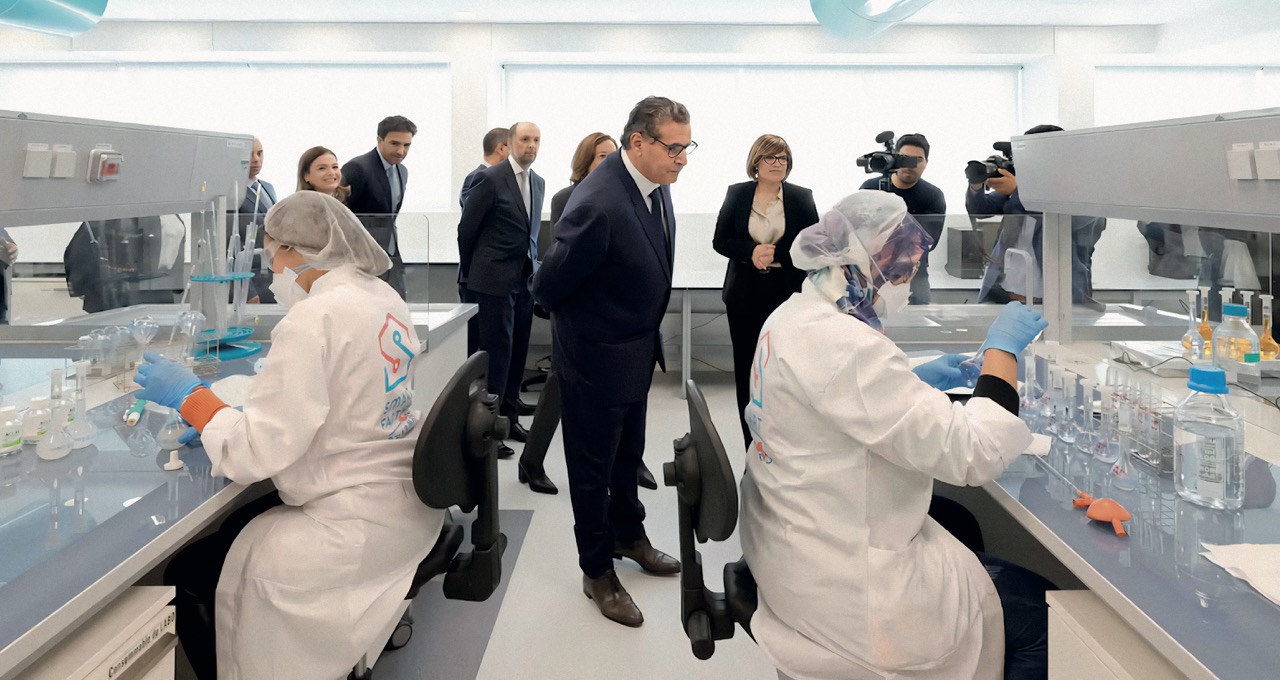
Yet in the wake of announced withdrawals by several international laboratories from low-profit markets, some see an opportunity to be seized. “This opens up space for Moroccan manufacturers—especially generics producers—to expand their portfolios and strengthen their competitiveness,” says a pharmaceutical industry expert. According to her, major national players already have the industrial capacity and investment needed to move upmarket, provided the state plays its role as a catalyst.
Because that is the core challenge: replacing the withdrawal of multinationals with a credible rise in local production—without ever compromising therapeutic quality. But this requires strong political will, a clear strategic direction, and above all, a coherent message that balances price regulation with market attractiveness. It is precisely on this point that the comparison with the United States—however disproportionate it may seem—takes on full meaning.
By brandishing the weapon of “fair pricing” against pharmaceutical giants, Donald Trump didn’t just initiate a pricing reform—he launched a showdown, making it clear that the interests of American patients come before those of shareholders. A confrontational stance, backed by a state apparatus determined to carry weight at the negotiating table. Morocco, too, must take advantage of this global rebalancing to finally strengthen its own bargaining power with pharmaceutical companies.
Written in French by Younes Saoury, edited in English by Eric Nielson.


