

A few kilometers north of Agadir, Taghazout is a place where the Atlantic Ocean offers some of Morocco’s most renowned waves, attracting thousands of surfers from around the world each year. The fishing village’s destiny shifted in the 1970s with the arrival of the first international surfers, primarily from Europe.
This interaction with wave-loving foreigners, often in search of freedom and untouched natural spaces, planted the seeds of an unexpected transformation. The surfers’ presence gradually introduced new values and customs: yoga, meditation, and environmental respect are now part of the local culture.
In the 1990s, entrepreneurs, first foreign and then local, invested in creating surf camps and guesthouses. Today, Taghazout and its surroundings « have more than 78 officially registered surf schools, not counting those operating informally, » says Saïd Bella, co-founder of Taghazout Surf Expo. Since 2022, this event has brought together well-known figures from the global surf community.
Fishing, once vital to the area, is declining in the face of this new economy, especially as the region struggles with dwindling fish stocks and competition from foreign fleets. Surfboards have now replaced fishing boats, drawing surfers and tourists seeking authenticity.
The rise of surfing has created new opportunities for the local youth. Many young people from Taghazout and neighboring villages are turning to the surf industry, often due to a lack of alternatives (between 2022 and 2023, the unemployment rate in the Souss-Massa region saw « a significant increase of 2.1%, rising from 11.4% to 13.5%,« according to the High Commission for Planning), with an additional 22,000 unemployed individuals, reaching a total of 119,000). For some, however, it’s also because they are « convinced that surfing is the future of Taghazout, » as shared by Hamid, a young surfer from the area.
More and more young people are starting their own businesses, often self-funded, and are venturing into activities such as training, equipment sales, and managing accommodations.
Taghazout Surf Expo: a favorable offshore breeze
Taghazout Surf Expo, whose third edition took place from October 24 to 27, aims to provide an international showcase for the surf ecosystem. This unique event on the African continent does more than gather enthusiasts and fans; it brings together researchers, entrepreneurs, local government representatives, and members of civil society.
« We are from the region and have observed the transformation of villages like Tamraght and Taghazout, from fishing villages to surfing destinations. We grew up here and witnessed these changes, » explains Saïd Bella. « Returning from our experiences abroad, we discovered a vibrant local economy centered around surfing, with friends starting businesses around this activity. »
The idea to organize an event emerged in 2015-2016, but the Covid crisis accelerated the plans: « The need to revive this economy was clear, » he says, especially since the original goal of Taghazout Surf Expo was also to demystify the image of surfers and the surf industry.
Taghazout Surf Expo thus stands as an innovative platform for exchanging and sharing ideas. Beyond the sport itself, it is an agora: the goal is to foster essential discussions on the economic, social, and environmental challenges of surfing in the region.
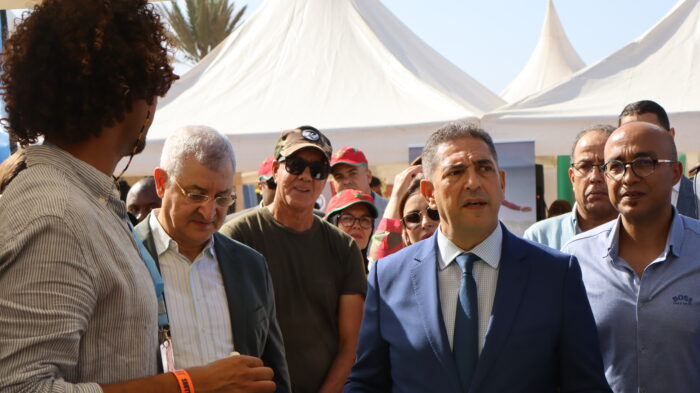
For Saïd Bella, Morocco has an invaluable asset: the diversity of its surf spots. « Our Atlantic coast, from Tangier to Lagouira, is a blessing. We have beautiful spots, » he emphasizes. Anchor Point (located near the village of Taghazout), for example, accommodates all surfing levels, from beginner to expert, with four additional spots nearby.
“If the waves aren’t working at Anchor Point, they’ll be working at Anza, and so on,” Bella explains. Moreover, Morocco is only three hours from Europe, where the surf market is already substantial and growing rapidly. However, the surf season in Europe is limited to just two months a year, while Morocco can host surfers almost year-round.
Bella’s vision for developing surfing goes far beyond events: « If we want to develop surfing economically, we need to build up surf tourism, surfing infrastructure, access to the sport, and accommodation and transportation for surfers, » he argues. Unlike conventional tourists who seek typical hotel packages, surfers spend more diversely, contributing directly to the local economy through a dispersed circuit.
Beyond tourism, Bella also sees an industrial opportunity in surfing: « Today, all surf brands produce in countries like China or Thailand, » he explains. Thanks to its proximity to Europe, Morocco could develop local production of surf equipment, reducing transportation costs and the carbon footprint of products, thereby meeting the demands of a particularly dynamic European market.
Anchor Point: A future international hub?
Let’s return to Taghazout and Anchor Point. Behind the famous waves that draw surfers and enthusiasts, the Souss-Massa Regional Tourism Development Company (SDRT) hopes to make this area a model of integrated and sustainable tourism, respecting “the environment and local culture.” During the third edition of Taghazout Surf Expo, SDRT Director General Abdelkrim Azenfar presented a vision where each detail aims to enhance the region’s appeal without compromising its uniqueness.
As part of diversifying the tourism offerings in the Souss-Massa region, SDRT has conducted development studies for key areas like Anchor Point. The goal is to create a “light-impact surf village” with minimal environmental footprint. “We’ve looked at examples from Portugal and other global surf spots. However, this site includes an argan forest, and we must respect the natural character of the area, which means we can’t aim for very high occupancy rates,” cautions Abdelkrim Azenfar.
This approach aims to minimize impact on the argan forest and ensure coexistence between tourist facilities and local flora, an essential asset in a region where nature is a core part of the visitor experience. It also limits land use to 6-7% of the total area, or around 30 hectares, with 20 hectares allocated to tourist infrastructure and the remainder dedicated to pathways and common spaces. This caps total accommodation capacity at approximately 500 beds, a challenge SDRT plans to address by “innovating with unique lodging solutions integrated into the natural environment.”
Managing this project thus requires a delicate balance between ambition and preservation. Unlike the Taghazout Bay resort, which spans a large area and is managed by the Taghazout Resort Development and Promotion Company (SAPST), smaller projects of 30 to 50 hectares, like Anchor Point, lack a single developer. Each investor is free to build, impacting the architectural harmony of the projects. “In the long term, we risk ending up with very different concepts, sometimes disconnected from one another,” warns Azenfar.
« We want to bring a touch of modernity without compromising the village’s authenticity »
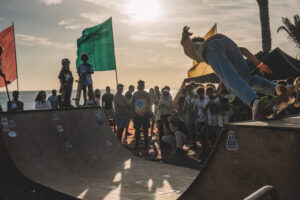
The development of Anchor Point and Taghazout, however, goes beyond accommodations. The goal is to offer tourism activities that enrich the visitor experience, a need that SDRT’s director general identifies as « crucial. » Complementary activities to surfing, such as yoga and trekking, will be encouraged to increase the region’s appeal to tourists seeking wellness and nature.
In the rural hinterland, financial support covering up to 50% of the investment is also available for lodging facilities, with a dual objective: to renovate existing installations and to encourage the creation of new projects. « To maintain the authenticity of these areas, new developments will be rental-based, with the land remaining state-owned and under strict control to ensure the original design remains unchanged, » Azenfar explains.
A double-edged development
The economic success of Taghazout, however, raises crucial questions of sustainability. The region is facing dual pressure: an increasing demand for tourism and rapid development, symbolized by the ambitious Taghazout Bay project. This initiative aims to provide high-end hotel infrastructure and recreational spaces to attract international clientele, but the offerings and prices may not appeal to certain surfers who seek a more authentic experience that aligns with their values beyond just the waves.
Can Taghazout and its surroundings continue to develop without sacrificing their culture and social harmony? A solution advocated by many researchers is to preserve a “globalized margin,” a space where modern infrastructure coexists with local practices that respect the environment.
The future of Taghazout will thus depend on the region’s ability to find a balance between the economic demands of tourism, local cultural values, and ecological imperatives. At the center of all these variables: surfing.
Written in French by ElMehdi El Azhary, edited in English by Eric Nielson


