

The port of Tanger Med is structured around three activities. The roll-on/roll-off (ro-ro) port enables almost half a million trucks to make the journey between Morocco and the Old Continent every year. There is also the passenger port, which enables millions of visitors to enter Morocco via its northern tip, with particular intensity during the Marhaba period (June to September).
But perhaps the most talked-about activity for Tanger Med in 2023 was container transport. Nearly 17 years after its inauguration, the port complex now tops the international rankings in this field. Last March, it made the top 20 of the world’s busiest ports, according to the French analysis firm Alphaliner.
With almost 9 million TEU containers (twenty-foot equivalent units, a measure of port traffic) handled in 2023, Tanger Med, the Mediterranean’s leading port, overtook historic leaders such as New York and Hamburg. The port thus joins a very select club, dominated by Shanghai with almost 50 million TEU containers, and Rotterdam with 15 million TEU containers.
Tanger Med also stands out for the quality of the services it provides. In 2023 and 2024, the complex ranked 4th among the world’s most efficient ports in the CPPI (Global Port Performance Index) ranking drawn up by the World Bank and analysts Standard & Poor’s.
The downside? The port could be a victim of its own success, as it is on the verge of overcapacity. Nevertheless, its managers remain confident in their ability to overcome this challenge. And to validate the achievements that have enabled them to rank among the world’s elite, while developing the other activities that have made the port such a success.
Circumstantial growth..
Rachid Houari isn’t as delighted as one might think when asked about Tanger Med’s recent accolades. While he gives credit to the international rankings, the Deputy General Manager of the Tanger Med port authority nevertheless points out that these accolades were awarded at a time when « container activity recorded a growth of 13%. A good performance indeed, but still a long way from those recorded at the height of the Covid crisis (20% growth in 2020 and 24% in 2021) ».
During the health crisis, the world’s shipping maps were reshuffled. Already renowned for its efficiency, the port of Tanger Med has become an essential point of passage for ships whose stopping points have been reduced.
« The major flows from Asia, with millions of containers, were supposed to reach the Mediterranean via Singapore and the Suez Canal. Instead of nine ports of call, the ships had to choose six. And Tanger Med was one of the most competitive ports on this route », says Rachid Houari.
And the figures prove him right. In 2020, container activity grew by 20%. The upturn is confirmed in 2021, with a growth of 21%. And between 2019 and 2023, container traffic at Tanger Med rose from 4.8 million to 8.6 million TEU containers, according to the latest annual report from TMSA, the holding company responsible for Tanger Med Port Authority. This represents an increase of almost 85% in just four years.
According to some experts, Tanger Med has also been able to take advantage of other crises affecting international maritime traffic, starting with the real threats in the Red Sea.
As Paul Tourret, Director of the Higher Institute of Maritime Economics of Nantes (ISEMAR, Institut Supérieur d’Economie Maritime de Nantes ), puts it: « The Red Sea crisis has redirected certain shipping routes, intensifying transshipment in strait ports such as Algeciras, Tanger Med and Las Palmas. The Strait of Gibraltar, which used to be an exit from the European zone, has become a gateway. To date, shipowners have adjusted their operations accordingly. The situation continues to be monitored for persistent risks. And even if there is less disruption in the Red Sea, shipowners won’t take the risk of going back« .
But if there has been a redirection of maritime traffic, its impact has so far been barely felt on the Tanger Med side, brushed off Rachid Houari: « Tanger Med is quite simply perfectly placed, whether you’re coming from the Suez Canal or southern Africa. The recent increases in tonnage, and therefore in containers, are not simply due to the incidents in the Red Sea ».
…structural explanation
The reasons for Tanger Med’s success are more structural than circumstantial. The port complex, like other international-standard ports, benefits first and foremost from a strategic location chosen by King Mohammed VI himself.
« The Strait of Gibraltar is one of the world’s two main container crossroads, linking Europe to Africa and serving as a passage between the Mediterranean and the Atlantic. It’s a bit like a mirror. It’s a crucial point for shipping routes to Northern Europe, North and South America and Africa, » explains Paul Tourret.
In a market dominated by Asia – notably the Chinese ports and the port of Singapore – the Western Mediterranean (stretching from Valencia in Spain to Sines in Portugal, and including Tangiers) accounts for almost 15% of world traffic, or 30 million TEU containers according to the expert’s estimates. Morocco has also benefited from the Tanger Med project and its integration into a powerful industrial backline.
« Tanger Med has redefined the landscape thanks to its extensive capacities and competitive costs, particularly in terms of labor. Morocco offers great handling capacity on the southern shore, where major shipowners such as MSC, Maersk and CMA-CGM are based« , stresses the French specialist. In short, Tanger Med was well-equipped to take advantage of the various crises that have affected maritime transport. The port’s emergence even outstripped the forecasts of its managers.
Expansion vs. productivity
« According to our plans, we were to reach 9 million containers in 2027. But we got closer to that figure in 2023, which means we’re almost four years ahead of our estimates, » says Rachid Houari, Deputy Managing Director of the Tanger Med Port Authority. However, Professor Najib Cherfaoui, a specialist in port management, is more nuanced: « It’s not that the port has achieved its objectives ahead of schedule, it’s more that we made a mistake in our calculations and failed to anticipate ».
Nevertheless, Tanger Med managers and experts agree that the port is on the verge of reaching its theoretical maximum capacity of 9 million TEUs. Could those in charge be considering extending the port to increase its container capacity?
« Tanger Med can no longer expand because there is no continental shelf in the region. The Strait of Gibraltar plunges abruptly into the ocean. We can’t build a breakwater and expand the port. Which means that next year, Tanger Med will still be handling 9 million containers », says the Moroccan specialist, almost fatalistically.
Those in charge of the port’s infrastructure, however, are more optimistic, even if they are reluctant to comment on a possible extension. « I think the question is premature (…) It’s not because activity is growing at a certain rate that we should immediately hypothesize an extension. What is certain is that Tanger Med is equipped to exceed its theoretical capacity, and intends to do so », says Rachid Houari.
Rather than gamble on an extension, Tanger Med’s managers have decided to improve its productivity. They cite as an example the performance of terminals managed by APM Terminals (a subsidiary of the Maersk group). « Last year, TC1 (container terminal 1), which is managed by APM, came close to the 2.5 million container mark, even though on paper it is equipped to handle 1.5 million containers« , notes Rachid Houari.
In a recent press release, APM Terminals even announced that it would be increasing the capacity of its Tanger Med terminals in view of the « exceptional performance » achieved. Planned for 2025, phase 3 of APM Terminals’ development in Tangier will enable it to expand its capacity by one million TEU containers. And according to expert Paul Tourret, with enhanced productivity, the port can handle an annual flow of 10 million TEU containers.
Preparing for the World Cup
But Tanger Med’s managers also have other priorities to juggle with. While they are keen to maintain their performance in the logistics field, the port’s managers are also aiming to develop the roll-on/roll-off port, through which both passengers and haulage trucks pass.
By 2023, some 478,000 lorries – or a queue of lorries some 9,500 kilometers long, equivalent to four Tangier-Guerguerat journeys – will have used the eight berths (sections of quay specialized in loading and unloading cargo) and the 35 hectares of quay land (space artificially created to extend the port’s surface area and enable various activities on the ground, such as the transport or storage of goods, etc.).
Tanger Med currently handles 1,300 trucks a day, and could handle 1,900, for a capacity of 700,000 trucks. And with business set to grow at an annual rate of 7% between now and 2035, the port’s ambition is to develop twelve new berths and an additional 86 hectares of open land, which could enable it to absorb 1.3 million transport trucks, according to Rachid Houari’s estimates.
The extension will also include the passenger port, which can accommodate 7 million people. Last year, it welcomed 2.7 million passengers (up 30% on 2022), including 1.6 million during the Marhaba 2023 operation alone.
The port’s managers are well aware of the growth in activity, but also of the future challenge represented by the organization of a World Cup around the Strait of Gibraltar. The cost of the extension project is estimated at almost 450 million euros, of which 200 million could be raised from the International Finance Corporation (IFC), a subsidiary of the World Bank. Announced several months ago, the deal has not yet been finalized, according to our sources.
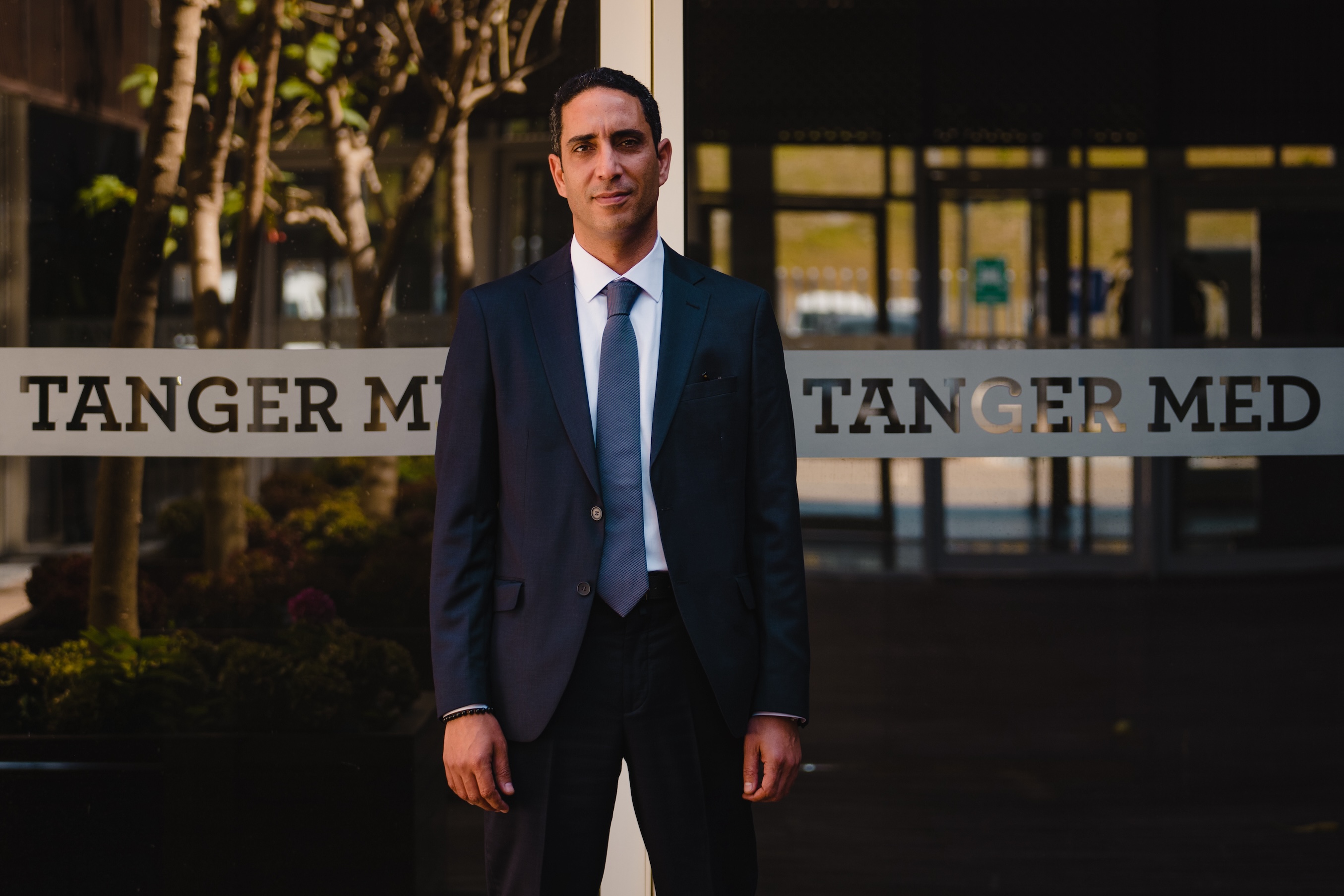
As we are about to conclude our interview, Rachid Houari is cautious. Perhaps to remove any doubts we may still have about the project’s success, he invites us to keep a sense of perspective.
« Today, we’re talking about more than 8 million containers transiting through Tanger Med. In the first year, we didn’t even do 100,000, a tiny fraction of current activity. We had to believe it: many experts were saying that Tanger Med would only be able to handle a maximum of one million containers« . As the port’s comings and goings continue, beyond his window, the manager takes a moment and smiles: « Fortunately, the experts were wrong ».
Export: Tanger Med on the move
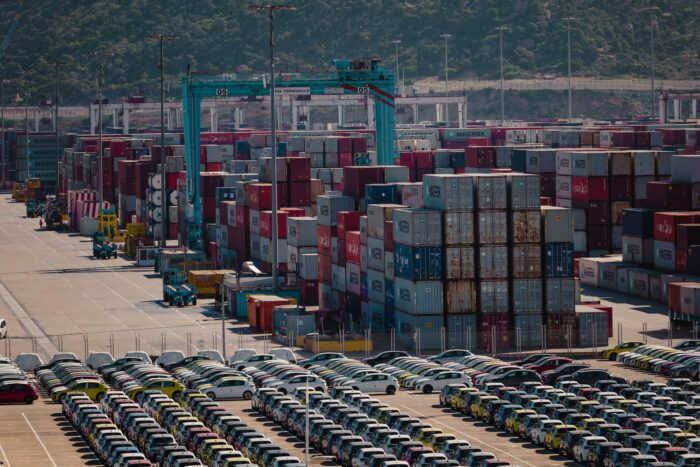
Against the backdrop of the turquoise sea, thousands of brightly-colored cars wait patiently for their turn to begin their journey. Lined up with almost military precision, they were produced a few weeks ago at the Renault and Stellantis factories in Morocco.
This spectacle, visible from the office of the Managing Director of Tanger Med Utilities, is revealed as we discuss the performance of the port complex’s logistics platform.
In 2023 alone, the port’s two terminals, the « Terminal à Véhicules Renault (TVR) » and the « Terminal à Véhicules Multiutilisateurs (TVCU) », saw a total of 578,446 vehicles destined for export pass through them, an increase of 21% on the previous year.
This traffic mainly includes 341,758 vehicles for export, produced by the Renault plants at Melloussa and Somaca in Casablanca, as well as 176,208 vehicles produced by the Stellantis plant in Kenitra[/frame]
Written by Yassine Majdi, edited in English by S.E.


