

The European Union (EU) is playing all its cards in the industrial battle. Its latest instrument is the Carbon Border Adjustment Mechanism (CBAM), which aims to establish fair competition between European and imported products, thereby curbing the relocation of industrial companies from the Old Continent.
In effect since October 1, 2023, with a three-year test phase, this mechanism defines, from 2026, the level of the “carbon tax” to be paid by companies whose products exceed the threshold of greenhouse gas emissions tolerated within the EU.
On the other side of the Mediterranean, the Tanger Med Group intends to take full advantage of the situation. Developer of more than 3,000 hectares of industrial and commercial zones at the gateway to the continent, the port complex, which is home to over 1,300 companies in the automotive, aeronautics, textile, agri-food and logistics sectors, has already embarked on its green transition.
With an investment of 2 billion dirhams, a roadmap has been drawn up from 2022 to help manufacturers in the north of the country to decarbonize their production and maintain their competitive edge.
From wind power to solar energy
“In recent years, we have seen strong demand from manufacturers for renewable energy, which is often cheaper than conventional energy in Morocco, in addition to the challenge of decarbonization with the introduction of the carbon tax at EU borders”
“In recent years, we’ve seen strong demand from manufacturers for renewable energy, often cheaper than conventional energy in Morocco, in addition to the challenge of decarbonization with the introduction of the carbon tax at the EU’s borders”, assures Zakaria El Bouamri, Managing Director of Tanger Med Utilities, a long-standing provider of resource management services for the industrial and logistics zones developed and managed by Tanger Med.
In concrete terms, the group is actively trying to produce green electricity for the users of its ecosystem. Two major projects should help achieve this goal: a wind farm and a solar power plant. The first, currently under development near the port complex, on the hill of the Logistics Free Zone, will have a capacity of 15 MW and will supply the port directly, before injecting the surplus into the industrial zones. Commissioning is scheduled for the second quarter of 2025.
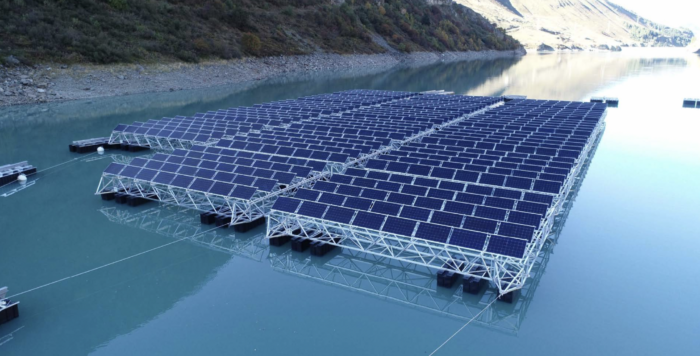
More ambitiously, the Tanger Med Group is also planning to build a floating photovoltaic solar park on the Oued Rmel dam
More ambitiously, the Tanger Med Group is also planning to build a floating photovoltaic solar park on the Oued Rmel dam reservoir. Covering an area of 8 hectares, the future solar power plant will have an initial output of 13 MW, which should eventually rise to 26 MW.
Faced with the lack of available land around the port, located in the heart of a mountainous region, the group chose to develop a floating park. “It’s difficult to find 8 or 10 hectares in the region that could be used for a solar farm. Inside the port, even the landfalls are managed and optimized to the maximum for logistical needs. So the floating park was the obvious choice,” explains Zakaria El Bouamri.
Ready for 2026
Manufacturers are waiting for the start-up, but above all, they need visibility. They need to be told that in 2026 or 2027, they’ll have over 80% or even over 90% renewable energy. With the mechanisms and projects we’re working on, we’re confident we’ll be able to honor these commitments.”
According to the manager, the two projects currently being deployed should be able to cover up to 90% of industrial needs in the region from 2026, and provide a green kilowatt-hour 15% cheaper than the price of conventional electricity.
“Manufacturers are waiting for the start-up, but above all, they need visibility. They need to be told that in 2026 or 2027, they’ll have over 80% or even over 90% renewable energy. With the mechanisms and projects we’re working on, we’re confident that we’ll be able to meet these commitments,” says the CEO of Tanger Med Utilities.
But demand remains strong. And production from these 2 parks will not be sufficient. Tanger Med will have to adapt. According to our information, the group is currently in discussions with private wind farm developers with a goal to purchase their future production and make it available to the zone’s industrial companies. A further argument to attract investors to Tanger Med. “Green electricity at a competitive price. What more could you ask for?” sums up a consultant closely following developments in the zone.
Decarbonization all the way
In addition to decarbonizing electricity for industrial customers, the group is also committed to making renewable energy available to ships transiting through its port, in line with the EU’s carbon tax, which also takes into account CO2 emissions when transporting goods.
Since February 2024, an Onshore Power Supply system has enabled moored ships to connect to the port complex’s local electricity grid, thus avoiding the use of their on-board diesel generators and reducing polluting gas emissions
Since February 2024, an Onshore Power Supply system has been installed on 800 meters of quays at Tanger Med 2, enabling moored ships to connect to the port complex’s local power grid, thus avoiding the use of onboard diesel generators and reducing polluting gas emissions. The system is scheduled to be rolled out across all Tanger Med terminals by 2026, and will save more than 100,000 tonnes of CO₂ per year at the port complex.
Last but not least, Tanger Med officials are keeping their eyes riveted on the development of green hydrogen projects in the kingdom, which would in future meet operators’ needs for green fuels. An action plan has already been put in place to prepare the necessary infrastructure for the deployment of green mobility solutions.
This program also includes the future conversion of the entire port complex’s fleet of service and operating vehicles to electric and green hydrogen vehicles. By 2030, the Group also aims to develop the production by electrolysis and distribution of green hydrogen, with a projected capacity of 3,000 tonnes of hydrogen per year, which will be made available to customers at all port terminals.
Written by Safae Hadri, edited in english by S.E.


