

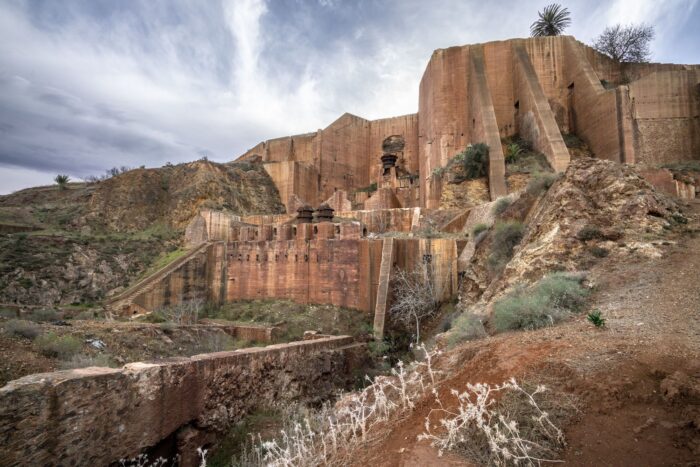
You have to step back to appreciate the sheer scale of the place. The San Daniel processing plant, built in 1932 on the slopes of Jbel Ouichane, about ten kilometers southwest of Nador in the Beni Bou Ifrour mountain range, spans a vertical drop of 94 meters. All that remains is a tangle of buttresses, staircases, and vertical walls. The Ouichane mining site (from the Tarifit word Ouixane), of which San Daniel is the heart, was closed in the 1970s.
This industrial heritage is largely forgotten today. The concept of industrial heritage—whether factories, mines, workshops, transportation infrastructure, or workers’ housing estates—only began to gain recognition in Europe in the second half of the 20th century. Long considered too recent or lacking in aesthetic value, these sites are now fully integrated into policies for the protection and promotion of cultural heritage. Certain iconic sites, such as the Völklingen Ironworks in Germany, inscribed in 1994, or the Ironbridge Gorge site in England, listed in 1986, even appear on UNESCO’s World Heritage List.
While the Kingdom cannot boast an industrial tradition comparable to that of Western Europe, it nonetheless is home to several remarkable sites that deserve recognition and promotion, such as the Ouichane mining site.
An indelible mark
This site was long one of the most important in the Kingdom. Now closed, the mines have left an indelible mark on the landscape, but also on the history of the province of Nador. In total, it is estimated that between 1915 and 1976, the year of its closure, 60 million tons of iron ore were extracted from the three sites of the deposit. Several remnants are still visible: two sites equipped with desulfurization furnaces, a few elements of workers’ housing complexes, but above all the colossal San Daniel processing plant. It was there that the extracted ore was crushed and sorted.
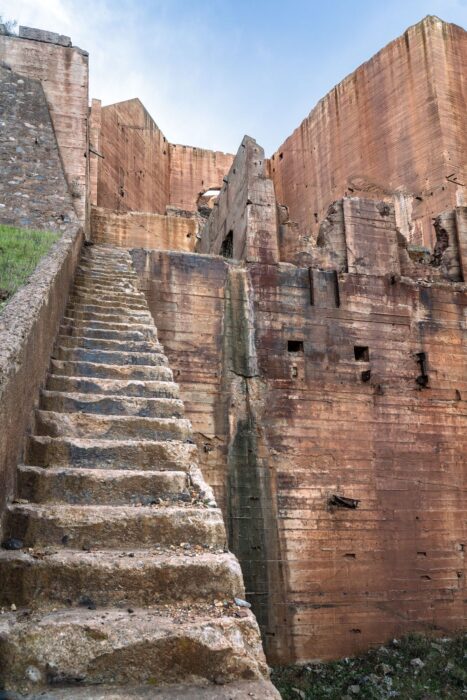
Access to the site is from above, after passing through the village of Ouichane, via a road that does not offer a full view of it. There is a large esplanade, a few ruined buildings, and—the only non-mineral touch in this landscape—a solitary palm tree overlooking the cliff where the processing plant stands. You need to step back a bit to grasp the monumentality of the site. Built in 1932, the structure—whose concrete has taken on the ochre hue of iron oxide—towers on the mountainside. The interlacing of buttresses, staircases, and vertical walls gives the site the air of a half-buried Mayan pyramid.
A Prelude to the Rif War
The modern history of Ouichane begins in 1905, when the Spanish geologist Alfonso del Vallo discovered a major iron deposit composed mainly of hematite and magnetite (two minerals rich in iron oxide). Named “Mines du Rif” by the Spanish, this site played a central role in their ambitions in Morocco. They quickly began negotiations with Jilali Ben Driss Zerhouni El Youssefi, also known as Rogui Bou Hmara (the man with the donkey), a warlord and smuggler who controlled parts of the North and Eastern regions at the time. He, who also claimed to be the half-brother of Sultan Moulay Abdelaziz, granted them a concession.
Mohamed Améziane, a tribal and religious leader whose territory encompassed the lands in question, seeing his rights violated, called for war against the Rogui before turning his attention to the Spanish. In 1908, attacks against European workers forced them to seek refuge in Melilla. In 1909, the construction site of the 28-kilometer railway line intended to connect the mines to the port was in turn targeted.
This attack provoked the anger of the commander-in-chief of Melilla, who, on July 9, 1909, mobilized three brigades to dislodge Améziane’s troops entrenched on Mount Gourougou. But on July 27, 1909, during the battle known as the Barranco del Lobo (Wolf Ravine), and despite the use of heavy artillery, the Spanish army suffered a severe humiliation and heavy losses… A foretaste of the Rif War. As for Rogui, captured in 1909, he perished under tortures from another era (read *La Mort du Rogui* by Maurice Le Glay—not for the faint of heart).
Despite resistance from the Rif, the site was put into operation in 1914 by the Compañía Española de Minas del Rif (CEMR), a company incorporated under Spanish law but 80% French-owned. Initially, the site yielded only modest returns. Industrial mining of the deposit did not truly begin until the mid-1920s, after the end of the Rif War and the surrender of Abdelkrim El Khattabi. From then on, production and profits continued to rise, peaking in the 1950s, leading to the boom of the city of Melilla, through which the ore was exported.
A fool’s bargain and social tragedy
Upon independence, the state took a keen interest in this mining gem. What followed were a decade of extremely difficult negotiations in which economic and financial considerations intertwined with a tense political context (the Ifni War of 1957–58). Initially, on April 15, 1959, the government of Abdallah Ibrahim acquired 26.65% of the capital and secured three seats on the board of directors. Then, in 1967, the Spanish finally sold off all their assets. SEFERIF (Société d’exploitation du fer du Rif à Ouichane et Iberkanene) succeeded CEMR.
While this transaction was viewed by some in Spain as outright expropriation, the Moroccan side saw it more as a fair return to the status quo, but also as a fool’s bargain: the Spanish had allegedly oversold a deposit with overestimated reserves. Indeed, SEFERIF quickly depleted its surface layers.
The exploitation of deeper deposits with high sulfur content proved economically unfeasible as the raw materials crisis emerged in the 1970s. The site was eventually closed, leaving thousands of workers unemployed. And added to this social tragedy is another legacy—this one environmental—due to the extensive pollution caused by 60 years of mining.
Written in French by François Beaurain; edited in English by AngloMedia Group.


