

While awaiting the rollout of desalination plants, which are expected to produce 1.7 billion cubic meters of water per year by 2030 and thus ease Morocco’s structural water stress, drinking water supply still relies heavily on dam reservoirs. After seven years of drought, winter rains have brought some relief, with significant water inflows into the dams in recent weeks, making it possible to move out of the danger zone for drinking water until summer, according to hydrologist Mohamed Jalil.
For Rabat, Salé, and Casablanca, water is primarily treated at the Bouregreg station of the Office national de l’électricité et de l’eau potable (ONEE), before being conveyed to these urban areas. With an installed production capacity of 775,000 m³ per day, this complex represents one of the largest dam water treatment plants in Africa, and supplies nearly nine million inhabitants.
In addition to this station, the city of Casablanca also benefits from the Oum Azza treatment plant, with a production capacity of 430,000 m³ per day.
From the Sebou to the Bouregreg
“By 2030, the entire Rabat-Casablanca area will be supplied with desalinated water”
But this model is set to evolve. Lahoucine Boubkeur, regional production director for Casablanca-Settat at ONEE-Branche Eau, points to the future commissioning of desalination plants along the Atlantic coast. He tells us that by 2030, the entire Rabat-Casablanca area will be supplied with desalinated water, while dam water will be increasingly directed toward agriculture and other strategic reserves. For the time being, the Bouregreg station benefits from interconnection with the Sebou basin to supply this area.
In August 2023, the Garde du Sebou dam was connected to the Sidi Mohammed Ben Abdellah dam, within the Bouregreg-Chaouia hydraulic basin. This interconnection has helped reinforce the region’s drinking water supply. The surplus water from the Sebou basin, previously discharged into the Atlantic, is now conveyed to the Rabat region.
Thanks to two pumping stations, 15 cubic meters of water per second arrive in the capital, or nearly 440 million cubic meters per year, Lahoucine Boubkeur informs us. To date, more than 950 million cubic meters of water have been transferred via this new interconnection. Over the long term, the goal is to also connect the Oum Er-Rbia, a major basin in the kingdom.
Water treatment
From the intake tower at the dam, pre-treatment is initiated by adding 3 to 4 grams of chlorine per cubic meter of water, Abdelilah Belhaj, director of water quality control at the Office national de l’électricité et de l’eau (ONEE), tells TelQuel. « We inject it for bacteriological treatment, and the treatment of organic matter, iron, manganese, and possibly ammonia, » he specifies. This first treatment, called pre-chlorination, acts throughout the water’s transfer to the station, which takes one to two hours.
Another process is also used as an alternative to pre-chlorination: the injection of ozone, once the water has arrived at the station. « This product has certain advantages over chlorine. It is effective against microbiology, virology, and also the elimination of parasites, » explains Abdelilah Belhaj. Depending on water quality and operating conditions, ONEE alternates between pre-chlorination and pre-ozonation. In Morocco, only the Bouregreg station has this ozonation process.
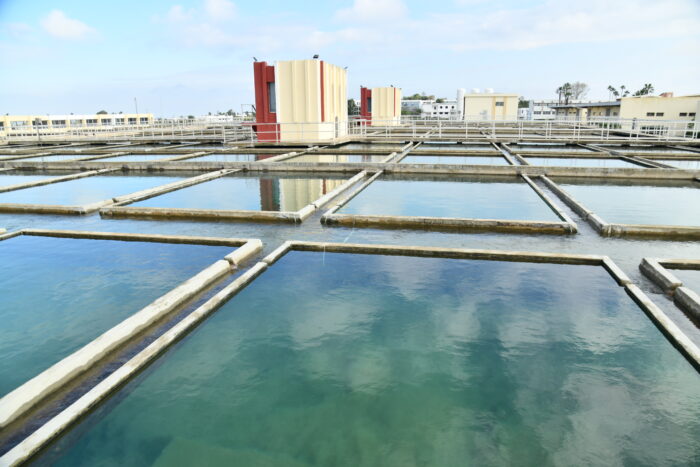
Once at the station, the raw water arrives in what is called an intake structure, where most of the treatment reagents are injected. « The most widely used reagent remains aluminum sulfate, which destabilizes clay particles, » notes the director of water quality control. This stage corresponds to flocculation, the grouping of small particles into clusters (flocs) to facilitate their separation from the liquid. Other flocculants are used to facilitate this process.
“In reservoirs, if the water stagnates, it can have an earthy or musty taste. It is a natural taste. But it is perceived by the population if left untreated”
Powdered activated carbon can also be added to remove bad tastes and odors generated naturally. « In reservoirs, if there is water stagnation and eutrophication (the enrichment of water with nutrients, promoting algae growth, ed.), the water can have an earthy or musty taste. It is a natural taste. But it is perceived by the population if left untreated, » he elaborates.
Filters and clarifiers
The water then passes through clarifiers. « In general, at the end of this stage, the water is almost clear, this is what we call clarification, » he indicates. Next come the sand filters. These retain the residue to reduce turbidity, which measures how cloudy the water is.
During the final disinfection, chlorine is added to remain present in the drinking water, at around one gram per cubic meter. « After the injection of chlorine, the water leaving the station is drinkable, » concludes Abdelilah Belhaj. He also mentions a final adjustment using caustic soda, which slightly raises the pH. « This is not for health reasons, but to ensure the water is not aggressive or corrosive toward materials and infrastructure, » he specifies.
From the departure structure, the water is sent to four destinations: Casablanca, Rabat, Salé, and Rommani. The distributor, — henceforth the regional multi-service companies (SRM) —, then takes charge of conveying this domestic, and therefore drinkable, water to households. The potability of water across the kingdom is ensured by a network of 120 ONEE laboratories, overseen by the central laboratory located at the heart of the Bouregreg station complex.
Tests at the central laboratory
The central laboratory monitors and controls the quality of drinking water, whether it comes from dams, desalination plants, or groundwater. « The objective is to protect the health of consumers, and that of the environment, » comments Hamoucha El Boujnini, head of bacteriological and parasitological analysis at the central laboratory.
She adds that the laboratory also conducts more analyses than what is recommended by national regulations, which has allowed it to obtain numerous certifications. She mentions, for example, a unit created for the detection of microscopic algae, in order to monitor water quality in dam reservoirs. « Since we are a reference laboratory, we have put in place this type of analysis to ensure quality, and to take preventive action in the event of deterioration, » she shares with us.
Divided into several sections, the laboratory carries out chemical analyses of minerals as well as organic micropollutants. This latter department focuses on the presence of pesticides and polycyclic aromatic hydrocarbons, which can emanate from industrial processes. « Nearly 200 pesticides are screened for during analyses. But fortunately, we don’t find them, as these are still drinking water analyses, » explains Saida Zaza, head of the organic micropollutant analysis department.
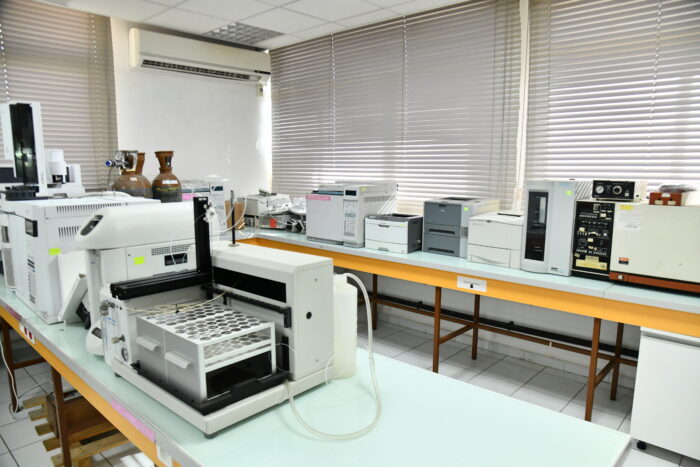
As for PFAS, the forever chemicals making headlines in Europe, they are not currently screened for at the laboratory. Saida Zaza justifies this by the complexity of the analysis — thousands of PFAS exist — and notes that in Morocco, standards regarding PFAS have not yet been established. « But we need to prepare for it, » she states.
For potability purposes, organic micropollutant analyses primarily monitor trihalomethanes, byproducts of chlorine disinfection. The teams in this department also focus on compounds responsible for taste and odor. While the water is assuredly drinkable, some people prefer to drink bottled water due to the taste.
What affects the taste and odor of water
“Drinking water in Morocco is strictly controlled. What comes out of the population’s tap is water that has no harmful impact on health”
What can alter the taste of water? When interviewed previously, Houda Bilrha, head of the water quality and public hydraulic domain preservation division at the Ministry of Equipment and Water, first pointed to the different regions of origin. « Depending on the geology of the soil, one water can be more saline than another. The salinity level meets standards, but it may fall in the higher range, » she mentions by way of example.
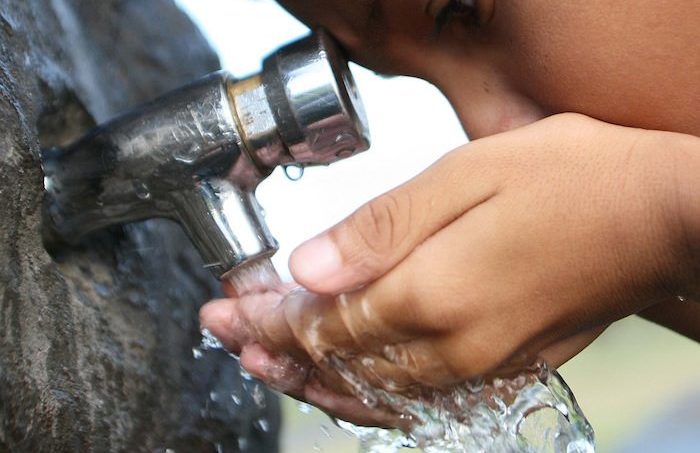
As for odor, Houda Bilrha believes it can intensify during drought conditions, when water must be pumped from lower levels of the dam, where algae growth occurs, for example. « In that case, we are talking about food safety, which has nothing to do with water potability, which is linked to what has an impact on health. It is an odor that comes from certain elements found in dams or groundwater, but which do not affect human health, » she specifies, adding that food safety can also relate to the color of the water.
« Of course, sometimes color is an indicator of pollution. But drinking water in Morocco is strictly controlled. What comes out of the population’s tap is water that has no harmful impact on health, » she reminds us.
Written in French by Salomé Krumenacher, edited in English by Eric Nielson


