

As waiting lists grow in public hospitals and access to care remains an uphill battle for many insured patients, another system of coverage is quietly taking shape. In several cities across the Kingdom, local associations offer citizens surgical procedures in private clinics, with no direct or indirect costs. Available only to those holding basic health coverage (CNSS, CNOPS, or AMO-Tadamon and AMO-Achamil), this offer attracts many patients, often with limited means and in urgent need of care. Yet behind this apparent generosity, this intermediary system raises many questions.
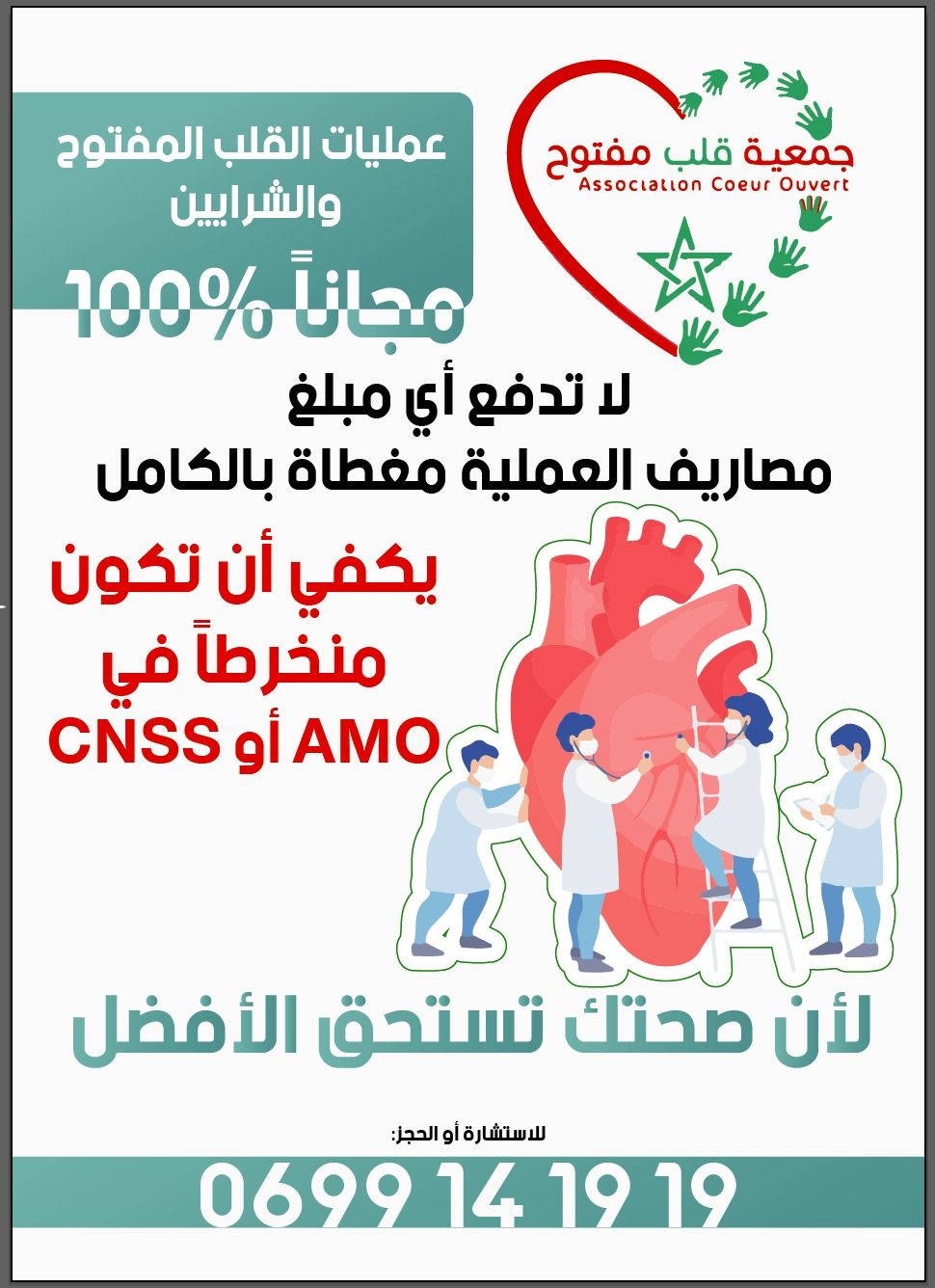
Among the organizations active in this field, the Association Matquich Houmti claims to cover several types of procedures: hernias, goiters, hemorrhoids, gallbladder surgery, uterine cysts, liver cysts, and even open-heart surgery. Other associations, like Sanad, based in Guercif, claim to cover costs for similar conditions, with a particular focus on heart surgery, often one of the most expensive procedures. Some even specialize exclusively in this type of operation.
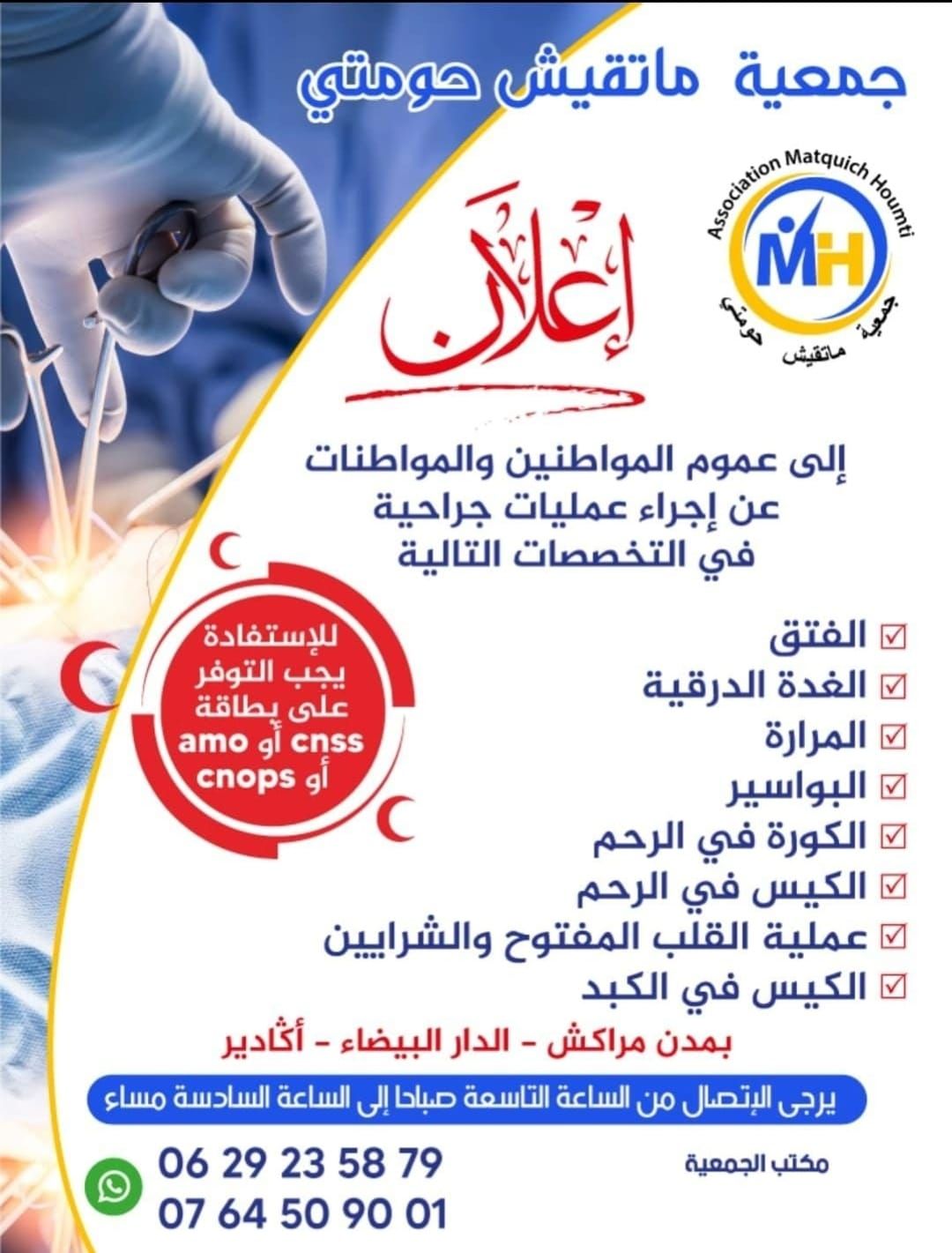
On social media, testimonials abound on the Facebook pages of these associations, praising the efficiency and free nature of the service. Verifying the truthfulness of these testimonials, often posted as videos, remains difficult, however. At the center of the question is: how does this system actually work, and what is the exact nature of the relationship between these associations and the so-called « partner » private clinics?
As queues continue to grow longer in public hospitals, a parallel healthcare system is forming around certain associations, unknown to the general public, which promise to cover surgeries that are sometimes complex and costly. But behind…
— TelQuel (@TelQuelOfficiel) July 25, 2025
A well-oiled system
To understand the modus operandi of this system, TelQuel contacted the heads of several associations, including Matquich Houmti, multiple times, posing as a potential patient. At no point were any fees mentioned, either directly or indirectly. However, the prerequisite was clearly stated: having active health coverage. From the very first exchange, it is requested that a copy of the national ID card (CIN) be sent, a precondition for scheduling an appointment with a partner clinic.
“I need to send the CIN to the doctor to start the coverage process,” explained one of the officials, after going through a series of questions about health coverage, place of residence, and the nature of the condition, in a tone and pace reminiscent of call center standards. A well-oiled mechanism.
Once this first step is completed, the association sends the patient a list of medical exams to perform: lab tests, imaging, preoperative assessments. Based on the results, they set a surgery date in coordination with a doctor, then direct the patient to a private clinic.
One worrying detail: in some cases, associations require that the patient send their entire medical file via WhatsApp, including their medical and surgical history. “I’m going to forward it to the surgeon, it’s to save time,” one of our contacts casually remarked, with marked benevolence.
A practice that raises concerns. “Associations do not have the right to review patients’ lab or radiology reports. This is not within their prerogatives and, above all, constitutes a violation of Law No. 09-08 on the protection of individuals with regard to the processing of personal data,” warns an expert on health coverage, contacted by TelQuel.
According to information gathered from these associations, the procedures are offered in several cities across the Kingdom. In Marrakech, the Association Matquich Houmti explicitly cites the Clinique Internationale, a subsidiary of the CIM Santé group. In Agadir, it notably mentions the Tilila Clinic, as well as another private facility located in Hay El Mohammadi. In Casablanca, however, no slots would be available “before the month of September,” we are told. Other associations also refer to clinics belonging to the Oncorad and Akdital groups, as well as smaller facilities established in various cities across the country.
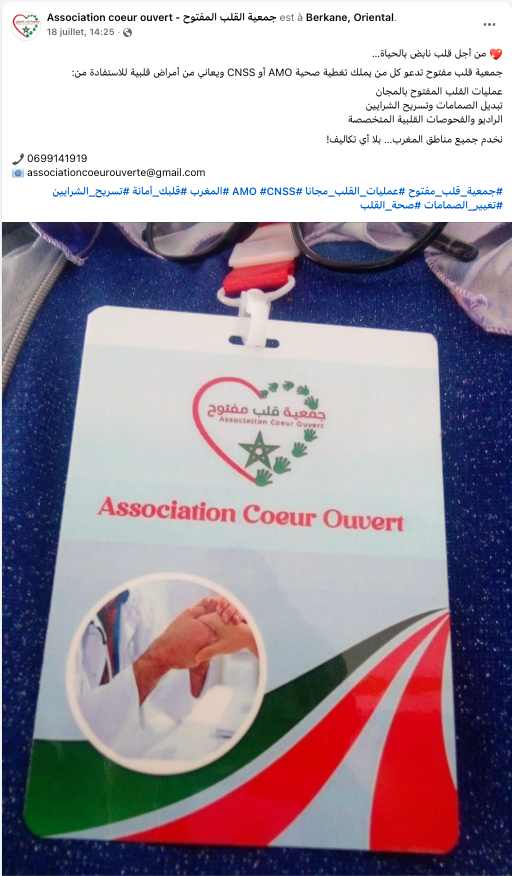
When charity becomes a cover
Practices that, despite their apparent generosity, raise numerous questions: lack of a formal framework, opaque handling of personal data, unclear links with private healthcare facilities… For if the procedure is presented as “completely free” for the patient, who is actually covering the co-payment, the portion not reimbursed by insurance plans for the majority of surgical procedures?
“These associations use the banner of solidarity and charity as a cover, but in theory, they are obliged to guarantee the actual free nature of the surgical procedure by paying the remaining amount themselves,” recalls a healthcare sector insider. He adds: “Given the often high cost of the procedures they cover, it is legitimate to question the real financial capacity of these associations to cover everything. Otherwise, it amounts to deception.”
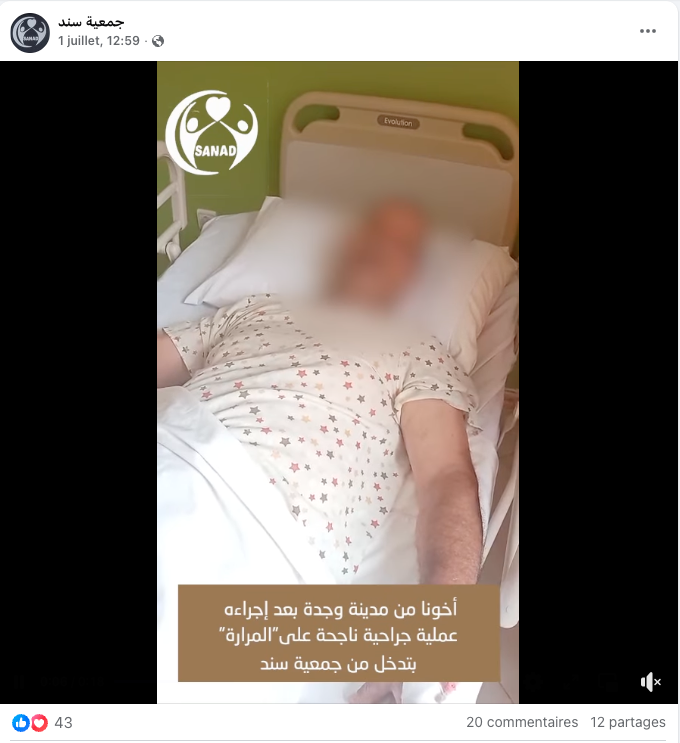
A first observation is clear: browsing the Facebook pages of these associations reveals nothing to suggest they have substantial financial resources. Their other declared activities are often limited to distributing basic food supplies in remote villages. Neither the quality nor the quantity of these goods indicates any significant budgetary commitment. Moreover, these actions are frequently carried out in partnership with other associations, themselves modestly funded.
Another revealing element: a significant portion of the posts is devoted to activities with a strong religious connotation—collective Quran recitation sessions, amdaḥ nabawiya, or reports on charitable distributions in isolated areas—far from structured medical communication.
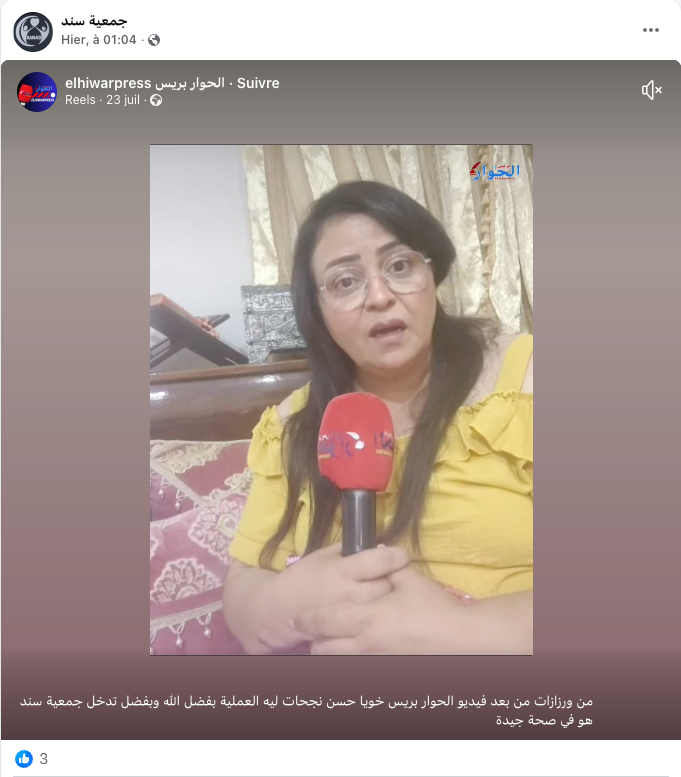
Even more troubling, one of the associations regularly shares posts from another Facebook page that presents itself as a “free and independent media platform.” Yet this page has no website, and its content is almost exclusively devoted to promoting the activities of the said association. A clear attempt to legitimize and amplify the visibility of these charitable actions? Everything points in that direction, even though, in principle, solidarity should not require a showcase.
The rebate business
Behind the spiritual and charitable veneer, a well-oiled mechanism seems to be taking shape. While religious posts and reports from the villages paint a picture of piety and dedication, other clues suggest a more pragmatic strategy focused on capturing patient flows. As one traces the exchanges, discussions, and promises of “free” surgeries, a question arises: what benefits do these associations and private clinics derive from this intermediation?
Asked by TelQuel, Fahd Charaâ, CEO of the CIM Santé group, denies any involvement of his group in this mechanism. He asserts that he has “never called upon an association to play this role.”
Specifically questioned about the Clinique Internationale in Marrakech, mentioned by the Association Matquich Houmti, he is categorical: “We work with structured associations, within a clear framework, such as the Association of Ulemas or the police association. Their members receive certain benefits, but we never use a structure to bring us patients. In fact, it is a practice I strongly denounce.”
Fahd Charaâ notes that the Clinique Internationale in Marrakech is regularly at full capacity: “Why would I seek patients through an association when I don’t even have available beds?” The executive emphasizes the group’s independence from any non-contracted associative structure.
The same goes for Akdital. Contacted by TelQuel, Abdelkoddous Hafsi, director of communications and public relations for the group, rejects any direct or indirect link with local or national associations acting as intermediaries. “Anything charitable goes exclusively through the Akdital Foundation, 100% funded by the group,” he explains.
He stresses that this foundation intervenes only with people in precarious situations, lacking medical coverage, and in urgent need of care. “The contact is made directly between the Foundation and the individuals concerned, or their relatives,” he explains, before concluding: “Our doctors have sufficient renown to attract patients. Do we really need intermediaries to recruit them?”
A hypothesis, presented by some as a certainty: “Some associations operate on behalf of small clinics that struggle to fill their bed capacity”
A clarification that further undermines the narrative promoted by some associations regarding their supposed links with private hospital facilities. If neither the CIM Santé group nor Akdital acknowledge any agreements or partnerships with these structures, on what basis do the associations direct patients? And more importantly, how is care provided once patients are sent to these clinics?
Several industry insiders, speaking anonymously, put forward a hypothesis, presented by some as a certainty: “Some associations operate on behalf of small clinics that struggle to fill their bed capacity.” Others reportedly collaborate with “practitioners who still have difficulty building a patient base.” In both cases, these operations would be carried out in exchange for “rebates” paid for each patient referred.
The co-payment stake
These same associations regularly highlight the “free” nature of open-heart surgeries. Yet, according to several industry professionals, this type of procedure is fully covered by AMO, as are many other long-term and costly conditions. The real issue lies in the co-payment, the portion not reimbursed by insurance.
Several collected testimonies report patients being directed to small private clinics, where they were asked to pay the remaining balance “to speed up the scheduling of the procedure”
This is where the problem lies: several collected testimonies report patients being directed to small private clinics, where they were asked to pay the remaining balance “to speed up the scheduling of the procedure.”
One of our sources adds an important detail: “At first, the associations offer the potential patient coverage in a facility belonging to a large private clinic group, but the patient ends up having the procedure in a small clinic,” he explains. The associations justify this change by “the lack of available space in the promised clinics, which would prolong the waiting time while the operation needs to be performed urgently.”
A more marginal, yet equally concerning practice was reported by another industry insider: “Some clinics, when processing a coverage request, manipulate the patient’s medical documents to artificially increase the reimbursement amount. This would allow them to cover both the co-payment and the rebates paid to the associations,” he says, while denouncing a drift that could undermine the financial balance of health insurance schemes.
Implicitly, these so-called “free” procedures are less about structured solidarity than about a parallel system, tolerated for lack of alternatives, where the line between charitable action and profitable arrangement remains blurred. In a country where access to healthcare remains profoundly unequal, these informal channels thrive on scarcity, medical urgency, and the absence of effective oversight.
The question remains: how long can this opaque intermediation continue without authorities questioning the need for strict regulation? According to an industry professional, a national investigation into these practices is currently underway. An assertion that, at this stage, the Ministry of Health and Social Protection has neither confirmed nor denied.
Written in French by Younes Saoury, edited in English by Eric Nielson


