

At the corner of the boulevards Anfa and Zerktouni, a 551-square-meter plot of land sums up the paradoxes of Casablanca: a piece of history erased, and a project undermined by opaque administrative decisions. On this parcel of land stood Villa Mauvillier, built in 1932 by Gustave Cottet—one of the era’s leading architects.
Neither the heritage dimension of the site, nor its symbolic value, slowed down the administrative machinery: curiously, this emblematic address was not included in the architectural heritage preservation plan, even though it was piloted by the Urban Agency. An omission which, in the midst of Casablanca’s transformation into a tourist and business hub, sounds like yet another renunciation of what underpins its identity.
Today, nothing remains of the Villa Mauvillier. On June 12, 2020, the Urban Agency and the then Wali of the Casablanca-Settat region, Said Ahmidouch, gave the nod for its demolition. So did Abdessamad Haiker, then vice-president of the local council in charge of urban planning. « I received the request from Tower Seven Art, the owner of the villa, ratified by the Wali, but also by the Urban Agency, which stressed that the project envisaged by the company was in keeping with the urban landscape of the area. So I put my signature to it », he assures us. Before his death, the building had changed hands: Ahmed Chamcham, owner of Tower Seven Art, had bought it for almost 30 million dirhams from the Bennis family.
The investment was driven by the developer’s stated ambition: to build a 14-story Marriott Bonvoy hotel on the site. A top-shelf establishment, intended to bolster the notoriously insufficient hotel room capacity in a city that dreams of being a business and tourism hub.
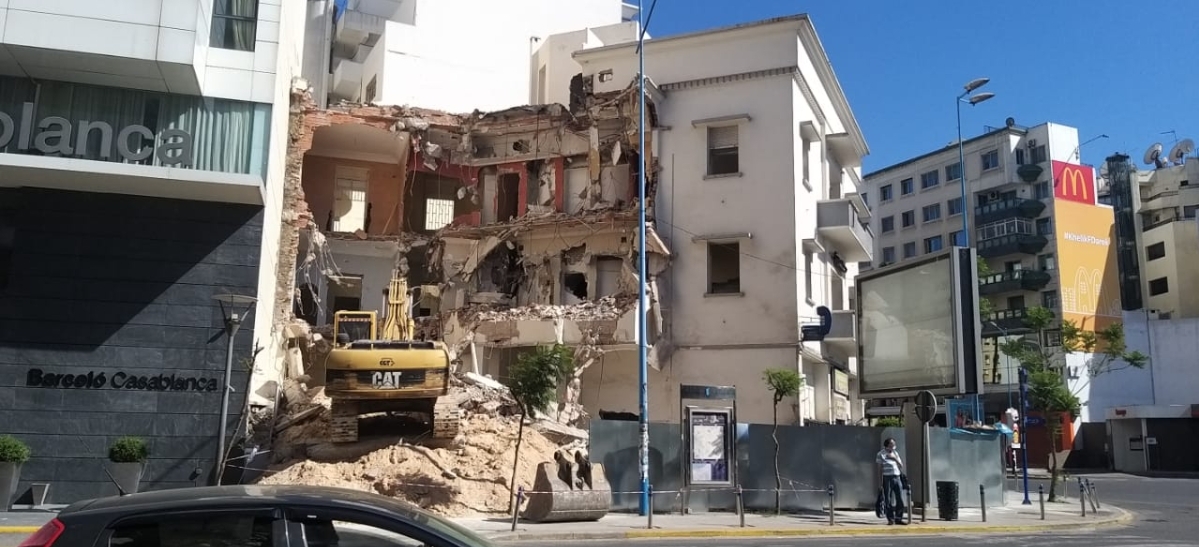
The demolition took place discreetly on a Sunday morning in June 2020 while Casablanca was mostly under COVID confinement. « Most demolition work on historic buildings is carried out at weekends, no doubt to avoid any mobilization of heritage defenders », observes an activist committed to preserving the city’s architectural identity.
A judicial soap opera with many twists and turns
But what was supposed to mark the beginning of a new urban page quickly turned into a soap opera with many twists and turns. First act: a notification from the Caïda of Sidi Belyout ordered an immediate halt to the demolition work. The reason given? Non-compliance and the absence of a worksite sign, required to give the work its formal legality.
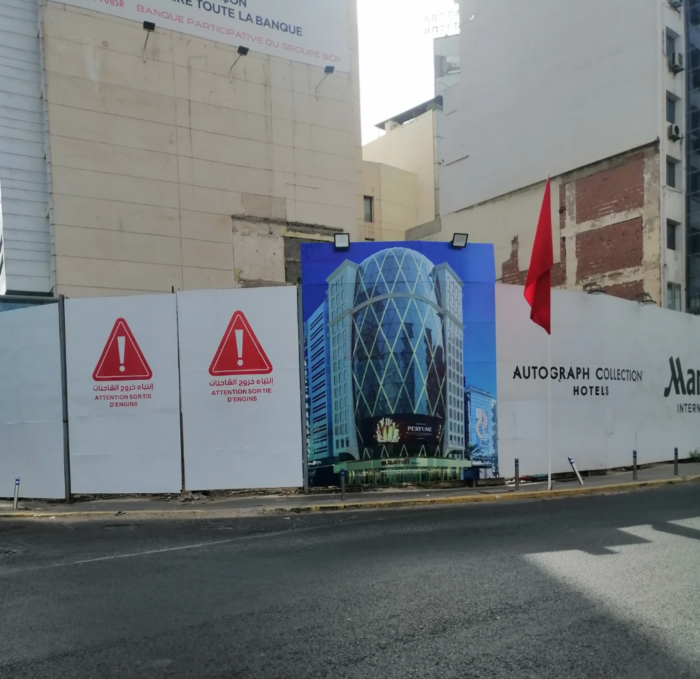
The case then went to court. A few weeks later, the Ministry of the Interior lodged an appeal. In mid-November 2020, the courts once again upheld the initial ruling: a verdict later confirmed by the Court of Cassation, which ruled in favor of the developer.
In the meantime, the developer has taken care to raise the palisade in line with the comments made. But the authorities have remained silent. The site has ground to a halt, with no official communication to clarify the situation. « Abdessamad Haiker, now a local councillor in opposition, explains : « The company had a building permit and could of course resume work.
Bolstered by the first favorable rulings, the developer therefore attempted a cautious resumption a few months later, in 2021. The shovels started up again discreetly. However, the legal drama soon resumed for a second season, following proceedings initiated by a mysterious plaintiff. It wasn’t until early 2025 that a new ruling was handed down, this time ordering an immediate halt to construction. The reason? « Difficulties in executing the decision » that had authorized the resumption of work.
This decision was overturned on appeal, leaving us to believe that the project would soon be unblocked… until June 5, when the judges once again ruled in favor of the plaintiff, confirming the existence of obstacles to the proper completion of the project. As for the plaintiff, his identity has not yet been revealed. The mystery deepens, while the project seems to be suspended ad vitam aeternam.
Express expropriation
But it’s not the season finale yet . Barely five days after this latest ruling, the Casablanca Municipal Council convened an extraordinary session. On the agenda were just four items, the first of which caught the eye: the expropriation for public use of the plot belonging to the Tower Seven Art company, « with a view to erecting a public facility ». And despite the opposition of 6 elected PJD members, the councillors ended up approving this expropriation for public use. The decision rekindled the controversy surrounding the Villa Mauvillier site.
According to Abdessamad Haiker, president of the PJD group on the Casablanca Local Council, it was the wali of the Casablanca-Settat region, Mohamed Mhidia, who initiated this extraordinary session, expressly asking the council president to put it on the agenda. Better still, he asserts that the agenda was partly dictated by the wilaya. And Haiker is astonished: « The Communal Council introduced the notion of public utility in the first item, whereas the version transmitted by the wali was limited to the approval of the expropriation decision ». In the elected official’s view, the change to the item on the agenda compromises the regularity of discussions, and renders any deliberations « non-compliant with current regulations ».
This interpretation is refuted by Lhoucine Nasrollah, third vice-chairman of the Local Council, who chaired the session in the absence of Nabila Rmili, who was on « official business ». He asserts that the notion of« public utility » was indeed included in the wali’s correspondence, and points out that the assessment of this notion falls precisely within the prerogatives of the Communal Council.
Another grievance raised by the PJD local councillor was the existence of a valid building permit for Tower Seven Art. In his view, this makes the expropriation procedure legally questionable. » It is forbidden to initiate an expropriation procedure on a plot of land that has already been the subject of a building permit, especially as work had already begun and the developer was in the process of laying the foundations », he argues, citing a number of similar cases.
A question of utility
Lhoucine Nasrollah does not share this view. For the Vice-President of the Municipal Council, the PJD councillor’s argument is unfounded. » Expropriation targets the land as property, and is not conditional on the existence or otherwise of a building permit issued to the owner », he explains. The law on expropriation stipulates that expropriation can only take place once it has been declared to be in the public interest », he insists.
It’s true that the area suffers from a crying lack of parking spaces. But with a surface area limited to 551 m², it’s hard to imagine that this plot alone will be enough to meet the neighborhood’s needs
But beyond this interpretative battle over procedural regularity, another fundamental question remains: what does the commune really intend to do with this plot? According to several elected representatives contacted by TelQuel, including a vice-president of the council, the chosen direction is to build a multi-story underground parking lot, coupled with a new administrative annex. It’s true that the area suffers from a crying lack of parking spaces. But with a surface area limited to 551 m², it’s hard to imagine that this plot alone would be sufficient to meet the needs of the neighborhood. As for the construction of a new communal antenna, it raises other questions: the commune has no shortage of land for this type of facility, in less controversial areas and with a clearer legal status.
It is also essential to question the validity of this expropriation decision, given that this plot of land was to house a hotel with over 100 rooms, and promised to create up to 100 direct jobs. A strategic project, especially in the run-up to the 2030 World Cup.
For Abdessamad Haiker, « no decision on the nature of the planned public facilities has yet been taken by the infrastructure commission ». He pointed out that the latter had met just before the extraordinary session convened by the Council Presidency. This statement casts doubt on the very basis of the decision to expropriate for public use.
Steering by sight
Any expropriation procedure must be preceded by a declaration of public interest (DUP). This declaration, which forms the legal basis for the operation, is issued by decree by the competent authority, in accordance with the provisions of article 2 of law 7-81 on expropriation for public use.
Before reaching this decisive stage, the law requires an administrative inquiry to be carried out by the president of the local council concerned. In particular, the project must be publicly posted at the commune’s head office for a period of one month, giving citizens and other interested parties the opportunity to find out about the planned operation and, where appropriate, to submit their observations.
« The timing of the extraordinary session, the failure to define the nature of the project to be built in place of this plot, and the absence of any clear justification of the public interest, cast a shadow over this decision »
The file submitted to the inquiry must contain a set of precise documents, detailed in article 5: a site plan, an explanatory note, the proposed development plan, as well as financial documents justifying the feasibility of the operation. The purpose of all these elements is to guarantee a degree of transparency in the process and to justify, in a well-argued manner, the public interest of the proposed expropriation.
These conditions do not seem to have been met in the present case. Abdessamad Haiker openly questions the legality of the process: « The timing of the extraordinary session, the failure to define the nature of the project to be built in place of this plot of land, and the absence of any clear justification of the public interest, cast a shadow over this decision. In his view, these shortcomings undermine the very legal basis for expropriation.
For those who have closely followed this legal and administrative soap opera, one thing is certain: the lack of clarity in the intentions and the pile-up of hasty decisions fuel the impression that the project is being steered by sight. Above all, the public interest argument brandished to justify the expropriation is hard to convince. As is so often the case in Casablanca, the length of the administrative process will be the key to clarity. It will probably be months, if not years, before we find out what will become of this small plot of land, once the promise of a luxury hotel and once the jewel in the crown of the White City’s Art Deco elegance.
Written in French by Younes Saoury; edited in English by AngloMedia Group


