
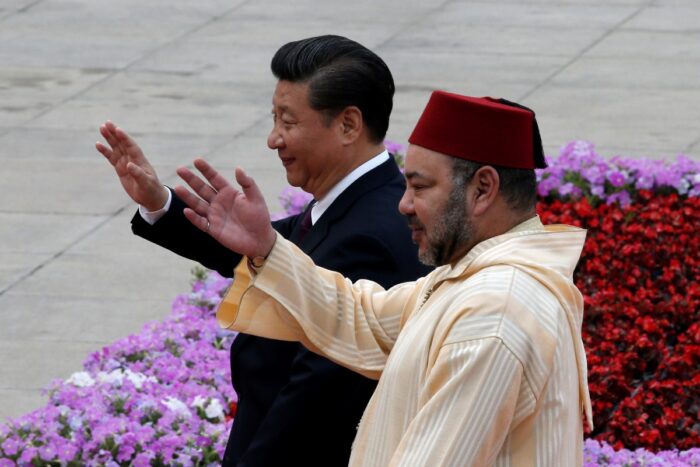
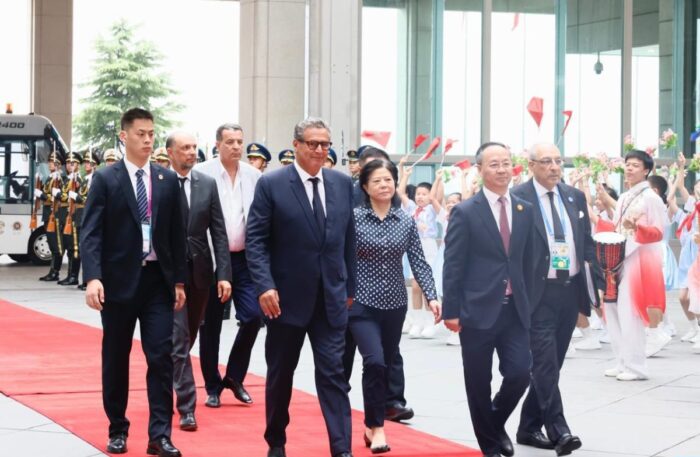
The rapprochement between China and Morocco in two images? First, King Mohammed VI’s visit to Beijing in May 2016. Then, Chinese President Xi Jinping’s brief stop in Casablanca, where he was welcomed by Crown Prince Moulay Hassan in November 2024.
Cultural exchanges, civilizational closeness, financial agreements, but also a shared entrepreneurial ambition… and a shared workplace: the ties being forged between the Kingdom and the Asian giant — thankfully — go beyond handshakes between leaders.
Within the Tanger Tech city, as in many gigafactories and Chinese companies established in the Kingdom, Chinese and Moroccan employees work side by side. These situations are expected to become more common. TelQuel therefore sought to learn more about the Sino-Moroccan work experiences that could reshape the future of employment in Morocco.
A small issue with punctuality…
As president of the Morocco-China Business Council at the General Confederation of Moroccan Enterprises (CGEM), Mehdi Laraki believes in the compatibility between workers from the two countries. “Moroccans and Chinese share a lot in common,” he says. Whether it’s the importance of relationships, the culture of gift-giving, respect for elders, or even simple interests like horses, tea, or board games, he observes human and professional practices capable of creating synergy between Chinese and Moroccan employees.
“But there’s one thing we’re really falling short on,” he laments, “and that’s punctuality.” From his professional experience with China, he’s learned one key lesson: “A Chinese person is never on time; they’re always early.” From now on, he applies that same standard to himself.
“Moroccans and Chinese share a lot in common”
Moreover, certain aspects of Chinese interpersonal relations are often unfamiliar to Moroccans, even though they are essential for maintaining cordial exchanges with the Chinese. “There’s a proper way to hand over a business card: with both hands, and don’t put it away — turn it over and place it in front of you,” he offers as an example. More importantly, “you must never cause a Chinese person to lose face, nor criticize their country. That’s something they absolutely do not tolerate, and for that, they might write you off for life.”
When interviewed by TelQuel, the Chinese embassy in Morocco emphasized shared values such as “the importance of family and hospitality.” While acknowledging fundamental and sometimes challenging differences, such as language or — often — religion, Beijing’s diplomatic representatives in Rabat believe these are offset by Moroccan entrepreneurship, which “focuses on building long-term trust-based relationships, perfectly aligned with the Chinese business philosophy.”
The diplomats also affirm that Chinese expatriates are making great efforts to adapt to the Moroccan environment. Learning Arabic and French, participating in local celebrations, “Chinese residents who have lived in Morocco for ten or twenty years are well integrated into the country’s daily life.”
Lessons from experience
According to the embassy of the People’s Republic, there is a model for Chinese companies in Morocco, and it’s fairly straightforward: “Chinese investment + local management.” A system that offers several advantages in terms of professional synergy, particularly “better collaboration between Chinese and Moroccan teams.” But what about the Moroccan perspective? Since the beginning of Beijing’s investments in the Kingdom, many work stories have emerged involving Chinese companies and Moroccan employees. TelQuel listened to two of them — whose experiences are not necessarily representative of all Chinese companies in Morocco.
The first, Reda*, is a manager at a Chinese company based in northern Morocco. One of the first things to note is that he feels close to his Chinese colleagues. “They’re quite multilingual, since many lived in Egypt or Algeria before coming here. And when it comes to religion, there are a lot of Chinese Muslims who come here — they can make up half the staff on some teams,” he says.
These favorable conditions have allowed our interviewee to make friends at work, “even if the atmosphere among colleagues is a bit unusual,” he admits. He observes: “No one says good morning in the morning, and in general, they’re very secretive about their personal lives.” To illustrate this, he shares an anecdote: “While talking about China with one of my colleagues, I found out he hadn’t even told his friends he was living in Morocco. He doesn’t want them to bother him about it.” A culture that initially unsettled our interviewee.
Reda, who has worked in Moroccan and European companies, was especially surprised by the way management operates. “It’s really in bulldozer mode. They’re absolutely not focused on risk mitigation, ensuring compliance, or following rules… That’s how they succeeded in their own country, but here, it works less well,” he describes.
In simple terms, in his company, “decisions usually come from the top, in China.” Then, on site, “they execute them without asking too many questions, and it’s difficult for us (Moroccans) to have any influence,” he explains. When the strategy hits an obstacle, the bulldozer returns. “When we try to explain that we can’t carry out a certain action without a specific guarantee, they respond, ‘Yes, yes, we’ve already done this elsewhere, we know so-and-so,’” he recounts.
The manager points out that in the mindset of the Chinese headquarters, Morocco is just one country among dozens in Africa. “They don’t really differentiate between investing in Togo or in Morocco. Yet here, the regulatory and administrative framework is much more complex. It’s not so easy to launch a business in Morocco, but that’s also what gives it staying power,” he suggests.
In the end, when reality catches up with strategy, it’s up to Reda to “clean up the mess.” He regrets a process that often leaves local employees out of the loop, assigning them only the task of “putting out fires.” Another example of this distance: staff face difficulties when it comes to obtaining certain information. “We often find ourselves stuck in our procedures because many things are ‘confidential.’” These challenges raise questions about the much-touted technology transfers the Moroccan state hopes for in partnering with Chinese giants.
Over a billion inhabitants, the world’s second-largest consumer market, cutting-edge industries… China is all that and more. Are Moroccan and Chinese cultures truly compatible in the workplace? pic.twitter.com/2VKL1Jp2MY
— TelQuel (@TelQuelOfficiel) June 12, 2025
Africa as a springboard
Adam*, for his part, has worked longer in a major Chinese tech company. He observed the same methodological patterns as Reda and explains it through the structure of hierarchy in China: “Top management is sacred.” To reach it, one must go through an entire structure that Adam likens to a “kind of anthill.” “The hierarchical chain is immense, and all important decisions, ultimately, are made in China, never in Morocco,” he emphasizes.
In this context, it’s hard to avoid a certain condescension, both interviewees note. The Chinese perceive Africa as a “blank slate (…) They see themselves as the ones who will open the door to renewables on the continent,” says Adam. For Reda, the young age of the expatriates also plays a role: “They’re often under 30. Sometimes they’re fresh out of school and convinced that China is the absolute best and that other (countries) are worth less.”
Adam explains that in very large companies, there’s a promotion mechanism based on international experience. Young Chinese graduates are parachuted into a country for a period of three to five years. Then, repeat the experience in a second market. “If they get good results, they can return to China with a strategic position within the company… and live like royalty back home,” Adam jokes, before pointing out the less amusing side effects of this system.
“Let’s say a young Chinese employee arrives in a French-speaking country. He comes in with a certain idea of the company’s policies, but above all with a fear of the hierarchy. To show quick results, he’ll try to impose a certain pace — in a market that may not respond to his expectations,” he explains.
More simply, this means that to please his superiors and speed up his promotion, a freshly graduated manager, out of zeal, is capable of “tearing down all the long-term development built by his predecessor.”
Cop story
Two factors fuel these behaviors. The first can be summed up in two words: revenue. More than any others, says Adam, large Chinese companies are obsessed with results. The second is the distance from decision-making. “To enter a market, headquarters don’t base their strategy on concrete studies or field feedback,” he explains.
According to him, Chinese executives tend to base their projections on data gathered online. But in some sectors, like renewable energy, to boost its appeal, “Morocco can make a lot of big announcements.” And that’s how “three or four official press releases” can shape revenue projections, even if the reality of the market allows for only a third or a quarter of that figure.
In other words, “if they ask for eight million in revenue and the market can only support four, they consider that not their problem.” Along the way, when the company doesn’t meet the target — “and that happens all the time,” he emphasizes — management will trigger meetings to understand the situation. “And despite that, they’ll still push us to reach at least 70% of the original goal, which is completely unrealistic,” he says.
This strategy is accompanied by a “reporting culture,” Adam observes. To ensure companies are doing everything they can, people are hired whose only job is to report on project progress: “For a while, every day, a Chinese woman would call me, stop by my office to ask why a certain order wasn’t placed, why the revenue didn’t hit the expected target, why this, why that…”
Reda shares a similar experience. “When I’m traveling, I have to file a report. I have to justify every expense, every trip based on the people I met… I’d never done that before,” he says. For a Moroccan who isn’t used to this culture, this kind of monitoring “can feel suffocating,” Adam points out.
The picture painted by our interviewees may seem grim. And yet, they don’t regret the experience. It’s also this natural selection within companies capable of generating enormous profits that partly explains the rise of the corporate giants we know today: BYD, Alibaba, Xiaomi…
And Adam, despite his critical view of how these Chinese giants operate abroad, insists that working for these large groups “is undeniably beneficial for career development. There are lots of interesting things to learn… But it’s sometimes difficult.”
*Name has been changed.
Written in French by Marin Daniel Thézard, edited in English by Eric Nielson


