

June 22 brought another sleepless night, as Russia pounded the city with over 300 drones and several missiles. Buildings of the prestigious Kyiv Polytechnic University, apartments and infrastructure were ablaze until the early hours. At the time of writing, 10 civilians have been killed, with over 30 injured. The death toll will continue to climb as time passes.
“I don’t even read the news anymore,” says Stas Donchenko, a young barista. “Knowing about the strikes will bring me nothing but pain,” he adds. “I won’t be able to help the people who suffered… Every night is worse than the last.”
Yet it was only a few days before, in the early morning of June 17, that Kyiv residents emerged from their homes looking dark-eyed and weary – as they have done too many times since the beginning of Russia’s full-scale invasion of Ukraine. The previous night, Russian forces struck the city with over 400 drones and over a dozen ballistic and cruise missiles, killing almost thirty people and injuring many more. It was the deadliest attack on the capital in over a year, over nine hours of air alarms, explosions, both far and close, and the whirr of drones overhead. At times, the sky glowed orange. The walls of my building shook. As it grew light, I decided to give up on any attempt to sleep. Many residents, though used to living under aerial attack, took the fastest route to the air shelters.
Most, including myself, comforted themselves with the favourable statistics and remained in bed. The likelihood of being killed or injured in the average attack stands at around 1/17,000. This figure ranks spending the night in Kyiv as approximately as dangerous as giving birth in a developing country or higher-risk mountaineering. For many, it’s acceptable risk. Birds were beginning to chirp as the air defence boomed into action for the last time.
Yet when will it all be too much for Kyiv residents? Olga Rutkovska, an art historian and campaigner, says that she has never considered leaving. “Ukraine is my love… I prefer to go through this difficult period on my land with my people. I am a fatalist and do not hide in bomb shelters.” The shelters do not offer total assurance of survival if hit. “Modern weapons can destroy any object,” Olga adds. “I am not afraid of bombings… I have repeatedly travelled as a volunteer in humanitarian missions to the ‘gray’ zone, closer to our defenders.”
As Elsa Court recently articulated in the Kyiv Independent, Russia seems to be utilising sound as a psychological weapon. Its Shahed-type drones, which emit a piercing whirr as they fly low over the city before reaching their target, are particularly frightening.
The boom of a ballistic missile hitting an apartment block is enough to raise the most hardened veteran from his bed in fear. “After a while, you use decibels as a basis for understanding how much danger you’re in,” Court writes.
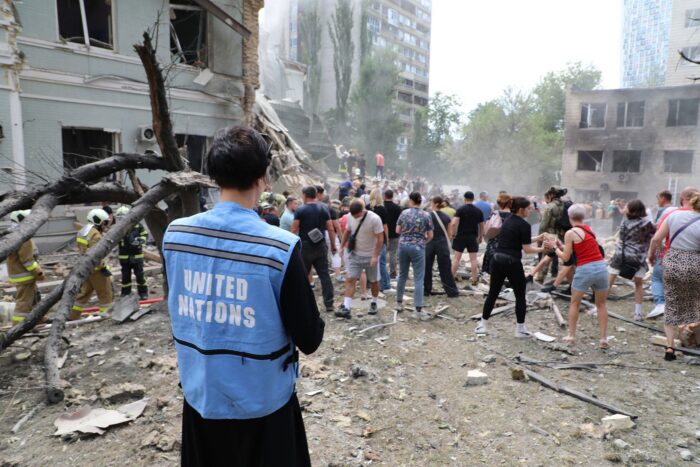
“The attacks have never been as intense and frightening as they are now,” says Anastasiia Kondrashova, a student. “In the past two months, there have been about ten missile hits within one kilometre of my home.” The danger of living under constant aerial attack has prompted Anastasiia’s family to consider moving to a safer part of Ukraine. “As for leaving Kyiv, yes… I’ve had those thoughts… my family and I have been considering moving to western Ukraine for a while, until the attacks ease. But we haven’t made a final decision yet.”
In eastern Ukraine, conditions are often worse. Kherson, a historical city which sits on the Dnipro River, faces the Russian forces amassed upon occupied territory on the opposite bank. Accordingly, the city is within artillery range, which has been regularly used on civilian targets. At the beginning of June, Human Rights Watch revealed that Russian troops had been deliberately targeting civilians walking in the street or in cars with drones. Residents in the city had reported what they called ‘human safaris’, accusing Russian troops of targeting civilians for fun or target practice.
Moscow has intensified its attacks on Ukrainian cities in recent weeks and is producing missiles and drones faster than ever, according to the Financial Times. While earlier in the war, Russia consistently attacked cities across Ukraine, from Kharkiv to Lviv, it now concentrates all its firepower on fewer cities. On the night of June 16, for example, only Odesa and Kyiv were significantly struck. This constitutes an attempt to overwhelm the cities’ air defence systems.
« Attacks do not cause fear, but rage and a desire to volunteer more for the Ukrainian military »
Kyiv mayor, Vitali Klitschko, claimed in a video that Russia had used cluster munitions in its attack on civilian neighbourhoods; “another clear sign of the genocide Russia is committing against Ukrainians.”
Volodymyr Zelenskyy, the Ukrainian president, said that the attacks were “pure terrorism” and “one of the most horrifying attacks on Kyiv.” Days later, the Ukrainian government reported on social media, search teams were still looking for survivors and bodies in the rubble of destroyed apartment blocks. The death count now approaches thirty, with over one hundred wounded.
A Russian spokesperson has claimed that they remain committed to only targeting sites associated with the Ukrainian military. Press agency images of children being pulled from rubble and smoke rising from across the city in residential areas lay waste to this claim. Its remotely controlled drones – simultaneously sending high quality images back to their operators – routinely hit civilian housing.
“We always respond and respond in kind. Therefore, our response will be very tough.”
“Russia does not target residential areas,” said Putin at a press conference with foreign journalists on June 19. The strikes “were not aimed at residential areas, but at facilities of the defence-industrial complex… at factories producing military equipment,” he claimed.
Putin, at the St. Peterburg International Economic Forum, recently spoke of “those whom we call neo-Nazis in Ukraine.” As Putin believes that Russia and Ukraine are one nation, he claims that Ukraine “belongs to [Russia].” Any Ukrainian attack on Russian soil would, according to Putin, result in a similar response. “We always respond and respond in kind. Therefore, our response will be very tough.”
Moscow has significantly stepped-up attacks on cities after Ukrainian military intelligence carried out ‘Operation Cobweb’, during which dozens of Russian stealth bombers were destroyed by drones on airfields deep within its borders.
Dmitry Peskov, a Kremlin spokesperson, recently affirmed during an interview with Sky News Russia’s desires for a strategically castrated Ukraine. They demand that Ukraine ceases to be “pumped up” with foreign weapons. The withdrawal of all such weapons would leave the country extremely vulnerable to Russian attack which, paired with Putin’s claims that Ukraine “belongs to Russia,” could likely result in an unstable peace. This was the key sticking point during talks in Istanbul, which ended in failure.
But does this form of warfare, as much psychological as strategic, have any effect on the morale of Kyiv’s citizens? “The attacks greatly interfere with life and at the same time have become a part of life for Kyiv residents. They do not cause fear, but rage and a desire to volunteer more for the Ukrainian military,” says Olga.
The calm before the storm?
On June 10, Pete Hegseth, the U.S. Defence Secretary, announced that the White House will reduce its budget for provisions for Ukraine in 2026, when Joe Biden-era pledges will be exhausted. This will only serve to widen the gap in spending between Russia and Ukraine – which already spends more of its GDP on defence than any other country globally. Given the failure of talks in Istanbul to bring the region any closer to peace, Putin appears committed to pressing ahead with conventional warfare.
“the presumption persists that enough aid and resolve will eventually break Moscow”
While the Kremlin’s grand strategy continues to be focused on making gains on the battlefield, its tactics are starkly different to those used at the beginning of its invasion. During its assault towards the strategically important city of Sumy, Russian troops have made use of motorcycles and civilian cars. Speed appears to be the new objective, with the Russian military showing few qualms in sacrificing large numbers of troops to gain little territory – the number of its casualties recently surpassed one million. Further south, Russian forces push to overrun Kostyantynivka, a key logistics hub for the Ukrainian military, also at great expense.
In Brussels, “the presumption persists that enough aid and resolve will eventually break Moscow,” writes analyst Elkhan Nuriyev in Politico. “But that is increasingly unlikely.” While Russia’s war aims have been greatly diluted – Putin had initially expected to take Kyiv within three days – the advantages that Ukraine has thus far enjoyed are waning. The most threatening domain is Kyiv’s paucity in manpower. How the country would fare against Russia without U.S. military aid is difficult to predict.
For the next few nights, an uneasy calm has replaced the drama of constant bombardment, as Russia re-stocks its missiles and drones. The odd air alarm goes unnoticed. How long until the next heavy attack, only the Kremlin knows. You wonder with what intensity the city will be struck, and the extent to which the air defence systems – already at maximum capacity – will be able to repel the assault.
Yet, during the day, normality reigns. In the fashionable Podil district, young journalists and marketing professionals drink cappuccinos and shop for vintage clothes. Techno events are held each weekend. An abundance of young amputees and men in fatigues are the only signs that, in the east, the nation fights for its survival against one of the most powerful militaries in the world. These moments of calm in Kyiv are precious, yet it’s unclear how much longer the capital’s residents will be able to keep blocking out the war.


