

On June 1st, in the corridors of the Ministry of Foreign Affairs in Rabat, faces were rather cheerful. It was a Sunday workday, certainly, but the mood was optimistic. It marked the culmination of nearly five years of behind-the-scenes efforts in London think tanks and the halls of Westminster, now nearing their conclusion. All lingering doubts faded in the face of the broad smiles shared by Foreign Minister Nasser Bourita and his British counterpart David Lammy as they headed toward a joint press conference.
In just a few minutes, the Rabat–London relationship would shift. The joint statement issued after the meeting between the two men would change the paradigm of relations between the two countries: “The United Kingdom considers that the Moroccan autonomy plan submitted in 2007 is the most credible, viable, and pragmatic solution to resolve this dispute.” A sentence that sounded like a revolution for a country that, for decades, had insisted on remaining neutral on the Sahara issue, limiting itself to supporting the UN process.
From that moment on, the distance traveled had to be acknowledged. Just a few years earlier, Morocco was nothing more than a forgotten dot on the map for His Majesty’s diplomats—a grey zone in Africa that Whitehall didn’t quite know how to handle. And Moroccan diplomacy was fully aware of it.
In response, a strategy took shape: infiltrate, persuade, seduce. A multi-year effort combining an influence campaign in London salons, lobbying in parliamentary corridors, charm offensives targeting influential think tanks, and an all-out business push. In this geopolitical game, a 21-minute parliamentary debate can have as much impact as years of traditional negotiations. To understand this diplomatic breakthrough, one must go back to the political context of the United Kingdom in the early 2020s.
Musical chairs at Downing Street
The story could have started off badly. At the beginning of the decade, the United Kingdom was going through a political crisis. Prime Ministers came and went at 10 Downing Street: Boris Johnson was ousted in 2022 after a series of scandals and was replaced by Liz Truss, whose historically short term—just over a month—would become the symbol of instability within the British Conservative Party. She was then succeeded by Rishi Sunak. This instability created a headache for Moroccan diplomats. Sources at the Ministry of Foreign Affairs recall: “It was difficult to find a stable interlocutor.”
Where others might have seen an obstacle, Moroccan diplomacy sensed an opportunity. “British politics runs in cycles,” notes an expert on the UK political scene. “A party usually stays in power for about 12 years before handing things over to the opposition. In 2020, the Conservative era was coming to an end. And the war in Ukraine hadn’t started yet,” our source continues.
Despite the “Global Britain” strategy launched to expand trade partnerships in a post-Brexit world, Rabat first had to “make itself heard” in an environment where “almost everyone was trying to carve out space,” the source adds. The challenge was immense.
The Kingdom was then suffering from a true geographic curse. In the offices of Whitehall, the Morocco file drifted somewhere between Africa and the Middle East, never quite finding its rightful place
The Kingdom was then suffering from a true geographic curse. In the offices of Whitehall, the Morocco file drifted somewhere between Africa and the Middle East, never quite finding its rightful place. British diplomacy classified the kingdom as a country in the MENA region, while Morocco presented itself as an African nation and projected its strategies across the continent. The result: a constant misunderstanding in how the file was handled. This confusion was far from trivial. Traditionally, London paid little attention to North and West Africa, viewing them more as a French sphere of influence, while the British focused their presence on East and Southern Africa. Morocco, therefore, had to make itself heard.
The charm offensive
In London, Moroccan diplomats deployed a strategy that had proven successful in other European capitals: multiply communication channels, occupy the space. The first battle was one of image—an effort to dispel certain clichés about the kingdom.
“Morocco is not just sunshine for vacationers or the country that produces Moroccan vegetables widely exported to the United Kingdom. Morocco is also a country where sunshine is transformed into clean energy capable of powering local industry and, why not, supplying energy to the United Kingdom,” representatives of the kingdom told their counterparts. That, in summary, was the message delivered to various actors on the British political scene in the early 2020s.
It was within this logic that XLINKS came into play. This private British submarine cable project, announced at the end of 2021, aims to transport electricity produced from Moroccan renewable energy to British homes. A game changer for Moroccan diplomacy, which seized on this opportunity.
“XLINKS allows us to change the narrative and make Morocco’s energy discourse more credible,” says an observer of the energy sector.
“XLINKS allows us to change the narrative and make Morocco’s energy discourse more credible,” says an observer of the energy sector. Admittedly, “governments have no direct involvement,” but the timing couldn’t have been better. “It’s a welcome development. The country is seen as forward-thinking, especially in the energy sector, and it helps showcase its achievements in the field,” our source continues.
This repositioning strategy was methodically deployed on all fronts. On June 5, 2024, post-Brexit trade relations were in the process of being rebuilt. That day, the Law Society in London—the heart of British legal tradition—transformed into a showcase for modern Morocco. The Morocco Investment Forum, organized by Invest Africa in partnership with the Moroccan embassy, brought together London’s top investors, decision-makers, and influencers under the prestigious “The Africa Debate” program.
Engaging exchanges at the Investment Forum co-organized with @InvestAfrica1 ahead of #TheAfricaDebate. With a great participation of the private sector & intl. investors, discussions showcased tremendous potential for intl. investments & concrete business opportunities pic.twitter.com/rr1dKdtVFe
— Morocco in UK (@MOROCCOinUK) June 6, 2024
Nothing was left to chance. Over four hours, a series of carefully choreographed panels unfolded. Leila Benali, Minister of Energy Transition and Sustainable Development, and Fouzi Lekjaâ, Minister Delegate for the Budget, set the tone from Rabat. On-site, Moroccan representatives took their turns at center stage: Tarik Hamane, then Acting Director General of Masen, Reda Hamedoun, Executive Director of Nareva, and Mehdi Tazi Riffi of Tanger Med.
On the British side, Daniel Horner of Dar UK spoke about “Morocco’s strategic initiatives,” while Stephen Orr of the British Chamber of Commerce Morocco represented British business interests in the kingdom. Morocco’s advantages were driven home: strategic geographic location, political and economic stability, and business-friendly reforms.
Former chief of staff to Mostafa Terrab at OCP, Morocco’s ambassador to the United Kingdom, Karim Hajoui, draws on his experience
The key sectors took the spotlight: renewable energy with a focus on green hydrogen, telecommunications, automotive, infrastructure… Not to mention the trump card of opportunities presented by the 2030 World Cup, co-hosted by Morocco, Spain, and Portugal—a prospect that dazzled London investors. Former chief of staff to Mostafa Terrab at OCP, Morocco’s ambassador to the United Kingdom, Karim Hajoui, drew on his experience.
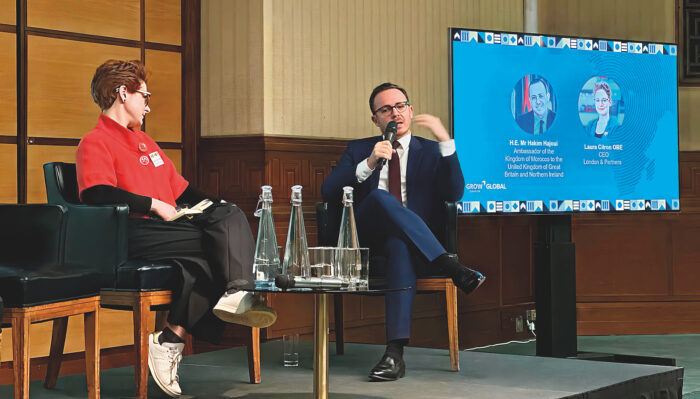
In conferences, he consistently highlights Morocco’s African roots, often citing the fertilizer policy implemented by the OCP group across the rest of the continent as an example. The diplomat can also be seen alongside Nigerian officials promoting the pipeline project between the two countries—once again, a project with a continental scope.
Human ties & Friendship will connect to as much as the new gas pipeline between our countries. @ChathamHouse 20th celebration of @AfricaProg with HE Gabriel Aduda, Nigerian Permanent Secretary – Ministry of Foreign Affairs & HE @SarafaTunjIsola, HICOM of Nigeria to the UK pic.twitter.com/FZHAbB22wC
— Hakim Hajoui (@AmbHHajoui) July 6, 2022
This positioning strategy aims to cement in British minds the image of Morocco as a regional leader in Africa. But the kingdom is not betting everything on business.
The security card
Morocco is also playing the security card. Officials emphasize the African foundation of the kingdom’s foreign policy, with communication focused on its strategy in the Sahel countries. “The main goal was to highlight the security-development nexus and the fight against illegal migration,” summarizes a source familiar with the discussions. The royal initiative for the Sahel is, in this context, widely presented to various British stakeholders: diplomats, parliamentarians, and security officials alike.
This strategic approach has taken concrete form through the strengthening of a long-standing military partnership. Since 1989, the armed forces of both countries have conducted the joint exercise Jbel Sahara, the latest edition of which took place in October 2024. Recently, this collaboration has expanded: British troops now participate in the African Lion military exercises, co-organized by Morocco and the United States. Forces from both nations also train together during the Flintlock exercise, organized by Africom, whose most recent edition was held in Côte d’Ivoire this past April.
Operational cooperation goes hand in hand with sustained institutional dialogue. As early as 2020, James Heappey, then UK Minister for the Armed Forces, visited Morocco, marking the start of intensified exchanges. In October 2024, Vice Admiral Edward Ahlgren, Senior Military Advisor for the Middle East and North Africa, met with the Minister Delegate for National Defense Administration, Abdellatif Loudiyi, as well as Abdellatif Hammouchi. This momentum culminated in March 2025 with the latter’s visit to London. The head of the DGSN (General Directorate for National Security) and the DGST (General Directorate for Territorial Surveillance) met with officials from MI5 (the UK’s domestic intelligence service) and the London police.
This institutional alignment naturally paves the way for business opportunities. Morocco has shown growing interest in the British defense industry, as evidenced by the mission organized by the ADS Group (Aerospace, Defence, Security & Space) in February 2025. The mission showcased British capabilities to Moroccan authorities and facilitated meetings with the defense administration, national police, gendarmerie, and other government agencies. This 2024–2025 sequence marks a deepening of security cooperation across all areas. On this front, the signals are clearly green.
Tories on the cake
While the economic and security machinery was being deployed, another, more subtle battle was playing out in the hushed corridors of Westminster Palace. “The British Parliament is the beating heart of political life in the United Kingdom. Ministers are regularly present there because they still represent their electoral constituencies. With all the debates, exchanges, and contradictions that occur, it’s a space where Morocco was able to make its voice heard,” summarizes a keen observer of British political life.
Work with the Tories began with “a Boris Johnson who seemed open to closer ties with Morocco.” But the Kingdom’s diplomats had to contend with the instability of the British government
Moroccan diplomacy carried out a “mapping” of MPs and Lords sitting in both houses of Parliament, using multiple pragmatic criteria. “Some have a genuine interest in Morocco, others in the scope of the Abraham Accords, and still others in energy issues,” a source who worked on the file tells us.
Work with the Tories (the British Conservatives) began under relatively favorable conditions, with “a Boris Johnson who seemed open to closer ties with Morocco,” the source continues. But the kingdom’s diplomats had to navigate the ongoing instability of the British government.
Gradually, “discussions and a convergence of views were initiated with David Cameron (when he was appointed foreign secretary under the Sunak government),” the source adds. The kingdom built up a base of support with a clear deadline in mind: the July 2024 general elections.
On May 8, 2024, Conservative MP Daniel Kawczynski advocated for Morocco’s cause during a 21-minute speech, highlighting the UK’s lag behind its Western competitors and even comparing the Polisario to the IRA
One man embodies the impact of Morocco’s message within the Tory party: Daniel Kawczynski. A member of the British Parliament since 2005 (until his defeat in July 2024), expert on the Maghreb and staunch opponent of the Polisario, he called for a parliamentary debate on May 8, 2024. He spoke for 21 minutes in support of Morocco, highlighted the UK’s lag behind other Western competitors, and even compared the Polisario to the IRA (the now-dissolved Irish Republican Army).
Bolder still, he publicly criticized the British ambassador to Morocco, whom he accused of being “an obstacle to recognition.” Coincidence? Simon Martin was recalled to London just a few weeks later. “Daniel Kawczynski is a real agitator,” says a source close to the matter when asked about the British MP. His impassioned intervention in favor of Morocco in Parliament was no accident.
A few months earlier, the British MP had visited the kingdom and met with Nasser Bourita. During his visit, he reportedly gained deeper insight into Morocco’s vision for development in the Sahara, as well as the prospects for a strengthened partnership between the two countries. His speech had an immediate and decisive impact.
“Thanks to that debate in Parliament, a space was created to pressure the British government to take a stance on the issue,” explains someone familiar with the case. A few weeks later, a group of 30 Conservative MPs and Peers (members of the House of Lords) signed a petition urging the Sunak government to reconsider its position on Morocco’s autonomy plan.
Lammy of Morocco
“We had to take that bet on the future. Invest in a relationship with David Lammy before he was surrounded by a couple dozen advisors who might interfere”
But while Morocco leaned on the Tories, it didn’t put all its eggs in the Conservative basket. The kingdom also cultivated ties within the Labour Party, the UK’s other major political force. And rightly so, as the July 2024 general election would be won by Labour. That’s how a relationship was initiated with Labour’s David Lammy well before he was appointed minister in Prime Minister Keir Starmer’s government.
“We had to take that bet on the future. Invest in a relationship with him before he was surrounded by a couple dozen advisors who might interfere,” explains this actor in the rapprochement between the two countries. Contacts began in 2023. At the time, he was the Shadow Minister at the British Foreign Office (a member of the official opposition party appointed by the opposition leader to scrutinize and challenge the responsibilities of a government minister).
It was a such an honour to host @DavidLammy, Shadow Foreign Secretary, to discuss Africa’s great opportunities pic.twitter.com/o0SmRvIbWC
— Hakim Hajoui (@AmbHHajoui) March 1, 2023
During David Lammy’s visit to Morocco on June 1st and 2nd, the focus was on development issues related to the Sahara, as well as the region’s potential economic opportunities for British businesses. “He understood what was at stake,” confirms a source familiar with the discussions with the British Foreign Secretary.
In June 2024, the Shadow Minister published a widely noted op-ed in the British magazine Foreign Affairs, in which he argued that the West must recognize the rise of “middle powers” and form partnerships with the Global South. His doctrine of “progressive realism”—defending the sovereignty of states rather than undermining it—aligned perfectly with Morocco’s approach to the Sahara issue.
Tilling the political field
But David Lammy wasn’t the only politician targeted by Morocco’s “Labour” approach. Once again, a “mapping” was carried out to identify the figures on the British left most receptive to Morocco’s message. The message was also tailored for Conservative interlocutors. “While the Tories have their old political sharks, Labour has fresh profiles looking to prove themselves and seeking ways to engage their communities. It was important to give the relationship a social dimension,” notes a source close to the matter.
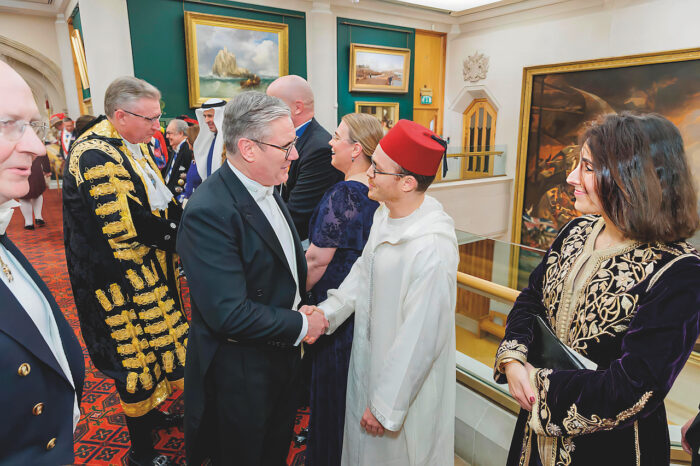
Cooperation with Morocco is welcomed by newly elected Labour members eager to attract votes from the Moroccan diaspora residing in their constituencies. Joe Powell, MP for Kensington and Bayswater (in West London), exemplifies this strategy of community targeting. Concerned with “improving the lives of his Moroccan constituents,” discussions were quickly initiated with Moroccan diplomatic actors in London with a view toward collaboration.
A warm evening yesterday with the @LFMorocco led by @josephpowell, alongside Ben Coleman @ChelFulhamBen, recently appointed Trade Envoy to , as well as other MPs and friends of Morocco for a memorable traditional Ftour at the Residence
Thank you also to Minister… pic.twitter.com/3PB65hnsVY
— Hakim Hajoui (@AmbHHajoui) March 11, 2025
In January 2025, the MP founded and joined, alongside fifteen other Labour colleagues in Parliament, the support group “Labours for Morocco.” He became its first president. “Within this group, discussions are more focused on the country’s development, education, and human rights. It includes people interested in Morocco’s energy potential, but also in the broader prospects for exchange with the country,” says a source familiar with British parliamentary activity.
Empowering conversation today in Parliament on Women’s Rights in Morocco. President of the @CNDHMaroc Ms @AminaBouayach shared powerful insights on legal reforms, gender equality & fighting gender-based violence. Thank you to our hosts @Abtisam_Mohamed @BaronessGoudie pic.twitter.com/k7FkygC2Oi
— Morocco in UK (@MOROCCOinUK) March 24, 2025
The stars have aligned. The Sahara issue now enjoys bipartisan support—Labour and Conservative—in the United Kingdom. A rare occurrence.
Serendipity
It was in this context of bipartisan support that Moroccan diplomatic officials worked to prepare the 5th session of the Morocco–United Kingdom Strategic Dialogue, held on June 1st at the Ministry of Foreign Affairs in Rabat. Just days earlier, on May 26th, Morocco received another boost: Kenya announced that it considered the Moroccan autonomy plan for the Sahara to be “the only sustainable approach” to resolving the regional dispute.
“In London, this information had a particular resonance. Not only because of Kenya’s historical stance—typically aligned with the Polisario—but also due to Nairobi’s strategic importance to the UK, which maintains military bases there,” explains a figure involved in the matter.
And so, in front of a beaming Nasser Bourita, David Lammy announced the evolution of the UK’s position on June 1st in Rabat. He reaffirmed it two days later before British MPs at Westminster Palace. But within Moroccan diplomacy, there was no sense of complacency. “This change must be consolidated. We need a solid foundation in the UK to anchor it further,” a Moroccan diplomat tells us. Efforts are also expected from London.
Domino effect: on June 3rd, a joint Morocco–Ghana statement was released, recognizing the primacy of the Moroccan autonomy plan in resolving the Sahara conflict. In Rabat, there is hope that the UK will champion this new stance within international institutions such as the Commonwealth. Among its 53 members are countries that share close ties with the kingdom—like Canada (through migration) and Australia (through phosphate trade).
British diplomats could be supported by this emerging African momentum. “There’s a sense of serendipity. It’s up to us to make sure it lasts,” concludes a Moroccan diplomatic source. The bet was bold. It turned out to be a winning one.
How did Morocco manage to shift the United Kingdom’s stance on the Sahara issue? From Westminster to Whitehall, an exclusive account of five years of influence diplomacy that transformed the British position. pic.twitter.com/YX0tTFXZ2w
— TelQuel (@TelQuelOfficiel) June 10, 2025
Written in French by Yassine Majdi, edited in English by Eric Nielson


