
For Li Changlin, being in Morocco is not new.
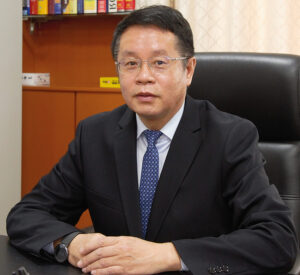
Appointed Chinese ambassador to Morocco three years ago, this is not the diplomat’s first experience in the kingdom. In the early 1990s, he spent a year in Rabat, where he was number 3 at the Chinese representation in the capital. He is therefore a privileged witness to the transformation that Rabat and the country as a whole have undergone over the past 30 years.
« The development seen over these years has been remarkable », he tells us during an interview in his offices at the end of October. The meeting took place just a few days before the Security Council adopted its resolution on Minurso on October 31.
What are the pillars of the Morocco-China relationship?
China and Morocco are both developing countries with a strong interest in exchanging expertise in their respective fields of specialization. We have to evolve in a world of perpetual turmoil and insecurity. It is therefore essential to strengthen our solidarity in order to face up to all the challenges of the modern world.
Our two countries have dynamic diplomats who share similar visions on many international issues. We defend this common vision in international and regional bodies. Coordination between Morocco and China in this area is very good.
I would also like to thank Morocco for its support on vital issues for China, such as Taiwan, Xinjiang (an autonomous region inhabited by the Uyghur minority) and human rights.
Listening to you, one might think that the relationship between our two countries is idyllic. But there must still be a few sticking points..
If there is a problem, it may lie in a lack of knowledge of the other side. Ten years ago, Morocco was looking to the United States, to Europe. Certainly, some senior Moroccan officials are familiar with China through the media, but have never set foot there.
Hence the message I conveyed to my colleagues, as well as to Chinese entrepreneurs and investors: « The best gift we could give our Moroccan friends is to introduce them to China« . One visit is worth 1,000 descriptions. Almost all Moroccans who have visited China have a new perception of it.
China cannot impose its choice of partner on Morocco. It’s up to Moroccans to make up their own minds, based on what they’ve seen and felt. In any case, China could be an alternative for Morocco.
After three years in Morocco, what is your perception of relations between Rabat and Beijing?
Without wishing to mince words, I would say that our bilateral relations have never been better. To make further progress, we need to develop our trust at the political level, bearing in mind that His Majesty King Mohammed VI’s visit to Beijing gave a new impetus to our bilateral cooperation.
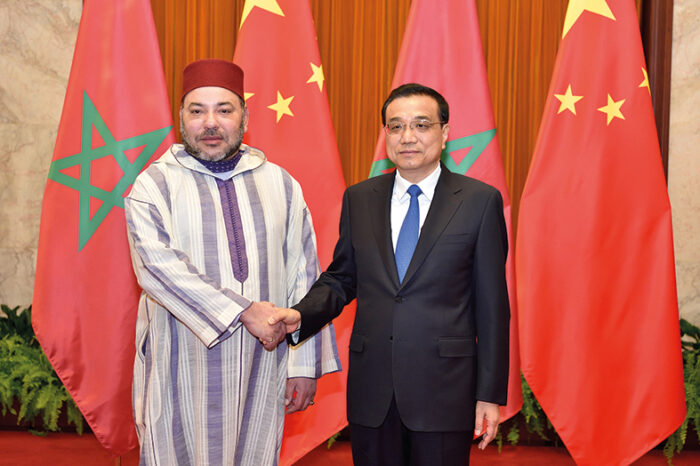
The Heads of State are in regular contact, and have exchanged several telephone calls and letters. This contact was even maintained during the Covid-19 period. The two Heads of State gave very clear directions for deepening political relations between the two countries.
What’s more, the last three years have been marked by visits by several high-level officials to both Morocco and China. All these contacts have contributed to a strengthened political relationship between the two countries.
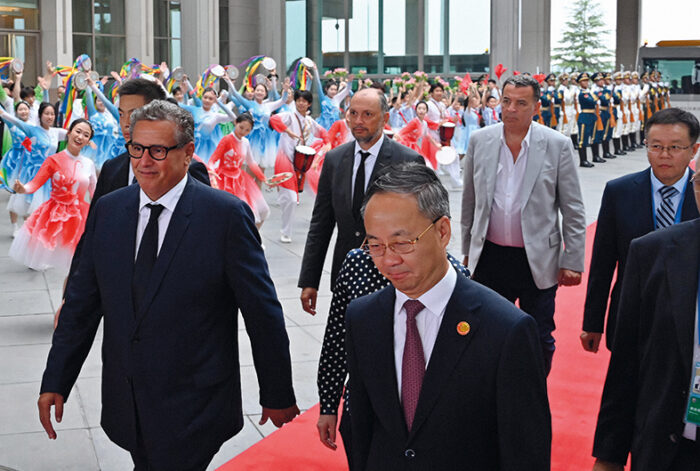
Head of government Aziz Akhannouch is one of the officials who have visited China in recent months..
The head of the Moroccan government was in Hefei, Anhui province, where he visited the Gotion High-Tech Group’s flagship factory. From what I’ve heard, he described the plant as a laboratory of the future. The Head of Government must no doubt have been impressed by the technological development he saw in China.
The relationship between Morocco and China has taken on a business dimension in recent years, with more and more Chinese companies setting up in Morocco..
Today, some fifty Chinese companies have set up in Morocco. Some are already active, while others are prospecting for certain projects. Morocco’s level of development and its development objectives are of particular interest to our companies.
And projects like the Cité Mohammed VI Tanger Tech can contribute to this momentum. It’s a project that has had its ups and downs. But I was able to visit the site a few months ago as part of an inspection visit, and I could see that almost a dozen companies have decided to set up in this zone.
They operate mainly in the automotive sector, and are therefore able to contribute to the establishment of a dedicated ecosystem in the region. This is particularly the case in the field of electric batteries, where a company like Gotion High-Tech has set up in Kénitra and should soon see its business take off.
There is also considerable interest in the textile sector. I receive Chinese missions to Morocco almost every week.
How do you explain this almost sudden interest in Morocco on the part of Chinese companies?
There is, of course, the political and cultural basis between the two countries. The various upheavals on the international scene have also had an impact on the way Chinese companies operate, which has contributed to this interest.
The third factor, which I mentioned earlier, is Morocco’s choice of development. China can contribute to strategic areas of Moroccan economic development. We’re talking about projects that can put Morocco on the world stage. I discuss this regularly with my colleagues.
Morocco is a medium-sized country, but one that is always on the lookout for the latest technological advances. Whether in the field of artificial intelligence, the digital transition, or the energy transition with major plans for the development of green hydrogen. China can contribute its know-how and technical expertise in all these key strategic sectors.
So what about the customs barriers erected by Europe and the United States against products from Chinese industry?
One day, when talking to a Chinese investor about Morocco, he mentioned the country’s geographical proximity to Europe and the free trade agreement with the United States, two strategic markets.
For my part, I believe that the phenomenon we are witnessing is one of the consequences of the conflict in Ukraine. The Americans and Europeans wanted to blame this conflict on a third country.
Ideology took precedence over logic. Above all, they saw how far China had advanced in several fields, such as electric batteries. Hence their decision to impose tariffs.
So China is collateral damage in the Russian-Ukrainian conflict?
« We were able to discover that Morocco has many assets: stability, numerous free-trade agreements, qualified human resources and geographical proximity to strategic markets »
The truth needs to be told here. Today, Chinese companies find it difficult to do business with the United States and Europe. As I told you, this is not a political choice but an ideological one motivated by the crisis in Ukraine.
China is not a party to the conflict, but the Americans want to blame our country. Our companies have experienced difficulties in Europe, and some have chosen to prosper in Morocco. There’s an awakening of conscience among Chinese companies.
When you encounter difficulties in one region, it’s probably logical to look to another. We were able to discover that Morocco has many advantages: stability, numerous free-trade agreements, skilled human resources and geographical proximity to strategic markets.
In its diplomatic action, China is guided by what are known as the Five Principles of Peaceful Coexistence. One of these five principles is respect for the territorial integrity of each country. Seen from Morocco, one would be tempted to say that Beijing does not fully apply this principle..
Very few Chinese are familiar with the Sahara issue. As far as we’re concerned, we’re in the diplomatic world and we work in Morocco. We’re obviously following developments closely.
I’m aware of the comments made by the Minister(Nasser Bourita, editor’s note), the Moroccan press and the international momentum on this issue. Regular reports on the subject are sent to Beijing, with a view to drawing up constructive proposals.
If memory serves (the interview took place before the vote on the latest resolution extending Minurso’s mandate), China has voted in favor of extending Minurso’s mandate for four or five consecutive years.
We believe that what is needed is a lasting political solution accepted by both parties. This is our position of principle. We also support the efforts of the UN Secretary-General’s Personal Envoy to resolve this dispute.
Beyond the Sahara, the Sahel is currently the focus of much attention. What do you think of the Royal Initiative to open up the region?
The Atlantic Initiative has a lot in common with the Road and Belt Initiative (The new Silk road, editor’s note). They both aim to enable participating countries to develop under the right conditions.
In particular, this involves building infrastructure, and I see in this strategy a similar approach by our two countries on the African continent. It even involves university partnerships, as both Morocco and China welcome several thousand African students.
What do you think would enable Morocco and China to further develop their relationship?
« In Chinese eyes, Morocco is still a small country. But the kingdom’s standing is evolving very positively. I remain convinced that we will soon see Morocco’s influence on a regional and global scale »
Undoubtedly, collaboration with China in strategic sectors for Morocco. These include, of course, the automotive industry and renewable energies. And let’s not forget textiles and tourism, in particular, by welcoming Chinese tourists. Next January, the Casablanca-Beijing flight will resume service (by RAM, editor’s note), which should, I think, further strengthen existing contacts.
In Chinese eyes, Morocco is still a small country. But the kingdom’s standing is evolving very positively. I’m convinced that we’ll soon be witnessing Morocco’s influence on a regional and global scale. The Chinese will undoubtedly see Morocco in a new light, just as I’m convinced that Moroccans are seeing China in a new way. This cross-fertilization can only be beneficial.
Written by Yassine Majdi. Edited in English by S.E.


