

The Sahara has long captured the European imagination. Considered the ultimate challenge to the technical will to control and master the African continent, it has inspired a multitude of initiatives, most often as ambitious as they were fanciful. Of all these projects, only one was ever actually undertaken: the Trans-Saharan Railway. Though never completed, it nevertheless left behind remnants that are still visible today in eastern Morocco.
It was at the end of the 19th century that the Trans-Saharan railway project was conceived. The idea was simple: connect Algeria to the Niger River in order to give coherence to the French colonial empire in Africa and to transport its riches back to the motherland. The undertaking was appealing, but the scale of the task and its cost dampened the French government’s enthusiasm.
For decades, this long-standing project would make the rounds among government ministries. Studies, commissions, and governments came and went without a single rail being laid. After much hesitation regarding the route, it was ultimately the mining prospects of Jerada (coal) and Bouarfa (manganese) that made a first section in the Oriental region possible.
From Oujda to Kenadsa
Work on the line connecting Oujda to Bouarfa began in November 1929. By May 1930, Berguent (also known as Berguem, today Aïn Béni Mathar) was connected to it. In February 1931, it was Bouarfa’s turn. But the financial crisis — a global depression — dampened the desire to extend this line, which at the time was more Moroccan than trans-Saharan.
A few years later, military considerations—a railway line would also allow troops to be transported more quickly across the colonial empire—led to the resumption of extension work between Kenadsa (coal mines located near Béchar in Algeria) and Bouarfa.
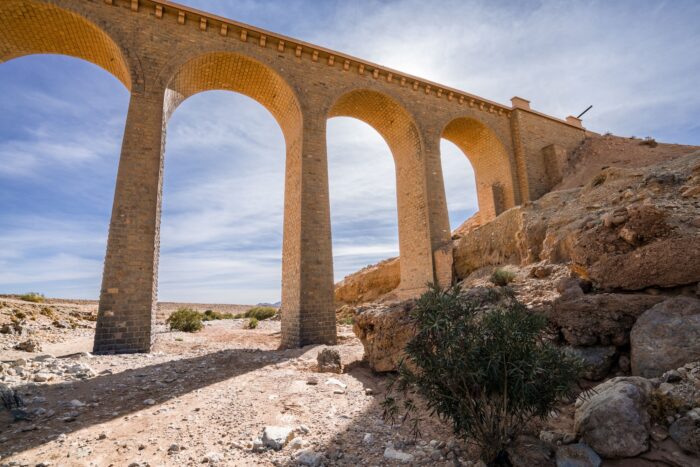
On December 8, 1941, this second section was finally inaugurated with great fanfare, as if the entire Sahara had finally been crossed. Yet it was only an additional 160 kilometers… Far from the 2,500 kilometers expected to complete the Trans-Saharan project, now renamed Med-Niger.
After World War II, all attempts to extend the line came to nothing. The project got buried in the desert sands and fell into oblivion.
Today, little remains of this monumental project. Only a few freight trains and the Oriental Desert Express—a tourist train featured in the 2015 film 007 Spectre—still travels the line from Oujda to Bouarfa.
With no passengers, the various stations along the route now lie abandoned. They are slowly falling into ruin, taking with them the last traces of a little-known chapter in Morocco’s history: that of the internment camps. This dark chapter would have been almost forgotten had it not been for the 2005 publication of Robert Satloff’sbook *Among the Righteous*, which caused a sensation.
The Memory of the Internment Camps
A brief look back. Following the signing of the armistice on June 22, 1940, in France, thousands of people found themselves interned in camps on the mainland: Spanish Republicans, foreign Jews, Communists, and others. Very quickly overwhelmed by the numbers, Pétain’s government decided to send these“undesirables” to Algeria, Tunisia, and Morocco.
Internment camps were then established in Morocco: up to 4,000 prisoners were held there across 14 sites. Several of these camps, located in the Oriental region, supplied the Med-Niger railway construction site and certain mining sites with the labor they needed.
Bouarfa, the largest camp, is said to have held up to 800 prisoners on its own, almost all of them Spanish. As for the Berguent camp, it was reserved exclusively for Jews. These were almost exclusively Jews from Eastern Europe. Having fled to France to escape Nazism, they had enlisted in 1939 in the Foreign Legion under the status of Volunteers for the Duration of the War (EVDGs).
22 Moroccan Jews were interned in the Boudenib camp for their activism in support of Moroccan independence
There were, however, very few Moroccan Jews. A few did end up there, however, apparently for political reasons. Thus, 22 Moroccan Jews were interned in the Boudenib camp for their activism in support of Moroccan independence.
Often mistakenly called “concentration camps,” the internment camps served a variety of purposes (for refugees, transit, internment of foreign workers, disciplinary purposes, etc.), but none were extermination camps.
Detention conditions in these camps were nonetheless appalling. Prisoners were at the mercy of the goodwill of some and the sadism of others. Due to the harsh climate, detention conditions in the camps of the Oriental region had a reputation for being the most dreadful.
In 1945, Michel Golski gave a poignant account in *A French Buchenwald* : “The deportee had very little water for drinking and washing. The mats were infested with bedbugs; scorpions and horned vipers were a constant danger. […] Our clothes were in tatters, our shoes worn out, our tents half-torn; hellish heat made life impossible; lice were swarming. We all had infected wounds on our arms and legs, but we were given only pitiful amounts of medicine and bandages.”
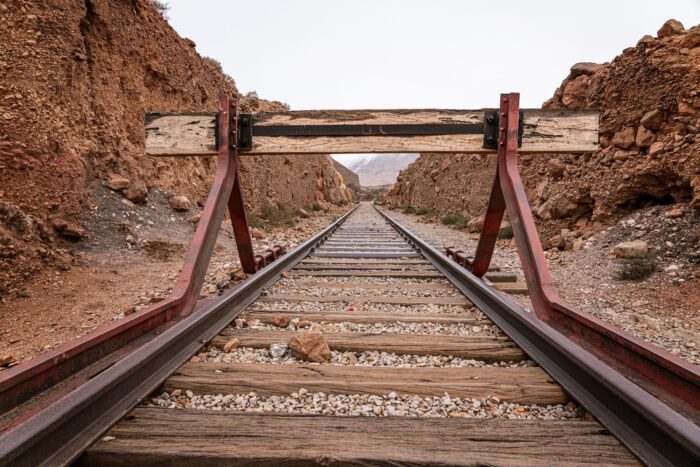
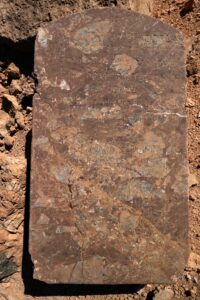
Today, no traces remain of the detention camps in the Oriental region. And for good reason: they were essentially makeshift barracks and itinerant encampments. Only the ballast—the stones crushed by hand by the prisoners to lay the railroad tracks—and the few gravestones in the Jewish cemetery of Berguent still bear witness to the horror of these camps.
Written in French by François Beaurain; edited by AngloMedia Group.


