

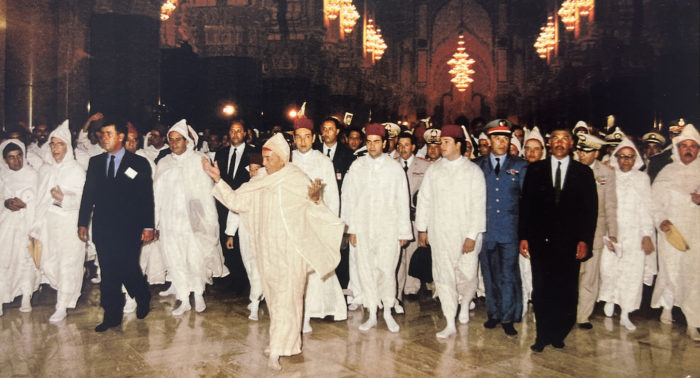
It is 1963 in Rabat, more precisely in front of a small hall of the mausoleum of Sultan Hassan I at the entrance to the royal palace. A swarm of religious figures, ulema, senior state officials, politicians, security officials, and diplomats prepare to enter this room where King Hassan II is waiting.
The event is significant, as the monarch is reviving an old tradition of the Alaouite dynasty, which consisted of honoring the ulema by establishing scholarly councils during Ramadan to debate Sharia, the Hadiths, fiqh, and the sciences of interpreting religious texts. Hassan II, enthroned two years earlier in 1961, names this Ramadan gathering the “dourous hassania” (Hassania lectures).
The late king explained the purpose of these lectures: “We pursue several objectives in reviving this cycle of Ramadan religious lectures: to satisfy our thirst for knowledge and learning (…) and to allow Our subjects who wish to better understand the precepts of religion to attend courses in numerous disciplines such as religion, hadith, law, grammar, and letters.”
Hassan II justifies his legitimacy
Let us place things back in their historical context. When he ascended the throne, the mere fact of being the son of the late Mohammed V and heir to the Alaouite dynasty did not, in the eyes of other political actors of the time, automatically give Hassan II the right to rule.
“Hassan II had to prove himself worthy after the death of Mohammed V, who was a consensual and popular figure,” researcher Youssef Belal explains to us. The new sovereign, therefore, had to prove himself and was, in effect, being tested.
“During the six months preceding his investiture, the Palace organized a series of lectures delivered by Prince Hassan, who in turn became a philosopher, economist, sociologist, or expert in international relations. The aim was to show the elites of the National Movement that the prince was, in some way, fit to govern the country,” writes Youssef Belal in The Sheikh and the Caliph: Religious Sociology of Political Islam in Morocco.
Hassan II still had to round out his résumé by proving that he had mastered Islamic fiqh (jurisprudence). This at a time when many observers “viewed him as a ‘playboy’ heir apparent who had nothing to do with the title of Commander of the Faithful,” Youssef Belal recalls.
According to the researcher, Hassan II succeeded in changing this perception because “he personally delivered lectures during the talks. He presented himself as an alim who mastered the jurisprudential knowledge of fiqh and theology, capable not only of listening to these discussions/lectures, but also of producing them.”
“Hassan II presented himself as an alim who mastered the jurisprudential knowledge of fiqh and theology, capable not only of listening to these discussions/lectures, but also of producing them”
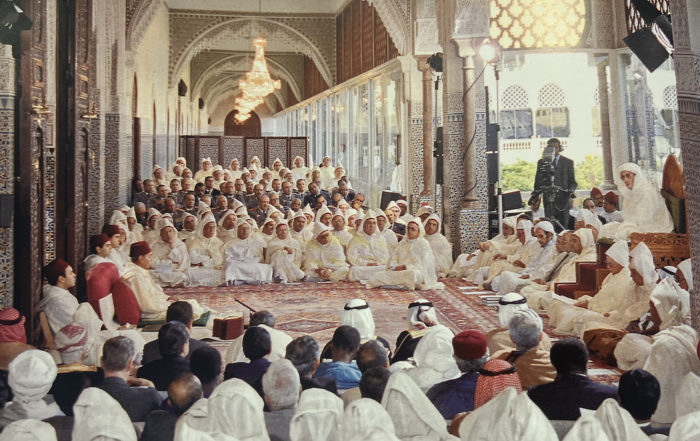
This staging of religious knowledge takes place in a context in which Hassan II’s power was being challenged by the left. As Commander of the Faithful, Hassan II is the man who rises above the fray, placing himself beyond petty political calculations. The ceremonial nature of the lectures presents him as a humble imam, close to his people.
Tradition dictates that all participants sit on the ground at the same level, regardless of their status. Hassan II is no exception to the rule. He is seated facing the platform, the only elevated position, where the scholar (alim) sits, escorted by the minister of religious affairs. He listens attentively, he comments, he debates…
Diplomatic instrument
Hassan II also turned the Ramadan lectures into a platform for foreign policy aimed at uniting the country against external enemies. “To fully understand the stakes of these Ramadan lectures, they must absolutely be placed within their geostrategic context,” notes historian Noureddine Belhaddad, referring generally to the Cold War and more specifically to its influence on conflicts in decolonized countries.
The first example is none other than Algeria. In October 1963, the Sand War broke out between Morocco and its eastern neighbor, supported by Egypt and Cuba, in the areas of Tindouf and Hassi-Beïda, before the clashes spread to Figuig.
“Under the aegis of Imarate Al Mouminine, the kingdom, king and people, stood united against their detractors, which demonstrates the importance of the symbolic values transmitted through the religious channel,” the historian adds.
Still on the diplomatic front, political scientist and writer Hassan Aourid recalls (see interview) a lecture by Hassan II in 1979 in which he sharply criticized Mauritania’s withdrawal from the tripartite agreement with Spain concerning the Sahara.
Islam of the middle path
The late 1970s and early 1980s were marked by the Khomeinist ideological offensive aimed at the entire Muslim world. Hassan II’s religious lectures were then used, according to Youssef Belal, to convey a message “after the emergence of Islamist movements, notably with the Iranian revolution of 1979.”
In such a context, the late king, he continues, sought to show through his dourous hassania that the kingdom was “a center of knowledge more humane than revolutionary Shiism, a bastion of Sunnism.” Noureddine Belhaddad agrees: “While the context lent itself to ideological confrontation, Hassan II managed to distinguish himself by emphasizing openness in his lectures.”
The historian notes that the objective was to project the image of a kingdom long imbued with the principles of communion and coexistence, values highlighted in Hassan II’s religious diplomacy.
One for all, all for the Ummah
Over the years, the Hassania lectures grew in scale and opened up to ulema, intellectuals, theologians, and foreign scholars. Regardless of their schools, branches, or religious paradigms, scholars were welcome to lead the debate.
As illustrated by Hassan II’s unexpected invitation in 1978 to the Lebanese political and religious leader Musa Sadr, one of the most prominent Shiite figures of the time. This was followed by the participation of Youssef Al Qaradawi, the spiritual reference of the Muslim Brotherhood, who delivered a lecture before the monarch in 1983.
The topics were chosen by the speakers themselves without any censorship. In one of his writings, Al Qaradawi notes that he had complete freedom to choose his subject, recounting this anecdote in the process: “Absorbed by the lecture more than by the king, I forgot at the end to offer my prayers for him. I let myself go, as if I were giving a seminar in a mosque in Doha. But at the end of the session, Hassan II warmly shook my hand, expressing his wish to see me again in the same setting the following season.”
The extent of the soft power generated by the Hassania lectures became evident in 1998, when more than 60 foreign ulema took part. They represented several Muslim countries, from Saudi Arabia and Lebanon to Senegal, Uzbekistan, and China.
As an anecdote, the boxing legend Muhammad Ali was also present at this major religious gathering along with other American and European converts. The event was grand, and Moroccan delegations “hosted the foreign guests in the most luxurious hotels. Around ten lectures were broadcast on television, recorded on audio and video cassettes, and then published in a volume translated into several languages,” writes political scientist Mounia Bennani-Chraïbi in Ramadan in Morocco: Sacralization and Inversion.
This shows that these gatherings, which over the years became highly sought after by scholars of all backgrounds, turned into a powerful instrument of influence and soft power.
Written in French by Naoufel Tber, edited in English by Eric Nielson


