

Like the street, the ocean is also a place where gender dynamics are reproduced. “In the lineup, that waiting zone for waves where the codes of surfing are played out, the relationships between female and male surfers reveal dynamics of power, respect, but also ordinary sexism,” observes Abdelfattah Nacer Idrissi, teacher-researcher at Ibn Zohr University in Agadir.
This observation forms the starting point of his study on the gender approach within Morocco’s surfing ecosystem, conducted in Taghazout and Tamraght. “This topic was suggested to me, and it was out of scientific curiosity that I took an interest in it,” says the professor. A linguist by training and himself a regular at the region’s coastal spots, he quickly began to question the place of women in this world: “I would see male and female surfers, and this female presence caught my attention. What is the perception of the female surfer? What are the clichés, the preconceptions? I also wanted to explore the aspect of inclusion and social development: does this practice become, for some women, a resource or even a source of income that allows them to live—or survive?” A study “ultimately much more sociological and anthropological than linguistic,” he acknowledges.
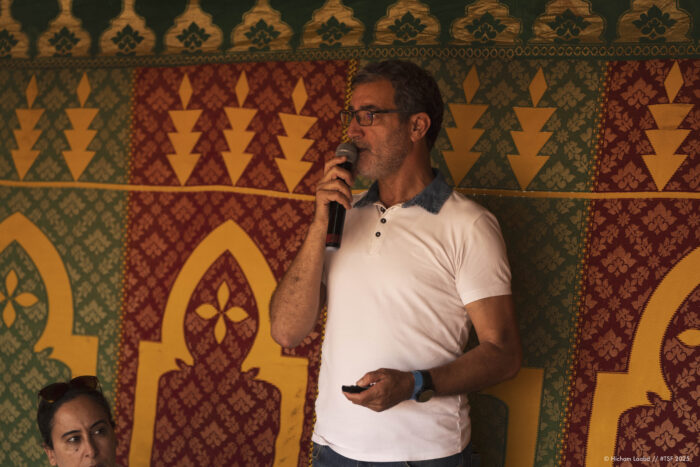
During the presentation of this study at the Taghazout Surf Expo at the end of last October, the researcher reminded everyone of an obvious fact: surfing remains, historically, a sport dominated by men. A reality from which Morocco is no exception. Female surfers there regularly report “condescending” or even “paternalistic” attitudes from certain male surfers.
Mansplaining and disguised flirting
Women speak of a “systemic doubt” that hangs over their abilities. Several say they are ignored in the lineup, their priority on waves often disregarded. In other words, it is “as if their presence were illegitimate,” according to the study. They recount that many male surfers steal their waves, assuming they would not know how to ride them.
Even the most experienced complain of men who, almost automatically, allow themselves to give them basic advice, as if they were beginners — a form of aquatic mansplaining that infantilizes and undermines their expertise. The term was popularized in 2008 by American author Rebecca Solnit through her essay Men Explain Things to Me: Facts Didn’t Get in Their Way.
But the phenomenon goes beyond the simple question of legitimacy. On several spots in the kingdom, some foreign female surfers interviewed as part of the study report persistent attempts at flirting, comments on their physical appearance, or attitudes that reduce them to their image rather than their athletic ability.
These findings, however, are not universal. The study highlights contrasting attitudes depending on the location. In Taghazout and Tamraght — villages now largely open to the international scene — the lineup is generally more respectful. The habit of seeing female surfers there has helped normalize their presence. Many surfers, whether local or traveling, follow the universal codes of respect inherent to surf culture.
Water, a mirror of society
Abdelfattah Nacer Idrissi has also examined how Moroccan society perceives female surfers. According to him, the way male surfers view their female counterparts reflects the country’s social contradictions: between openness and conservatism, respect and sexism, solidarity and gendered competition. “It is within this complexity that a legitimate place for women in the Moroccan ocean is being built,” he explains.
From a sociological perspective, he adds, women’s surfing embodies what Erving Goffman called a “frame break,” that often uncomfortable moment when an individual realizes they have misinterpreted the situation or that their usual points of reference no longer hold. And in Morocco, where gender roles have long remained strictly defined, the presence of women in the surfing world challenges several fundamental codes — first in public space in general, then in leisure spaces, traditionally masculine. Beaches, though mixed in certain tourist areas, remain territories where female presence is monitored and codified. Surfing offers women the opportunity to inhabit the ocean, perceived as dangerous and therefore masculine, and to assert themselves there as legitimate actors.
There is also a form of “bodily transgression” that takes place in the waves. The wetsuit, form-fitting and revealing, defies modest dress norms. Professor Nacer Idrissi here cites French sociologist Pierre Bourdieu, for whom this represents a questioning of the traditional “feminine bodily hexis,” a key concept in the theory of habitus that refers to the physical manifestation of internalized social dispositions.
Female surfers thus develop an athletic and powerful corporeality, breaking with ideals of discreet and reserved femininity, asserting through their practice a new relationship to the body and to public space.
Daily negotiations
In his study, the Moroccan researcher also refers to the more contemporary work of Judith Butler, Distinguished Professor at the University of California, Berkeley, and a specialist in gender and struggles for social justice. According to her, gender is performative — that is, constantly produced and reproduced through repeated acts.
Drawing a parallel with surfing, this sport becomes an “arena where Moroccan female surfers perform alternative femininities,” notes Nacer Idrissi. By developing strength, endurance, and courage, these women embody a form of femininity that reconciles physical power and female identity, challenging the traditionally established binary opposition between masculinity/strength and femininity/fragility.
The study also looked at the inclusion of women in surfing in Morocco. It emphasizes that such inclusion cannot simply be declared; it is built progressively through “daily negotiations, symbolic conquests, and material transformations.” In this context, the emergence of all-female surf camps represents a crucial step. These structures create protected spaces where inclusion can first be tested before expanding to other settings. They play a pioneering role, allowing women to develop their skills without having to constantly prove their legitimacy.
To go further, women must be allowed to legitimately occupy all surfing spaces, not just beginner or women-only spots — the renowned waves, the coveted early-morning sessions, and competitions as well. It would also mean including them in decision-making circles, within the governance structures of local surfing — associations and organizations included. Women must be consulted, heard, and their opinions taken into account, argues the author of the study.
« We’re here too »
The picture, however, is not entirely bleak. The study notes that the number of female surfers, both local and international, is constantly increasing, reflecting a gradual normalization. Moroccan instructors, entrepreneurs, and skilled surfers are becoming more visible. These local role models, sometimes more influential than foreign ones, demonstrate that an emancipatory practice of surfing can coexist with a confident Moroccan identity.
For Said Bella, co-founder of the Taghazout Surf Expo, the goal is not “to encourage,” a term that would imply women are absent, but “to make visible” those who are already present. “We must open the door, shine a light on those who are already here, and give others, who do not yet dare, the chance to say: we’re here too,” he explains. This approach takes concrete form: the event’s poster, created by artist Ayoub Normal, depicts a woman holding a child in her arms before a surfboard, sending a “powerful message of legacy,” he notes. Figures such as Soukaina Iraqui, Moroccan surfer and instructor, and Tasha Mentasti, regional director of the World Surf League for Africa, embody this movement and serve as inspiring references.

But this growing visibility does not erase the obstacles. For some practitioners, legitimacy in the lineup remains conditioned on technical skill. As Soukaina Iraqui explains: “What we often say is that when you surf well, there’s no longer any difference between men and women. The girls who surf well have their place, provided they are respectful, friendly, and know the rules of priority.”
This meritocratic vision, however, raises questions: how can beginners progress if their legitimacy already depends on an advanced level? The paradox is all the more striking because, as Soukaina herself acknowledges, “it’s mostly the girls we see being pushed” by coaches on technical spots where they shouldn’t yet be.
Her personal experience, overall positive — “in fifteen years of surfing, I’ve barely had two incidents” — cannot be generalized. She acknowledges this herself with clear-sightedness: “Maybe the fact that I’m a woman, a mother of two children, and that my husband is a well-known surfer in the community also plays a role: I don’t know.” This remark highlights the importance of social capital and networks in gaining access to a more peaceful practice, resources that not all female surfers necessarily have.
Written in French by Ghita Ismaili, edited in English by Eric Nielson


