

Speaking to the Italian daily La Verità on Monday September 22, the Minister of Industry and Trade, Ryad Mezzour, asserted that « half of the 3,000 terawatt-hours (TWh) consumed [in the European Union], i.e. 1,600 to 1,700 TWh, can be mobilized in Morocco today », adding that » in terms of identified and existing potential, Morocco has the capacity to supply more or less 50% of the electricity Europe needs at competitive prices. »
The Minister’s figures may come as a surprise, especially given that by the end of 2024, Moroccan energy production stood at around 42 terawatt-hours (TWh), forty times less than the 1,600 TWh quoted.
Still a long way off
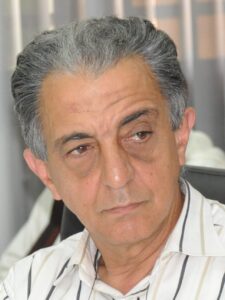
However, « there’s nothing new about talking about this today », says renewable energy expert Amin Bennouna. Over the years, Morocco’s ambition to supply European countries with electricity from renewable energies has never wavered and continues to drive the development of several energy projects. The expert mentions the Desertec project (launched in 2009 by the Trans-Mediterranean Cooperation for Renewable Energy): « More than fifteen years ago, the project was already aimed at covering part of Europe’s energy needs ».
Estimated at 400 billion euros, Desertec aimed to supply around 20% of Europe’s electricity by 2050, with a network of solar and wind farms installed in the Middle East and North Africa region. The electricity will be transmitted via power transmission cables.
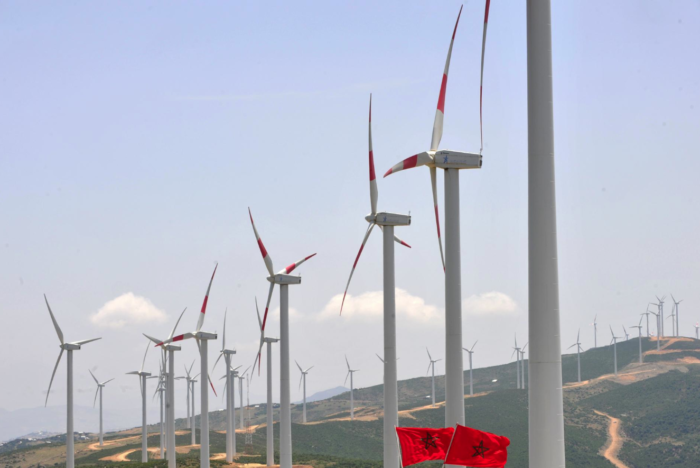
But for the moment, Moroccan production is not sufficient. Wind power, the kingdom’s leading source of renewable energy by 2024, is still a long way off these figures, with an output of 9256 gigawatt-hours (GWh), according to data gathered by Bennouna. The Aftissat wind farms, located south of Boujdour, can produce around 2,000 GWh, or 2 TWh. This makes them the largest wind farm complex in the country. It would take 800 projects of this scale to supply Europe with 1600 TWh.
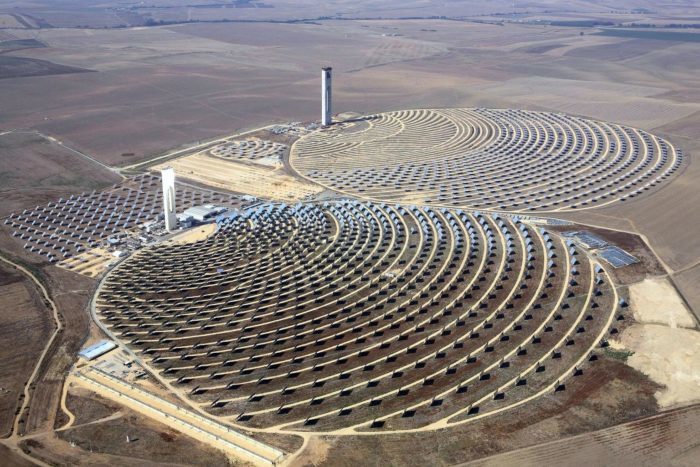
As for solar energy, the Noor Ouarzazate complex – currently the largest in the country, and waiting to be overtaken by the Noor Midelt complex – is expected to produce around 1700 gigawatt-hours (GWh) or 1.7 TWh.
Saved by batteries
However, Amin Bennouna confirms the Minister’s assertion: « It’s not wrong, not at all. Yes, Morocco’s non-agricultural arid zones would be more than capable of supplying Europe. With just solar energy, not to mention wind power ». Two intermittent energy sources, it should be remembered, whose production is neither continuous nor predictable, since it depends on meteorological factors and the diurnal cycle, particularly in the case of solar energy.
« With wind power, I don’t think we can have as much capacity. We know the windy zones, and we know that in these zones, the price of wind power is perfectly comparable with that of solar power, even if it remains more intermittent than solar power. However, as soon as you move away from these areas, this is no longer the case », explains the specialist. « In delimited areas, such as Boujdour or around Dakhla, we can generate significant quantities. But to reach the 1,600 TWh, we’d need to cover more areas, which would risk involving places where there’s less wind. So we have to wonder whether this could still be enough, » asks Bennouna?
He then points to the possibility of using solar energy through battery storage. » When you take intermittent electricity, such as solar energy, and put it in a battery, you can then do whatever you want with it, » stresses the expert. The use of these batteries, « whose prices are falling at a staggering rate, thanks to the electric car », could contribute to the competitive price of energy produced in Morocco. » Batteries, which are now very large, combined with solar power, make it possible to produce electricity at a lower price than nuclear or gas turbines, slightly higher than hydroelectric dams, and if we take into account the charging of market prices for coal, it’s even compatible with coal », Bennouna points out.
So we could speak of « tamed solar », energy that could be delivered in any quantity, at any time.
Projects by the thousands
Although, as Bennouna points out, reaching the 1,600 TWh target « requires not just one project, but a whole series of projects », Morocco must not lose heart or sight of its objectives. « If a project like Desertec were to see the light of day, it would inevitably start here. The kingdom offers the shortest and safest undersea distance to Europe, thanks in particular to the constant surveillance of the Strait of Gibraltar, which reduces the risk of sabotage. Once through the Strait, the land connection to Europe is simple. It’s all in our favor, » concludes the expert.
Although Morocco cannot currently supply half the electricity consumed in Europe, it does have the potential to do so. With a production of 1600 TWh « that can be mobilized today » in Morocco, as the Minister declared, but still beyond immediate reach. Hundreds, if not thousands, of projects are still needed to hope to export such a quantity of energy.
Written in French by Salomé Krumenacher; Edited in English by AngloMedia Group


