

The tug-of-war between Washington and Beijing over tariffs has not been lost by China. Some would even say that Xi Jinping prevailed over Donald Trump; a richly informative event. If China were merely a low-cost export power, it would have succumbed to the will of the White House. Yet the Asian giant is also an economy in the throes of transformation.
For several years now, Beijing has been pulling out all the stops in tech, electric battery, renewable energy and rare earth sectors… Above all, under Xi Jinping’s leadership, China has become a major consumer market. A market that is all the more promising given the country’s average savings rate of 30%. As Xi Jinping asserted last December, Beijing wants to awaken Chinese consumer demand through a « more proactive » fiscal policy.
As for Chinese tourist travel consumption, figures diverge, and the trend has been altered over the last five years by Beijing’s ultra-restrictive « Zero Covid » policy. But China is home to over 150 million travellers, and they are among the world’s biggest spenders. And if the figures from the « Welcome Chinese » label – which certifies foreign destinations capable of welcoming Chinese tourists to standards approved by the Ministry of Tourism in Beijing – are to be believed, the next decade should see an increase in their numbers, with 400 million travellers, representing a quarter of the world’s tourists.
« 前往摩洛哥 » (Travel to Morocco)
A godsend for a country like Morocco, which relies on tourism as a vector for development. In a conversation with TelQuel, the Chinese Embassy in Rabat pointed out that the Kingdom welcomed 59,719 Chinese tourists in 2023, and 106,483 in 2024 « an increase of 78% ». But if it is to capitalize on such momentum, Morocco needs to learn how to better welcome these visitors from afar. After all, the expectations of Chinese tourists are not necessarily comparable to those of European or American travellers.
Representing one in ten tourists worldwide and generating 150 million annual travelers, #China is the leading tourism market in terms of volume and revenue. Morocco is one of their ideal destinations. https://t.co/iqCBDQMN5N
– Embassy of China in Morocco (@ChineAmbMaroc) May 29, 2025
« Generally speaking, the Chinese hate the sun. So the Moroccan tourism offer should not be based on the beach or the opportunity to get a tan while visiting the desert »
Mehdi Laraki, President of the Morocco-China Business Council at the Confédération Générale des Entreprises du Maroc (CGEM), knows the Middle Kingdom and its people well. From the outset, he points out that « in general, the Chinese hate the sun. Morocco’s tourism offer should not be based on beaches or the opportunity to sunbathe while visiting the desert ». The UV index is a no-no. Nevertheless, Morocco has other assets likely to appeal to these new tourists. « The Chinese love cultural activities, » adds Mehdi Laraki.
(2/2) #Dialogue of Civilizations : Morocco ‘s medinas are symbols of the country’s history and culture. Under the country’s protection, they remain living spaces, retaining their historical specificities while integrating into the modern city. It’s often said… pic.twitter.com/Pc885s17BY
– Embassy of China in Morocco (@ChineAmbMaroc) June 9, 2025
By developing its museum offering, the National Museum Foundation (FNM) has, for example, enabled Chinese visitors to enjoy the 17 museums opened or renovated since its foundation in 2011. In 2020, the FNM signed two agreements with the National Museum of China (MNC) to strengthen cooperation and cultural exchanges between the Kingdom and the People’s Republic.
Beyond the museums, travelers discover the Cherifian Kingdom by strolling through the medinas, visiting historic sites, taking part in cultural events… But while Morocco has undeniable assets, capturing more Chinese tourists requires more investment, training and publicity.
Cherishing the forerunners
For Mehdi Laraki, the first step the Kingdom can take in the right direction is to get to know Chinese customers better. A case in point? » A Chinese person won’t go two days without eating a meal he’s used to, » he points out. Hence the need for Moroccan tourist towns to offer restaurants serving Chinese food.
Above all, it’s crucial to offer early-stage tourists a pleasant experience in order to encourage a large influx of new Chinese visitors. As Mehdi Laraki explains, this is due to the importance of the « guanxi », or network, for the citizens of the People’s Republic of China: « Relationships are very powerful with the Chinese. To buy a product, they refer to what their entourage and the celebrities they like think of it« . If the first Chinese tourists enjoy their trip, feel welcome and cared for, this could provide Morocco with a major tourist windfall from the far east.
In this respect, Mehdi Laraki believes that the Moroccan National Tourist Office (ONMT) is doing « a good job ». Recently, to raise the profile of the Moroccan offer, the ONMT hosted the reality TV show « Chinese Restaurant » in Tangier. The embassy of the People’s Republic describes the concept of this show, which has already been seen in France and Italy, as follows: to open « a Chinese restaurant in a foreign country to establish culinary links with customers from all over the world and tell good culinary stories. » The aim, continues the diplomatic representation, is to promote « the kindness, enthusiasm and charm of Moroccans » to the Chinese people.
The show, stresses the agency programming it, is supported by « several major personalities of the Chinese cultural landscape », such as chef Lin Shuwei (2.6 million fans), big-screen icon Huang Xiaomin (60 million followers) and Shen Yue, « an actress adored by young audiences ».
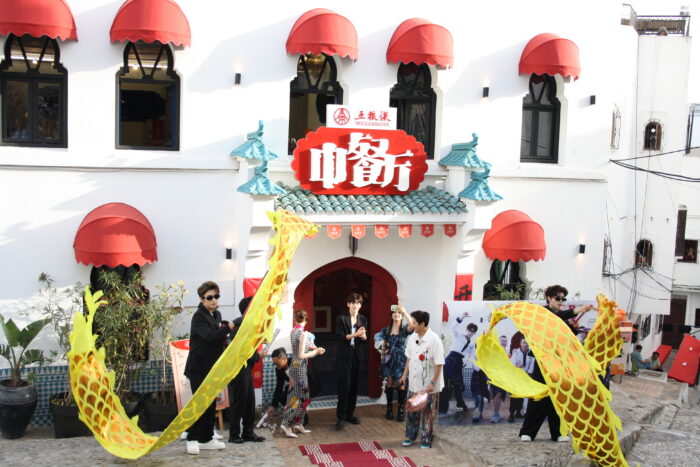
Here again, the ONMT can count on the power of « guanxi »– the trust that the Chinese place in the celebrities they follow – to promote Morocco as a destination.
From a more structural point of view, Mehdi Laraki believes that the tourism sector needs to do more to welcome Chinese visitors. » They need to feel safe, » he explains. Finally, whether it’s a question of language (spoken and written), food, or adapting to certain software programs, Moroccan tourist establishments need to get up to speed. To help them do so, Beijing offers the « Welcome Chinese » label: « A hotel can obtain it for around 5,000 dirhams a year », explains our contact.
The idea is that, in return for this payment and adaptive measures such as QR codes for Sinogram menus or the addition of at least one Chinese dish to the menu, the establishment benefits from high visibility on useful referencing sites. From Beijing’s point of view, this initiative aims to encourage citizens to travel abroad feeling at ease. « If you hear Chinese spoken in French airports, for example, it’s because they have the ‘Welcome Chinese’ label, » assures Mehdi Laraki. Parisian transport systems have also taken the plunge to welcome this new clientele. This partly explains France’s success with Chinese tourists: over 1.5 million visitors by 2023.
The Chinese Embassy in Morocco supports the « Welcome Chinese » initiative because it enhances the Kingdom’s attractiveness, and « promotes friendship and exchanges between the peoples of the two countries, while strengthening mutual understanding », it explains. In this sense, Beijing’s diplomatic representatives in Rabat place great hopes in tourism. « The development of targeted tourism offers and active promotion are already beginning to bear fruit ». And he believes they will contribute « in the years to come, to a significant increase in the number of Chinese visitors to Morocco ». How do you say marhaba in Mandarin?
Written in French by Marin Daniel Thézard; edited in English by Theodore Griffin.


