

Photos and text by Louis Witter, special correspondent in the West Bank
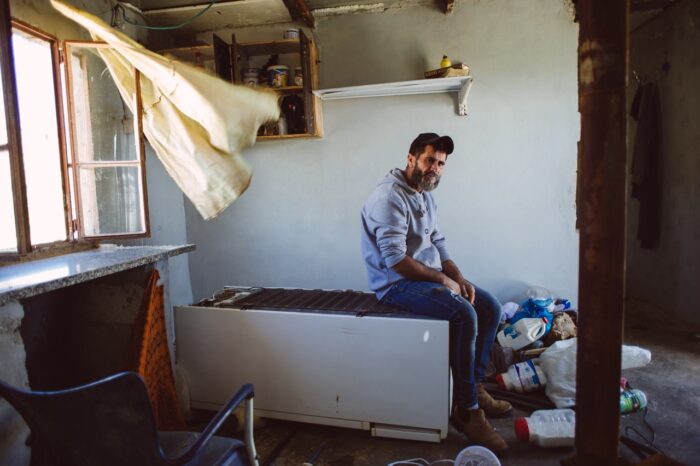
In a dark, windowless room on the ground floor of this building in Nablus, Hani Shtawi slowly sits down, rolling up the sleeves of his polo shirt. In just two days, he and his children have managed to put everything back in order.
Furniture, couch, television… everything had been turned upside down during the Israeli raid. « They searched the house from top to bottom, and about a hundred others on the same street, » he says softly.
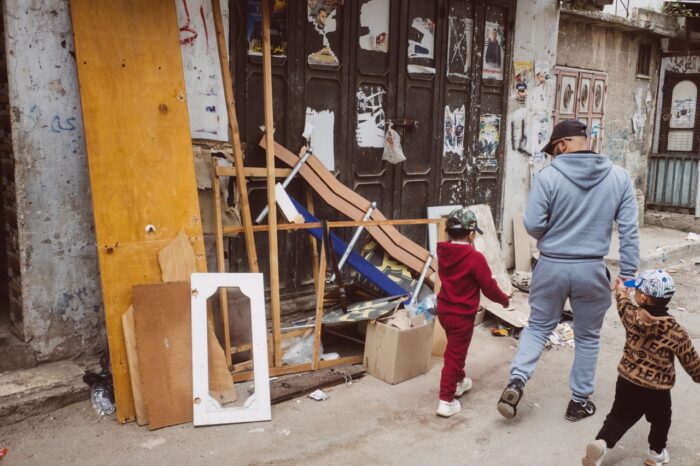
On the night of April 9, dozens of Israeli military vehicles stormed the Balata refugee camp, the most densely populated in the West Bank. Since the 1948 exodus, nearly 35,000 Palestinians have been living on these few hundred square meters—originally intended to house just 5,000 people.
Military searches
“They were interrogating people. Alone in a room, I could hear other men screaming, being beaten, while the soldiers questioned me, shoving me with the butt of their rifles”
At five in the morning, loud knocks echoed at Hani’s apartment door. He opened it, and immediately, around fifteen soldiers swarmed the upper floors. « They asked us for all our IDs. Once we handed them over, they separated me from the rest of my family, tied my hands, and blindfolded me, » continues the man in his fifties, lighting a cigarette.
For long minutes, the soldiers shouted, « Where are the weapons? Where are the weapons? » and began tearing the apartment apart. Tiles, wooden panels—every inch was searched. But they found nothing.
Hani was then taken to a neighboring house, converted into a temporary detention center. « There, they were interrogating people. Alone in a room, I could hear other men screaming, being beaten, while the soldiers questioned me, shoving me with the butt of their rifles, » he recounts.
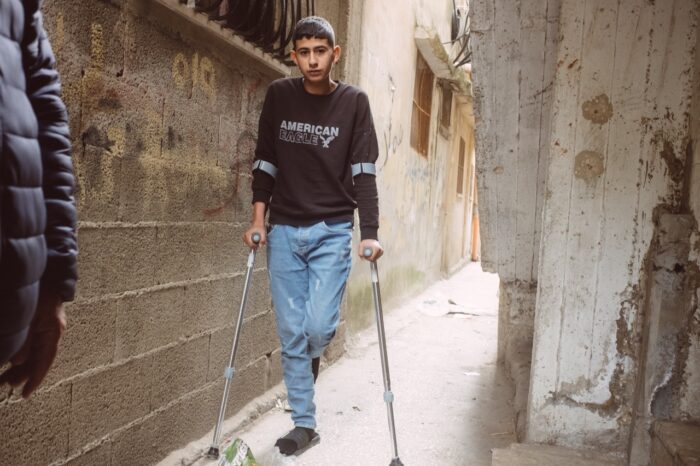
Beside him, a delicate white lace scarf over her hair, his 90-year-old mother lies down. Originally from a small village near Jaffa, she lived through the Nakba, the Palestinian exodus in 1948. « I was fifteen when the Israelis forced us out. We walked all the way to Jordan, and sometime later we arrived here, in Balata. »
When the soldiers arrived on April 9, she didn’t even have time to gather a few belongings or her medication. Locked in a room of the house with Hani’s wife and grandchildren, the wait was long. « Every time the boys walk out the door, I always wonder if I’ll ever see them again. Too many mothers have never seen their children come back, » she says, her voice trembling.
Never again
“What they want is to force us out of here. They want to erase the idea of the 1948 Palestinian refugees—erase the camps too”
« What they want is to force us out of here. They want to erase the idea of the 1948 Palestinian refugees—erase the camps too, » says Hani. His son, Nasser, joins the conversation: « When the soldiers arrived, my grandmother kept repeating ‘It’s happening again!’ because she’s already lived through it. »
Since the Hamas attacks on Israel on October 7, 2023, the eyes of the world have been fixed on Gaza, under relentless bombardment by Israeli airstrikes. Meanwhile, military raids and settler violence have been escalating in the West Bank. The goal is the same… pic.twitter.com/cx4O0sdS0t
— TelQuel (@TelQuelOfficiel) April 29, 2025
For her, it’s important to pass on this history: “I went back to the place thirty years ago. I don’t want them to forget where they come from, where we come from—from generation to generation. I hope we’ll return there one day.” Adjusting her scarf with a quick motion, she sighs: “In truth, what they want is to make us live through a new Nakba.”
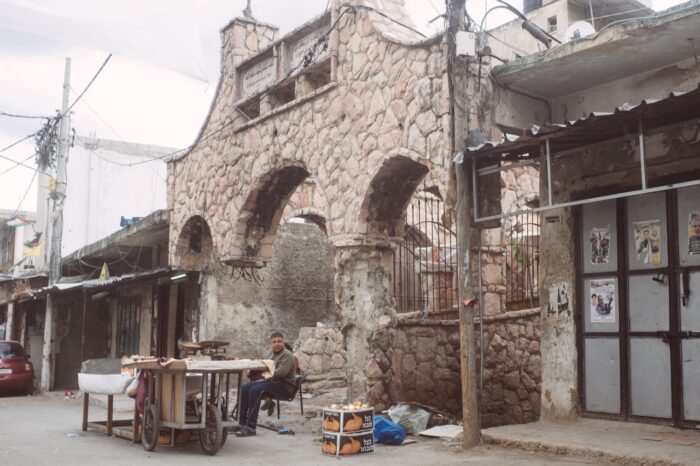
This Israeli raid in Balata is part of the broader “Iron Wall” operation, launched by the IDF on January 21 in the northern West Bank.
Under the guise of fighting Palestinian armed groups, the Netanyahu government has forcibly displaced more than 50,000 people, with no possibility of return
In the refugee camps of Jenin and then Tulkarem, just a few dozen kilometers apart, the Netanyahu government has forcibly displaced more than 50,000 people under the pretext of combating Palestinian armed groups—with no possibility of return.
In front of the Khalil Suleiman Hospital in Jenin, where the road once continued toward the camp just a few months ago, two meters of earth and rubble now block the way. Gunfire echoes through the empty, unreachable alleyways.
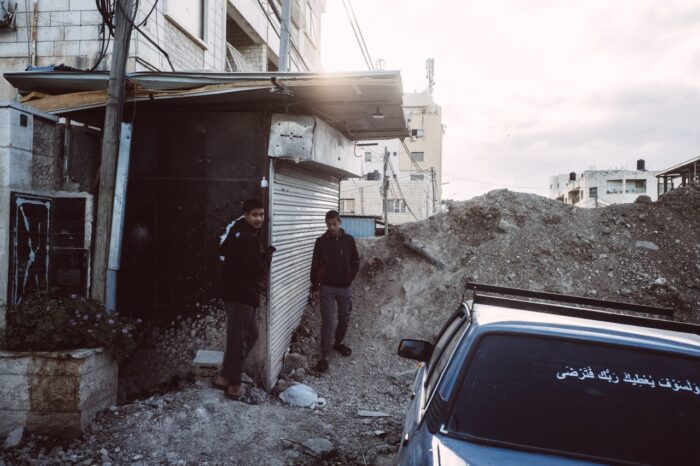
Since February, soldiers and snipers have taken up positions on the rooftops of surrounding buildings. Anyone who dares to cross the barrier now risks being shot by Israeli soldiers with M16 rifles.
Homeless in his own homeland
“The soldiers arrived at nine in the morning, and by four in the afternoon, we were gone. That was the last time I saw my neighborhood”
Like so many others, Nazmeh was forced to flee his home. In the village of Zababdeh, the Arab American University has seen its campus turned into a refuge for dozens of families expelled from Jenin. In a room barely ten square meters, the 53-year-old vegetable vendor is still struggling to grasp what happened, nearly three months later.
« The soldiers arrived at nine in the morning, and by four in the afternoon, we were gone. That was the last time I saw my neighborhood, » says the man, standing on the top floor of the building where he arrived earlier that morning.
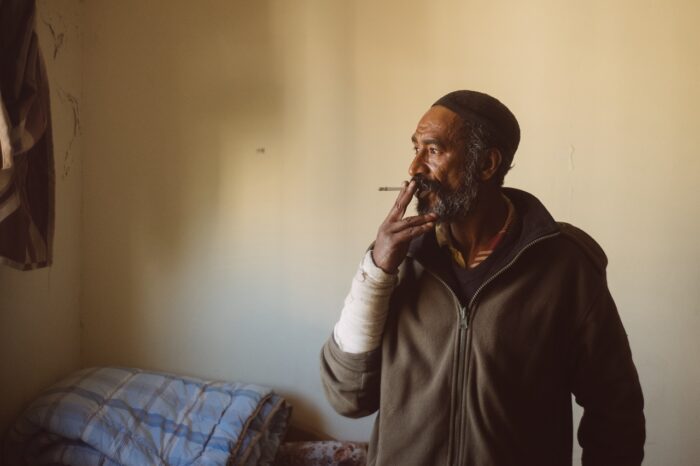
On the floor, five makeshift beds—for him, his brother, and his sons. “For hours, it was drones that spoke to us, ordering us to leave. If we refused, the Israelis threatened over loudspeakers to burn our houses,” Nazmeh continues.
His son Thaer is severely disabled. “We struggled to push his wheelchair through the mud, all the way to the end of the street where the soldiers were waiting. They didn’t even give us time to grab our belongings or the adapted car for my son, which they destroyed with bulldozers. I haven’t seen our home in eighty-four days, even though I’ve tried to go back several times.”
Of all he once had—IDs, diplomas, birth certificates—nothing remains: “When I tried to enter the camp the other day, for the tenth time, a soldier fired at the wall next to me to scare me off. All I could see was one part of the house burned, and another destroyed.”
Relentless raids and a war of attrition
Since the Hamas attacks on Israel on October 7, 2023, and the start of the war, Israeli military assaults have continued to multiply across the occupied West Bank. Following Israel’s breach of the Gaza ceasefire this past March, the most extreme ministers in Netanyahu’s government have doubled down on their openly stated annexation plans.
On January 6, Finance Minister Bezalel Smotrich even expressed, without hiding it, his desire for the occupied West Bank to endure the same hell as Gaza. “Nablus and Jenin must look like Jabaliya,” threatened the supremacist. Today, the northern city in the Palestinian enclave has been reduced to rubble—turned to ashes by more than a year of relentless bombardment.
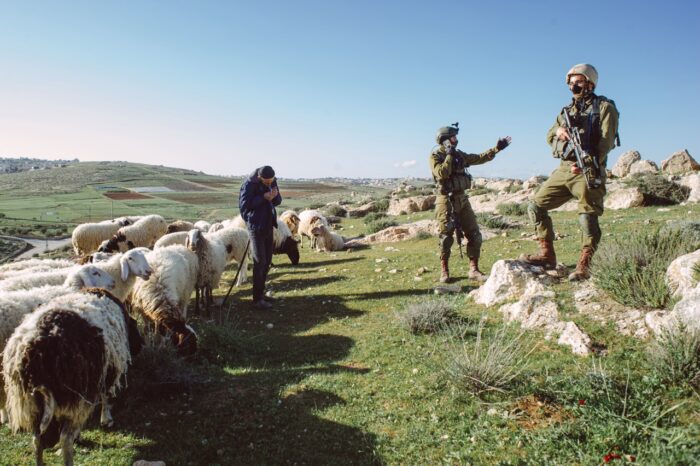
After five minutes on a dusty road, a warning comes into view on a concrete block: “Firing Zone.” In a cloud of sand, the pickup truck continues its path through the rocky, semi-desert terrain in the far south of the occupied West Bank.
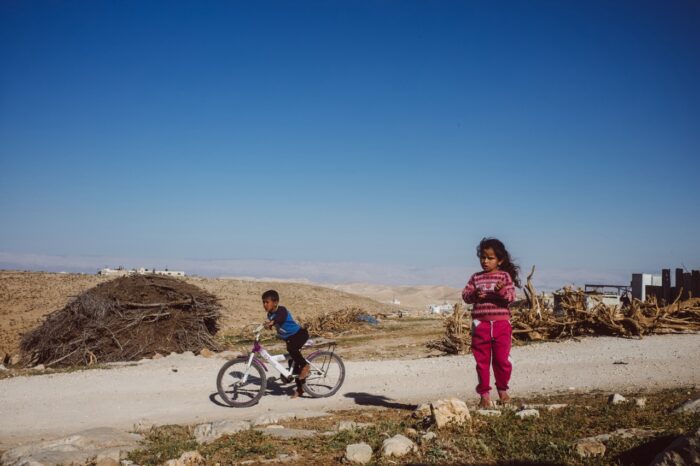
Riding alongside the vehicle on a donkey, two Israeli settlers make their way up the trail. On April 2, under the midday sun, the village of Jinba appears along the hillside. Located in the Masafer Yatta valley, just below the illegal settlement of Mitzpe Yahir, Jinba is one of twelve villages that have faced demolition orders since 1981, when Israel designated the area as a military zone.
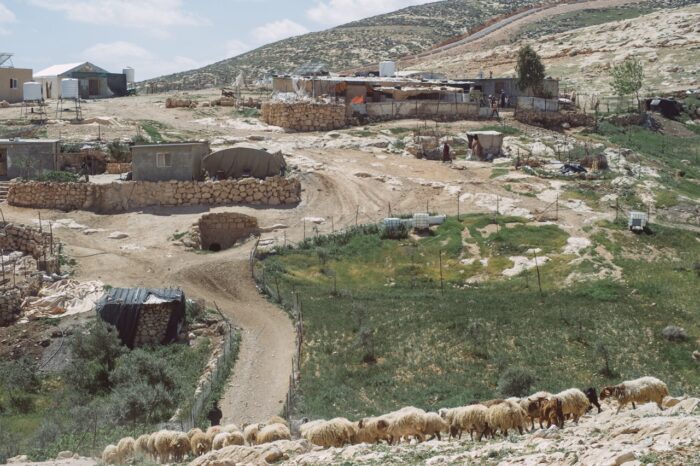
Just days before the end of Ramadan, on March 28, it’s barely nine in the morning when about fifteen settlers attack some shepherds just a few hundred meters from Goussai’s home—then turn their attention toward him.
Sitting on a low stone wall, the 17-year-old boy with piercing blue eyes retraces the events of his day: “On Friday, at the usual hour of prayer, I stepped out to pray when I saw settlers running toward me, their faces covered, armed with sticks and large rocks. I barely had time to warn my father inside the house before they were already on me.”
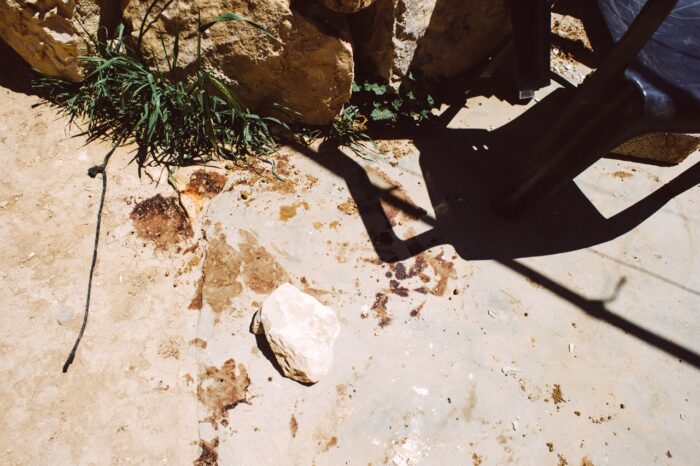
Goussai still bears the marks of the violent assault. His right arm is in a cast, his body covered in bruises, and his head scarred. His father, Aziz, also endured the settlers’ rampage. His son points to dried blood stains on the ground. Struck in the head with stones, Aziz now has a dozen staples in his scalp and a large white bandage across his forehead. The two of them waited three hours for medical help.
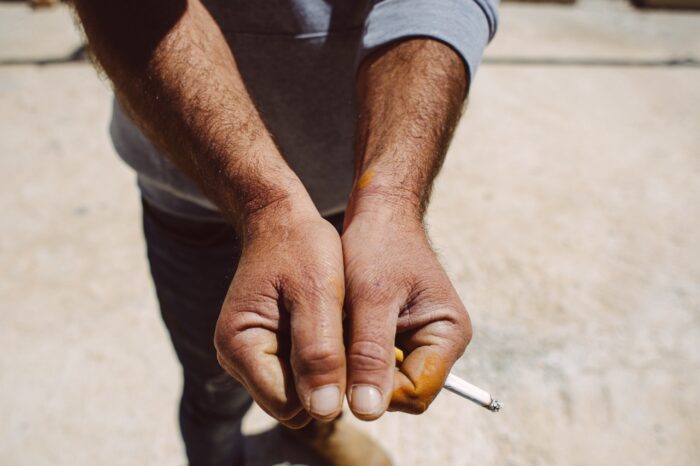
At 70 years old, Moussa can’t even recount the full history of attacks on the people of Jinba—there have been too many. “Since I was born, we’ve regularly faced attacks by settlers or the army. But this time, the army didn’t move while the settlers went wild. Over there, on the hill, they laughed and filmed us as they watched,” the man says in despair.
He picks up a lighter beside him, lights a cigarette, and takes a long drag. A few minutes later, soldiers arrested twenty-two people. While the very old and the very young were spared, the others were loaded into trucks—blindfolded, hands tied—and taken to the military base visible from the village.
After two hours of waiting, confined under the scorching sun, they were transferred to the Kiryat Arba police station—a settlement where Itamar Ben-Gvir, Israel’s Minister of National Security, has lived for years. There, they were interrogated for hours, accused of throwing stones at settlers.
As night fell, the army returned—around fifteen vehicles and a hundred soldiers. The settlers were also present. If not directly supported, they were at least tolerated by the military.
Violence broke out again in the village. The school was ransacked. Amid overturned chairs and broken glass, the charred remnants of a Palestinian flag could be seen in the classroom. Olive oil, wheat, and barley meant for the sheep—the harvests of recent months—were destroyed.
The settlers, an armed wing of the Israeli government
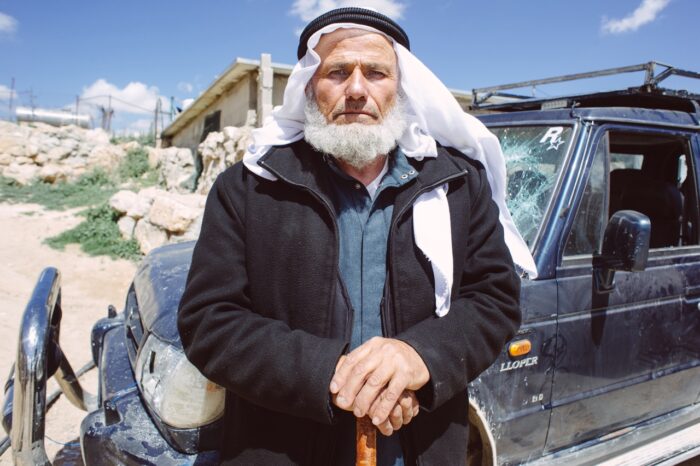
From one of the last houses on the edge of the Green Line—the 1948 border between the occupied West Bank and Israeli territory—an elderly man waves broadly. With the tip of his cane, he points to the shattered windows and slashed tires of his SUV. Around him, his granddaughter, dressed up for Eid, twirls while holding his hand.
Because of his age, Ali Jaber wasn’t arrested. So he saw everything that night, March 28: “They broke the doors, the windows, the lights, the refrigerators, the furniture—they smashed everything. They even tore open the sacks of grain meant for our animals. Anyone who tried to stop them was arrested by the army, which stood by watching without doing anything.” Beside him, his granddaughter adds, “They forced us outside from 1 a.m. to 5 a.m.—of course I was scared.”
On April 17 in Ar-Rakeez, settler violence took a new turn—the first time in over a year that something like this had happened. In his garden, Saeed Alamour spotted an armed settler carrying fencing materials, preparing to put up a barrier.
The settler pulled the trigger of his assault rifle. The bullet struck Saeed in the leg. The next day, the limb was amputated. Sheikh Saeed will never walk again
Saeed and his son Elyes approached the man to ask him to leave. The settler wasn’t alone—and very quickly, the blows began to rain down. Elyes was beaten to the ground, and Saeed tried to pull him away. The settler fired two shots into the air, then aimed at Saeed’s leg and pulled the trigger of his assault rifle.
The bullet struck Saeed in the leg, and the farmer began to lose a great deal of blood. For many long minutes, the ambulance was prevented from reaching him. His son was detained by the Israeli army, along with the shooter. The next day, Saeed’s leg was amputated. Sheikh Saeed will never walk again.
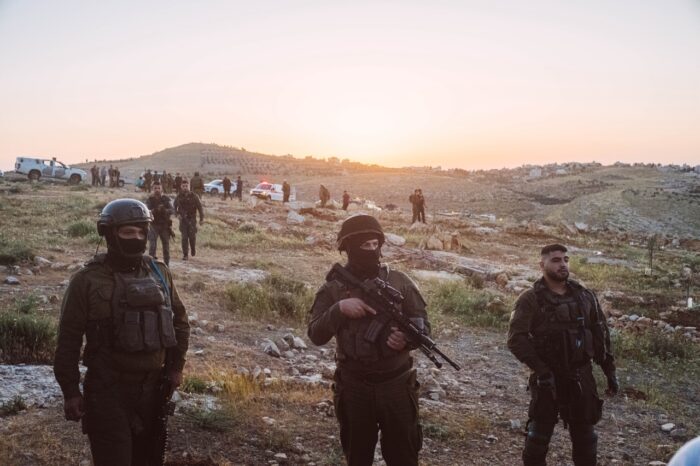
In the Masafer Yatta valley, as in other regions of the occupied West Bank, settlers act with impunity, a situation frequently condemned by the international community.
Settlers responsible for violence enjoy near-total immunity: only 3% of investigations opened into such violence result in a conviction, either partial or full.
Between January 1, 2024, and February 28, 2025, the United Nations recorded 1,687 such attacks.
In half of these cases, the army was present or involved. And one statistic highlights the near-total immunity enjoyed by settlers who commit violence: only 3% of investigations into violence result in a conviction, whether partial or full.
Written in French by Louis Witter, edited in English by Eric Nielson


