

No vengeful speeches in Rabat. No angry tweets, no charts waved in front of the cameras. Faced with the 10% tariffs imposed by Washington, Morocco remains calm. So does the business world. Among exporters and industrialists alike, no one is sounding the alarm.
For now, the Kingdom does not appear to be at risk. In 2024, Moroccan exports to the United States did not exceed 18.9 billion dirhams, or about 4.2% of total exports, mainly consisting of fertilizers, auto parts and semiconductors, citrus fruits, and processed seafood products.
The announced 10% therefore does not constitute an insurmountable break. Especially since it should not directly affect the Moroccan companies on the front lines. As Adil Zaidi, president of the Moroccan Automobile Federation, points out, it is primarily American importers — and ultimately consumers — who will foot the bill. Moroccan components, particularly in the automotive sector, will now enter the United States with an added cost, but this increase will mostly weigh on local production chains. By weakening the competitiveness of its own industries, Uncle Sam’s country is penalizing itself.
Faced with the outcry from many American companies, concerned about the impact on their production costs and competitiveness, Washington ultimately decided to temporarily suspend the implementation of the new tariffs. A 90-day pause was granted to all affected countries, with the exception of Beijing, which was hit with an increase to 125% in response to its retaliation. A reprieve, then, but one that does not exempt the United States’ trading partners — including Morocco — from strategic reflection to anticipate the coming months.
The world is shifting
The multiplication of protectionist measures, the instability of the rules of the game, and the rise in trade tensions between major powers reflect a world undergoing transformation.
« This is a structural phenomenon (the rise of protectionism, editor’s note), with a cyclical amplification, » observes Dominique Bocquet, senior fellow at the Policy Center for the New South (PCNS), a think tank based in Rabat. » Free trade went very far between 1980 and 2010, and a kind of pendulum swing is now taking place, » he explains.
In this new landscape, Morocco can no longer be content with marginal adjustments. It must fundamentally rethink its trade and industrial strategy to better defend its interests, diversify its markets, and strengthen its economic sovereignty.
“We must ask whether these new American tariffs are compatible with the Free Trade Agreement. And if they are not, draw the political and economic consequences”
Its first lever of action: negotiation. Or rather, reaffirming the contractual framework. The Free Trade Agreement (FTA) with the United States, which came into effect in 2006, is supposed to guarantee smooth trade without unexpected barriers. But as often happens, it is not the letter that causes problems, it is the spirit.
And on the American side, Donald Trump is among those who tear up contracts faster than they sign them. « We must ask whether these new tariffs are compatible with the agreement. And if they are not, draw the political and economic consequences, » summarizes Hakim Marrakchi, vice president of the Moroccan Exporters Association (ASMEX).
That still depends on Washington being willing to listen. Donald Trump is not a man easily swayed by an appeal to law. Moroccan diplomacy will therefore have to juggle between politics and economics. It is in this climate that Nasser Bourita, Minister of Foreign Affairs, traveled to Washington on April 8 to meet with U.S. Secretary of State Marco Rubio. For now, official communication remains limited to exchanges of courtesy and reaffirmations of positions on the Sahara. Nothing yet on tariffs or the future of the trade partnership between the two countries.
Beyond America
But what is the point of negotiating if one remains structurally disarmed? Because the problem is not limited to Washington. Morocco shows chronic deficits with the majority of its trading partners, whether it be Turkey, the European Union, or Egypt. Happy globalization has mostly benefited others, and it is time to put an end to a passive model of openness and lay the foundations for a new industrial pact.
The problem is not limited to Washington. Morocco shows chronic deficits with Turkey, the European Union, and Egypt
This requires, according to Adil Zaidi, less talk about attractiveness and more direct support for those who produce, innovate, and export — especially small and medium-sized industries (SMEs), often forgotten in major sectoral plans. « They are the ones who create real added value and sustainable jobs, » he insists.
The same diagnosis comes from Hakim Marrakchi, who laments a model of openness that has for too long favored foreign companies at the expense of the national industrial fabric. An industry that, until now, has mainly developed in acceleration zones, without sufficient spillover into the rest of the economy.
Tested by protectionism, the Kingdom cannot avoid a strategic introspection. « Morocco has accepted and risen to the challenge of competitiveness. Its industrial activities are, as a result, solid and wealth-creating. But they are designed for a free trade context, » notes Dominique Bocquet.
Morocco must transcend its status as a mere subcontractor and launch a strategy to strengthen its industry based on local integration, moving upmarket, training, and innovation. A fundamental transformation that requires better infrastructure, a more inclusive ecosystem, and genuine support for Moroccan project leaders. Otherwise, the opportunities offered by the reorganization of global value chains will continue to benefit… others.
The trap of bypassing
Among the opportunities emerging alongside the strengthening of the local industrial fabric: making Morocco a production platform for bypassing. In other words, attracting foreign manufacturers — particularly Chinese — who are looking to avoid American tariff barriers by setting up production in third countries with preferential agreements.
On paper, Morocco checks several boxes. With a rate of 10%, it is much more competitive than Vietnam (46%), Cambodia (49%), or China (125%). It has a free trade agreement with the United States, a strategic geographic position, and a relatively stable business climate. But potential alone is not enough. « It’s not that simple. Building a factory in Morocco takes up to 36 months. If we had prepared good infrastructure and well-equipped industrial zones, now would be the time, » laments Nabil Adel.
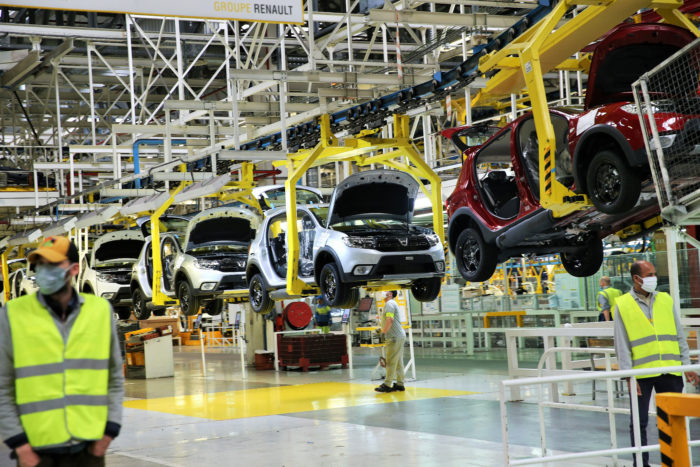
By betting too much on this windfall effect, Morocco also risks aiming at the wrong target. Behind the temptation of a rapid repositioning, particularly as a bypass platform for foreign manufacturers, lies a trap: substituting one dependency for another. Adil Zaidi is clear: « This is a very short-term opportunity, at a given moment, for one-off operations. But under no circumstances can it constitute a strategy. » If it wants to avoid this pitfall, the Kingdom must make diversification its priority. This requires strengthening the coherence of its industrial and trade policies.
Diversify, but…
Turning toward Africa, the BRICS, China… yes, but without turning away from Europe. Dominique Bocquet insists: « Morocco must be interested in all markets. Diversification is always a factor of resilience. And Western markets are not yet closed to Morocco, far from it, especially the European market. » Diversification must not be a reflex of escape, but a strategic choice. Multiplying agreements, yes. Rethinking their content, too. But not giving in to the temptation of withdrawal, nor of bilateral dependency.
“Morocco must be interested in all markets. Diversification is always a factor of resilience”
That diversification must first benefit Moroccan industry. Multiplying trade agreements is not enough if local businesses are not supported in taking advantage of them. The goal is to open new markets for those who are already producing, not simply to seek new routes for external flows. « It’s not free trade itself that is the issue, but the way we integrate it, » points out Hakim Marrakchi.
This moment of uncertainty must therefore serve as a wake-up call. The rise of trade barriers reveals a deeper trend: the return of states to global economic decision-making. This requires moving beyond passivity and building a response that matches the scale of the global shift. For Morocco, this means one thing: anticipating, investing in its fundamentals, and asserting a sovereign strategy.
Fertilizers: OCP once again in the crosshairs of the United States
In the trade turmoil triggered by the Trump administration, the fertilizer sector once again finds itself targeted by American protectionism — along with the OCP Group. Already hit since 2020 by a countervailing duty of about 16%, imposed following a dispute initiated by its American competitor Mosaic, the group must now deal with an additional 10% surtax. This tariff increase risks undermining the competitiveness of its products in the U.S. market.
Contacted by TelQuel, the group is playing it safe: « At this stage, the OCP Group is carefully assessing the potential implications for its activities in the United States, and no major change compared to the current situation is expected. » The OCP Group even states that it does not expect to be « involved in any discussions or negotiations related to this issue. »
Yet the American market carries significant weight in the group’s exports: about 21%, according to the latest estimates from the American rating agency Fitch, just behind South America (30%).
It was precisely this strong positioning that had prompted Mosaic’s accusations back in 2020. The American company filed a complaint against OCP, accusing it of benefiting from Moroccan state subsidies, thus initiating an unfair competition case that the Office has denied from the outset. Initially, the American courts sided with the complainant, imposing a 19.95% tax on Moroccan fertilizers — a rate that has since been revised several times, depending on the reviews conducted by U.S. authorities.
Written in French by Safae Hadri, edited in English by Eric Nielson


