

On Tuesday October 29, the European Commission officially adopted additional customs duties on electric cars imported from China, accused of creating unfair competition for the European automotive industry, which has been in a bad way for several years now.
Despite considerable hostility from Germany, Brussels decided to add a surcharge of up to 35% on Chinese battery-powered vehicles, on top of the 10% tax already in place, in order to re-establish a level playing field with manufacturers accused of benefiting from massive public subsidies. The 27 countries hope to protect the European automotive industry and its 14 million jobs from practices deemed unfair after a nine-month investigation by the Commission.
For its part, Beijing was quick to retaliate. China said it had taken the EU’s « protectionist » decision to the World Trade Organization (WTO), accusing the Commission of creating unfair competition on the market. According to Reuters, China’s Ministry of Commerce has even asked its automakers to stop investing in European countries that have supported this tax within the EU. Ten countries, including France, Italy and Poland, supported the decision. Five opposed (Germany, Hungary, Slovakia, Slovenia and Malta) and twelve abstained, including Spain, Romania and Sweden.
The stars align
Another player has emerged from this war between Beijing and Brussels: Morocco. At the gateway to Europe, the Kingdom has become the destination of choice for investments by Chinese carmakers seeking to avoid the European surtax, thanks in particular to the free-trade agreements signed with the Europeans in 1996 and the Americans in 2004. The EU is not alone in fearing competition from the Middle Kingdom. Since September 27, electric cars from China have been subject to a 100% tax at the US border.
« If Chinese companies set up in Morocco and achieve a high integration rate, around 75% to 80% depending on the sector of activity, the products automatically become Moroccan and can be exported without surtax under the various free trade agreements signed by Morocco, » Omar Sayarh explains to TelQuel. Sayarh is a managing partner of the law firm Dentons Morocco, renowned for having accompanied the biggest Chinese investors in Morocco, including Gotion High-Tech, which last June announced the establishment of an electric battery gigafactory, the largest in the Middle East and Africa region, for an investment of 12.8 billion dirhams.
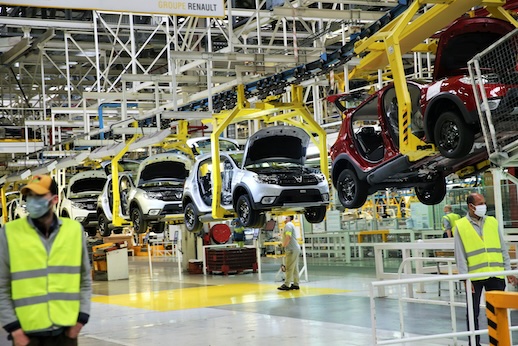
In addition to geographical proximity and free trade agreements, a Chinese automaker could also benefit from tax incentives and investment bonuses offered by Morocco under the Investment Charter, as well as local supplies of raw materials and renewable energies.
Phosphate is an essential element in the manufacture of cathodes for LFP (lithium, iron, phosphate) batteries, one of the most promising technologies on the electric battery market. With an annual production of almost 40 million tonnes by 2022, Morocco is the world’s second largest producer, far behind China, but with reserves far greater than those found in Chinese soil.
« We already have a reputation as a country that welcomes carmakers, with Renault and PSA showing their confidence. The ecosystem is there too, and has been strengthened in recent years with the arrival of Chinese OEMs and electric battery producers. It would make sense for Chinese automakers to set up in Morocco too« , insists Omar Sayarh.
Bridging the gap
To achieve this, this connoisseur of Chinese business circles insists on the need to increase efforts to promote Morocco as a destination for Chinese automotive manufacturers, but also to adapt in order to reduce the cultural gap between the two milieus. « Chinese companies arrive with a certain mindset, a way of doing things and a culture that’s different from the one we’re used to with Europeans and Americans. So it’s important to take the time to explain things and try to bridge this cultural gap, not just try to accommodate it, » he says.
« It’s essential to adopt a targeted approach with Chinese investors to attract them »
This approach is essential to the success of investment projects. As shown by the memorandum of understanding signed on December 9, 2017 with carmaker BYD, which provided for the Chinese giant to set up operations at Tanger Tech. A project that never saw the light of day.
Mehdi Laraki, President of the CGEM’s Morocco-China Business Council, sees the European surtax as a boost to accelerate the arrival of a new carmaker in Morocco, but not only: « The Chinese dynamic and interest in Morocco is real. We’ve been offering a lot of advantages in recent years, and not just in the automotive sector, but also in textiles and agriculture. For a long time, Europeans came to invest in Morocco mainly to take advantage of low-cost, unskilled labor. Today, this labor force is no longer simply cheap; it is now competitive and well-trained. And the Chinese have realized that it’s in their interest to come, » he adds.
He adds: « It‘s essential to adopt a targeted approach with Chinese investors to attract them. We need to move around more. We need to be more aggressive, and not just meet with this or that company. We need to organize roadshows, visit different cities and present the advantages Morocco has to offer. Now is the perfect time to strengthen our ties with China, and we shouldn’t deprive ourselves of this opportunity.«
Written by Safae Hadri. Edited in English by S.E.


