

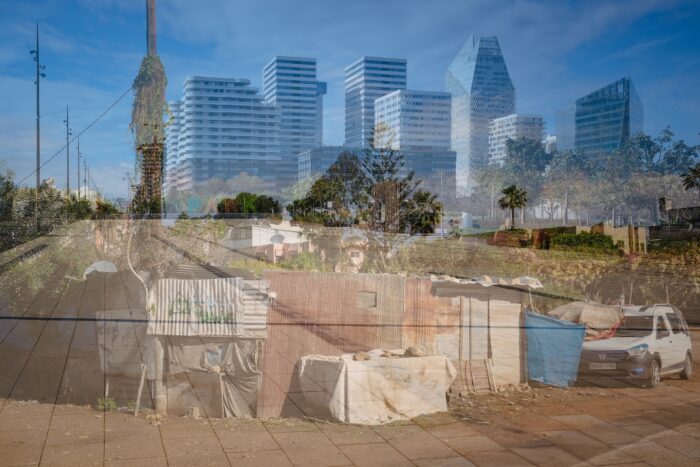
In Morocco, construction sites are far from progressing at the same pace. While cement is flowing for stadiums, roads and railroad lines in the run-up to the 2025 African Cup of Nations and the 2030 World Cup, the housing market remains frozen: real property transactions in free fall, projects postponed, demand at a standstill.
The Kingdom is building high-speed infrastructures for its international showcase, but seems to be struggling to house its citizens. Behind the public works boom lies a real estate crisis, accentuated by a crowding-out effect on labor, land and financing.
Two curves no longer talking to each other
The latest figures illustrate a two-speed economy. On the one hand, cement deliveries – the barometer of the construction industry – showed a spectacular rise of 10.38% to the end of August 2025, reaching almost 9.64 million tons. This performance was driven by the acceleration of infrastructure projects.
Real estate, on the other hand, is sluggish. According to Bank Al-Maghrib (BAM), the volume of transactions fell by 10.8% in the second quarter of 2025 compared with the previous quarter, and by 21.2% year-to-date. Prices, meanwhile, remained static: the Property Asset Price Index (PAPI) fell by just 0.2%, masking a decline in volumes that reflects the market’s loss of momentum.
The divergence is also evident in terms of space. Prices in Rabat continued to rise, while Casablanca and Tangier fell back slightly. Marrakech stands out for its relative resilience, driven by tourism and rental investment. The Moroccan real estate market thus appears fragmented and fragile.
Certainly, there is a glimmer of hope on the financing front: 25-year bank rates fell to 4.35 percent in September 2025, compared with 4.75 percent a few months earlier. But the easing is uneven across profiles. Salaried and self-employed workers are the main beneficiaries, while entrepreneurs and MREs continue to pay rates close to 5 percent, with high down-payment requirements and expensive insurance (0.43%). In other words, the downward trend is mainly benefiting the stable middle classes, but leaving out a significant proportion of potential demand, according to a recent analysis by real estate broker Afdal.ma.
Mega-projects, large lots and pressure on deadlines
« Public works are booming, driven by structural projects involving budgets of several billion dirhams »
At the same time, the construction industry is experiencing a euphoric cycle, driven almost exclusively by public works. Soccer stadiums, high-speed rail links, hydraulic and urban projects… all strategic projects that need to be delivered quickly and efficiently. Order books are overflowing.
« The public works sector is booming, driven by major projects with budgets of several billion dirhams », says Mohammed Mahboub, President of the FNBTP. Lots are reaching unprecedented sizes, between 1 and 4 billion dirhams, requiring majors capable of responding. Nevertheless, the FNBTP is calling for SMEs to take greater advantage of this trend, through subcontracting, otherwise the dynamic will only benefit a few major players.
Above all, this building spike has a cost: skilled labor is being sucked up by the big projects, leaving small sites and residential construction dry. Wages are skyrocketing: we’re talking about 200 dirhams a day for a specialized day laborer, sometimes more for masons or form workers. Small companies and private developers, unable to compete, are seeing their costs soar and their projects slow down.
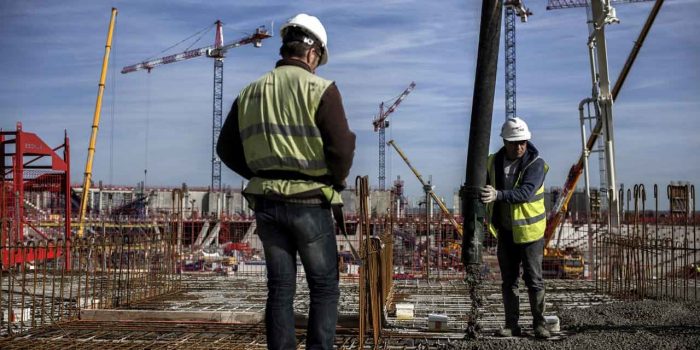
Some have suggested importing foreign labor, along the lines of the Gulf States, as a solution. But both the FNBTP and the CGEM reject this solution: « It would be an easy way out, and would not address the structural issues at stake », says Mohammed Mahboub. The sector prefers to rely on accelerated training, to transform this sporting window into a lever for sustainable skills development.
For what Morocco lacks is not manpower in general – the unemployment rate remains high and many agricultural workers are underemployed – but a skilled workforce capable of meeting the technical demands of major construction sites.
Demand excluded from the market
« Banks are financing fewer and fewer home purchases, except for premium profiles »
This lack of skills is imposing increasing costs – salaries, lead times, risks – while real estate is deprived of the impetus it needs to take off again.
Indeed, the Moroccan real estate market combines structural weaknesses with the aggravating effects of the public works boom. Demand is running out of steam, undermined by eroded purchasing power and still-fragile solvency. While financing conditions are becoming more flexible, they are not enough to turn intentions into purchases. » Banks are financing purchases less and less, except for premium profiles », observes Mohammed Lahlou, President of the Regional Union of Real Estate Brokers(URAI). As a result, modest and middle-income households, the heart of the market, find themselves excluded.
Added to this are the tightening of tax controls over the past two years, which have put off a number of cash buyers and blocked transactions in older properties, explains the estate agent. As for direct aid to purchase, presented as a flagship measure, it remains insufficient without additional mechanisms such as interest rate subsidies or public guarantees, he insists.
Poorly calibrated supply
Developers face a number of obstacles. Land remains expensive, especially in major cities. Input costs (cement, steel) have risen, due to massive demand from the public works sector. » The price per square meter is increasingly difficult to contain, as our costs are soaring », confides a major Casablanca developer who requested anonymity. Workers’ wages are following the same trend: 250 dirhams a day for a laborer, up to 320 dirhams for a qualified mason. These levels are squeezing margins and prompting some operators to postpone projects rather than incur a loss.
Added to this are administrative delays. « Getting a building permit is still an obstacle course, » sighs the same developer. At a time when the government is mobilizing its resources for major public projects, private real estate is often relegated to the background, exacerbating the delays.

Real estate also suffers from a mismatch between the product on offer and actual demand. In Casablanca, for example, regulations limit the proportion of studios in a project to 20%. » This is a major obstacle, even though demand from young households and first-time buyers is concentrated on small surface areas, » said Lahlou. The result is an overly inflexible supply that does not match needs or purchasing power.
Taxation further complicates the equation. The tax on undeveloped land (TNB), now collected by the DGI, has been raised to 30 dirhams/m² in some cases. In theory, this measure is intended to free up dormant land. But in the absence of a clear pipeline of permits and servicing, it is likely to remain an additional burden for developers, with no real translation into construction starts.
The need for arbitration
« We’re building to welcome the world, but not to house our own young households »
This stalemate highlights an implicit trade-off: the State concentrates its resources on the international showcase – World Cup 2030, CAN 2025, major facilities – and lets housing sink into its contradictions. As one Casablanca real estate agent sums up: « We’re building to welcome the world, not to house our own young households. » The paradox thus takes on a political dimension: the cranes going up for stadiums and freeways symbolize a Morocco that is a builder, looking outwards, but this energy masks an internal crisis – that of a housing market unable to meet the needs of its population.
However, the contrast between overheated public construction and stagnant real estate is not inevitable. Several levers exist to reconnect the two worlds and better calibrate supply. The FNBTP advocates better integration of SMEs in major construction projects: cutting mega parcels, subcontracting quotas, training clauses… all measures that would irrigate the local fabric and create a pool of skills for the future benefit of housing.
On the real estate front, the priority is to streamline the building process. Developers are calling for a digital one-stop shop, with enforceable deadlines, to speed up the process of obtaining permits and reduce uncertainty. They are also calling for rules to be adapted to real needs: studio ceilings to be made more flexible in areas of high demand, TNB to be made more effective by including servicing, and above all, the easing of tax constraints that discourage investment.
Finally, boosting the market means supporting solvent demand. Direct aid is not enough if it is not coupled with interest-rate subsidies or public guarantees. The recent cut in interest rates to 4.35 percent opens up a window of opportunity that should be seized to turn intentions into purchases, particularly for the urban middle classes. Added to this is the issue of productivity: widespread use of prefabrication and ready-mix concrete would reduce dependence on a scarce and expensive workforce, while improving quality and delivery times.
While Morocco is building high-speed infrastructure – stadiums, roads, railroad lines – its housing market is paradoxically stagnating. The euphoria of public works is accentuating the real estate breakdown and leaving thousands of households on the sidelines.
𝐿𝑖𝑠𝑒𝑧… pic.twitter.com/4WxXSSdxJ3-
TelQuel (@TelQuelOfficiel) September 19, 2025
Written in French by Safae Hadri; edited in English by AngloMedia Group.


