

With the 2030 World Cup just five years away, Morocco is speeding up its sports projects. The kingdom has proposed six stadiums to host matches at the world’s biggest soccer event. Five of these stadiums, located in Rabat, Tangiers, Fez, Agadir and Marrakech, will be mobilized for the 2025 African Cup of Nations (CAN) in December. Construction of the sixth, the Grand Stade Hassan II in Casablanca, is scheduled for completion by the end of 2027.
This colossal stadium, whose shape is reminiscent of the traditional moussem tents, is expected to accommodate between 108,800 and 115,000 spectators making it the largest soccer stadium in the world. As a candidate for the opening match or the final, it embodies Morocco’s ambitions on the international stage. « The CAN and the World Cup will be two events that will clearly generate economic momentum. That’s undeniable, » Zakaria Lahbabi, managing director of sports marketing agency Transatlas Sport Management, tells TelQuel.
Of the six Moroccan stadiums scheduled to host the 2030 World Cup, five already exist and are currently being upgraded. The sixth, the Grand Stadium Hassan II, is set to become the world’s largest, according to the country’s stated ambitions. But once the party’s over, how… pic.twitter.com/9x3m6dVN44
– TelQuel (@TelQuelOfficiel) June 9, 2025
The expert points out that « the majority of the stadiums planned are already 80% or even 90% ready », as they are « only undergoing upgrades ». But« the real issue », he points out, « is what we do with these stadiums afterwards. »
Billions and empty stadiums
The history of major sporting events is replete with examples of stadiums becoming empty shells after the end of the competition. Brazil and South Africa know all about it. Now it’s Morocco’s turn to pay the price. With the exception of Casablanca’s Mohammed V complex, regularly filled thanks to the popularity of Raja and Wydad, the country’s major stadiums are struggling to attract crowds. « We have a tendency to build stadiums that are oversized in relation to the reality of our national championship. With the possible exception of the Mohammed V Complex, which is supported by two very big clubs who can count on a real public, Other infrastructures, such as in Marrakech or Agadir, often remain empty, » points out Lahbabi.
« It’s a bit sad. Local clubs can’t fill them, » he confides. It’s difficult to make a 45,000-seat stadium profitable with just a few thousand spectators each week.
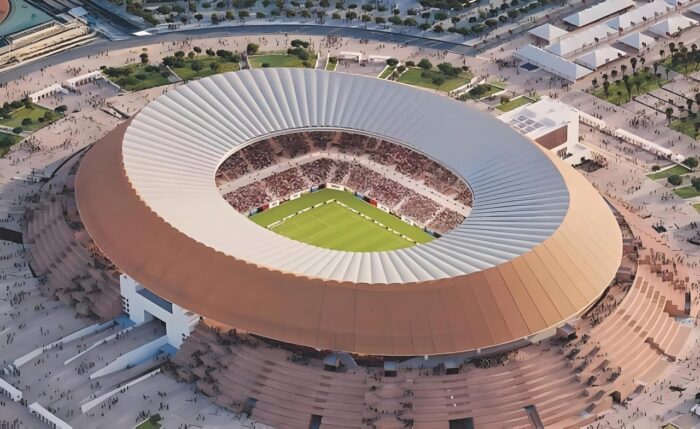
This is all the more worrying given the massive investment required. According to a study by Sogécapital Gestion, published in May 2023, Morocco’s share of the budget for organizing the 2030 World Cup is expected to be between $5 and $6 billion, or between 50 and 60 billion dirhams. In October of the same year, the government formalized a strategic partnership with the Caisse de dépôt et de gestion (CDG) to finance the upgrading of the six existing stadiums hosting the two competitions.
These are the major stadiums in Tangier, Agadir and Marrakech, and the sports complexes in Rabat (the Prince Moulay Abdallah stadium), Fez and Casablanca. The Mohammed V Complex will be used as a training stadium. The goal? To ensure that all the infrastructure meets the standards of the African Football Confederation (CAF) by 2025 and those of the FIFA by 2028.
A budget of 9.5 billion dirhams has been set for the first phase of upgrade and is online to be completed by the end of this year. The second phase, aimed at bringing the stadiums up to FIFA standards, will require a further investment of between 4.5 and 6 billion dirhams between 2025 and 2028. The same agreement launched the construction of the new Grand Stadium Hassan II in Benslimane with a budget estimated at five billion dirhams.
Beyond football
To make these stadiums profitable, Morocco will need to go beyond soccer matches. The profitability of a facility of this scale depends on its ability to generate constant revenue. « A stadium isn’t just about soccer. There are dressing rooms, refreshment stands, merchandising… but the show still has to attract people », our expert reminds us. Clearly, an empty stadium, even a brand-new one, doesn’t sell jerseys.
The challenge now is to breathe life into the environment around these stadiums. « These sites must become living spaces. There’s no need to invent: a Burger King or a McDonald’s, a sports store, a children’s play area… what any shopping center offers. In Marrakech, for example, the stadium is off-center. But if it hosted this type of infrastructure, it could generate rents, traffic and events, » suggests Zakaria Lahbabi. A model tried and tested elsewhere, notably at the Stadium of France near Paris. Zakaria Lahbabi, who has worked in the sector in France for ten years, knows it well: « These are places where concerts, trade shows, car shows and so on are held. This is not yet the case here, due to the lack of dynamic sales teams. » Despite these advantages, the Stadium of France, built for the 1998 World Cup, has not always been profitable.
Some European mega-stadiums are nevertheless leading the way. Munich’s Allianz Arena, for example, has been able to diversify its income thanks to its VIP boxes, interactive museum and guided tours which attract thousands of tourists every year. London’s Tottenham Hotspur Stadium goes even further. Between Premier League games, concerts by international stars and NFL matches, this ultramodern stadium never has an off-season.
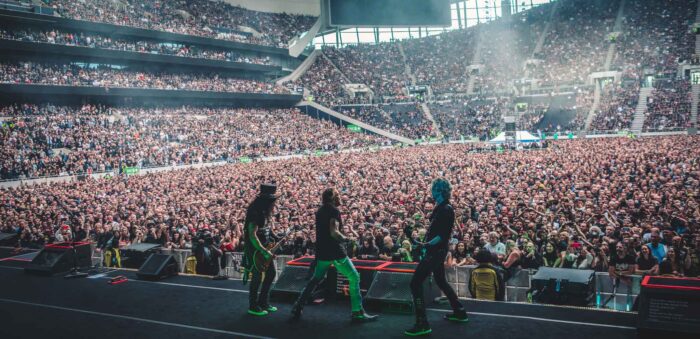
Can these models be adapted to the Moroccan context? « Bringing U2 to Morocco? It’s prohibitively expensive. And tickets would be out of reach for most people, » warns Lahbabi.
A vibrant stadium twelve months out of twelve?
Optimism may be the order of the day, but it needs to be measured. The European model, often cited as an example, is not so easily exported. Moroccan economic realities call for sobriety and imagination. One thing is certain: profitability will not come from a single player. It must be based on an ecosystem – in this case, the clubs, the Federation, the cities and the managers – capable of mobilizing infrastructures beyond the round ball.
The equation is a complex one. It requires responsive governance, a bold business strategy and exemplary synergy between the public and private sectors. The Grand Stadium of Casablanca, despite the popular fervor surrounding Raja and Wydad, cannot survive on local soccer revenues alone. It will have to become a veritable cultural and economic hub with year-round activities.
« Of course, if Raja and WAC play there, we’ll ensure a steady flow of spectators. For a big match, we can easily generate 1.5 million dirhams in ticket sales. So there’s real potential, but we need a collective vision adapted to the Moroccan context », insists Lahbabi.
The stakes go far beyond sport. But if the kingdom succeeds in this gamble of diversification, the 2030 World Cup could catalyze an urban and economic metamorphosis whose benefits will be measured over decades.
Written in French by Ghita Ismaili; edited in English by AngloMedia Group.


